
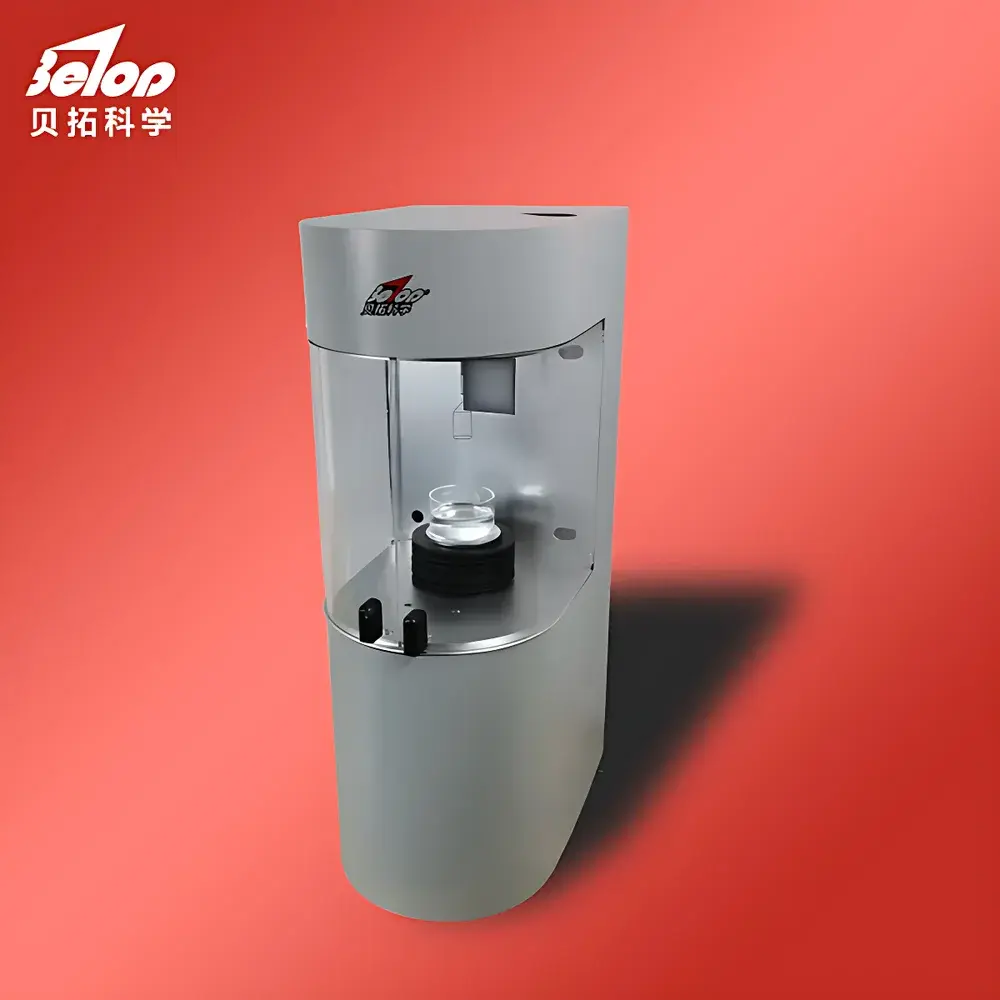
Betop Scientific KF100M3 Fully Automated Surface and Interfacial Tensiometer
| Brand | Betop Scientific |
|---|---|
| Origin | Guangdong, China |
| Manufacturer Type | Direct Manufacturer |
| Model | KF100M3 |
| Measurement Range | 1–1000 mN/m |
| Resolution | 0.001 mN/m |
| Accuracy | ±0.001 mN/m |
| Temperature Control Range | −10 °C to 130 °C (customizable up to 250 °C) |
| Temperature Display Accuracy | ±0.1 °C |
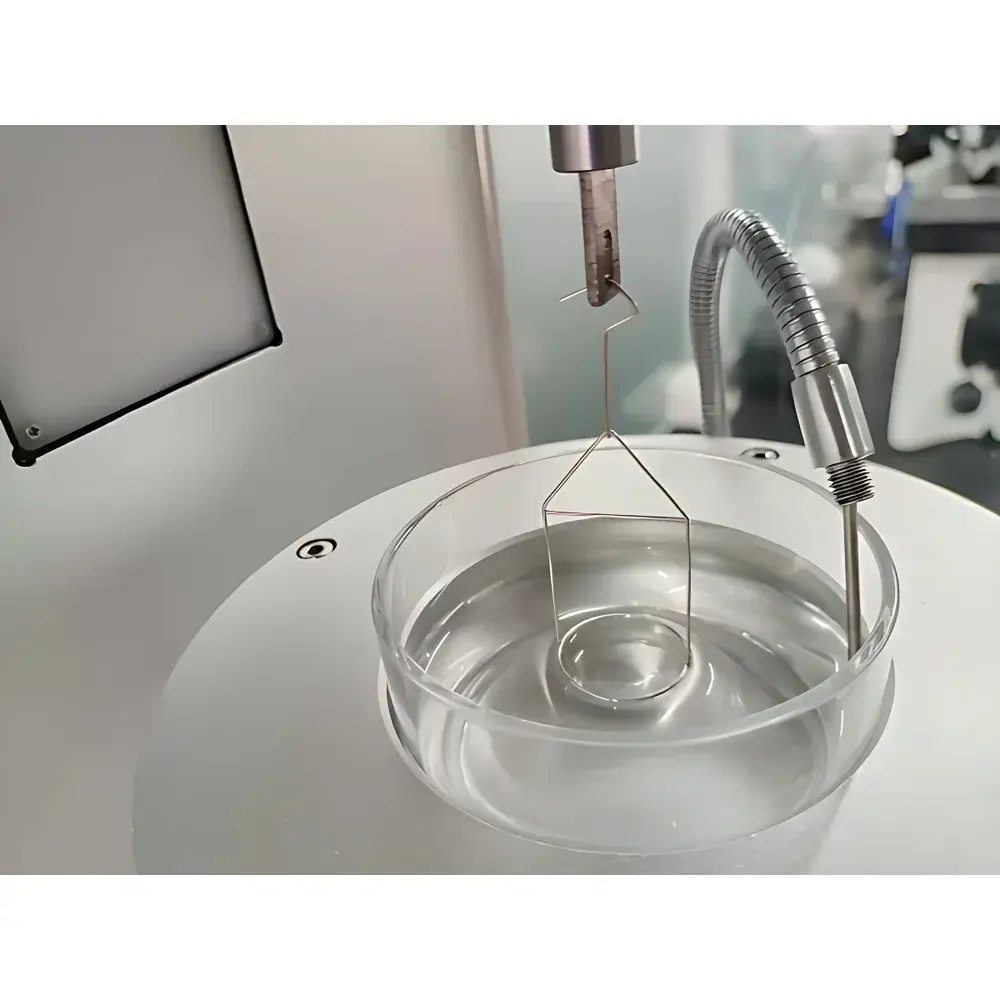
| Measurement Methods | Du Noüy Ring Method, Wilhelmy Plate Method |
| Balance Capacity | 210 g |
| Balance Sensitivity | ±0.1 mg |
| Liquid Density Range | 1–2200 kg/m³ |
| Density Resolution | 1 kg/m³ |
| Dynamic Contact Angle Range | 0–180° |
| Contact Angle Resolution | ±0.01° |
| Stage Travel | 100 mm vertical |
| Stage Speed | 0.099–500 mm/min (software-controlled, stepless) |
| Data Acquisition Rate | Up to 50 Hz |
| Illumination | Integrated white LED coaxial lighting |
| Dimensions (L×W×H) | 270 × 244 × 678 mm |
| Weight | 25 kg |
| Power Supply | 220 V, 50/60 Hz |
| Interface | RS-232 |
Overview
The Betop Scientific KF100M3 is a fully automated surface and interfacial tensiometer engineered for high-precision measurement of surface tension (γLV) and liquid–liquid or liquid–solid interfacial tension (γLL, γSL). It operates on two internationally standardized physical principles: the Wilhelmy plate method—based on the force balance of a vertically immersed platinum plate—and the Du Noüy ring method—relying on the maximum pull force required to detach a platinum ring from the liquid interface. These methods are thermodynamically grounded in Young–Laplace formalism and validated across decades of interfacial science practice. The instrument integrates a high-stability German-made analytical balance with active auto-protection circuitry, precision servo-driven vertical stage control, and real-time thermal regulation—enabling reproducible measurements under controlled environmental conditions. Designed for routine QC laboratories and advanced R&D facilities alike, the KF100M3 delivers traceable, GLP-compliant data essential for formulation development, regulatory submissions, and process optimization.
Key Features
- High-resolution force detection: 0.001 mN/m resolution and ±0.001 mN/m accuracy, meeting stringent requirements for CMC determination and low-tension surfactant systems.
- Dual-method flexibility: Seamless switching between Wilhelmy plate and Du Noüy ring protocols via software—eliminating manual hardware reconfiguration.
- Thermally stabilized sample environment: Peltier-based temperature control from −10 °C to 130 °C (extended options available), with ±0.1 °C display accuracy and programmable ramp/soak profiles.
- Real-time high-speed acquisition: 50 Hz sampling rate (20 ms per data point), enabling dynamic surface tension profiling during rapid adsorption or diffusion-limited processes.
- Optimized optical alignment: Integrated coaxial white LED illumination ensures consistent contrast at air–liquid and liquid–liquid interfaces—critical for accurate meniscus detection in both transparent and turbid systems.
- Extended vertical travel: 100 mm motorized stage range accommodates large-volume cells, multi-phase cuvettes, and custom interfacial chambers without mechanical interference.
- Intuitive software architecture: TENTION software suite provides full instrument control, automated calibration routines, statistical reporting, and audit-trail-enabled data logging compliant with FDA 21 CFR Part 11 requirements.
Sample Compatibility & Compliance
The KF100M3 supports a broad spectrum of sample types—including aqueous surfactant solutions, polymer melts, ionic liquids, crude oil–water emulsions, pharmaceutical suspensions, and functional coatings—without requiring solvent-specific accessories. Its modular design allows direct integration with external thermostats, humidity chambers, or gloveboxes for specialized testing environments. All measurement protocols conform to major international standards: ASTM D971 (ring method for oil–water interfacial tension), ASTM D133 (surface and interfacial tension of surfactant solutions), ISO 304 and ISO 1409 (Wilhelmy and ring methods), DIN EN 14210 and DIN EN 14370 (surfactant characterization), ISO 4311 (CMC determination), and OECD Test Guideline 115 (chemical safety assessment). Instrument validation documentation includes factory-certified calibration certificates traceable to NIST standards.
Software & Data Management
TENTION software (v3.x series) comprises five interoperable modules: SW31 (surface/interfacial tension), SW32 (dynamic contact angle and solid surface energy analysis), SW34 (liquid density), SW35 (colloidal stability assessment), and SW36 (custom scripting and batch processing). Each module supports automated sequence execution, parameter-dependent pass/fail logic, and export to CSV, PDF, or XML formats. Audit trails record user ID, timestamp, instrument state, and raw sensor values for every measurement—fully satisfying GLP and GMP documentation requirements. Advanced surface energy analysis implements Fowkes, Owens–Wendt–Rabel–Kaelble, Wu, and van Oss–Chaudhury–Good models to decompose total surface energy into dispersive, polar, Lewis acid/base, and hydrogen-bonding components—enabling quantitative prediction of wettability, adhesion, and coating compatibility.
Applications
- Quantitative evaluation of surfactant efficiency via critical micelle concentration (CMC) determination in pharmaceutical excipient screening and detergent formulation.
- Wettability assessment of APIs, tablets, and excipients using dynamic contact angle hysteresis and surface energy mapping.
- Monitoring oxidative aging of lubricants and transformer oils through time-resolved interfacial tension decay kinetics.
- Optimizing paint, ink, and coating formulations by correlating surface tension gradients with substrate spreading behavior and film uniformity.
- Assessing cleaning efficacy in food processing tanks via interfacial tension changes induced by residual organic films.
- Characterizing nanomaterial dispersion stability using interfacial rheology-derived parameters such as dilatational modulus and phase angle.
- Validating surface modification treatments on fibers, membranes, and biomedical devices through comparative surface energy profiling.
FAQ
What measurement methods does the KF100M3 support?
It supports both the Wilhelmy plate method and the Du Noüy ring method, with automatic method selection and calibration within the TENTION software.
Is the instrument compliant with FDA 21 CFR Part 11?
Yes—the TENTION software includes electronic signature capability, role-based access control, and immutable audit trails for all measurement events.
Can the KF100M3 measure interfacial tension between immiscible liquids?
Yes, it is routinely used for oil–water, polymer–solvent, and molten salt–metal interface characterization using the ring or plate method.
Does the system support temperature ramping during measurement?
Yes—programmable temperature profiles (ramp, hold, cycle) can be synchronized with surface tension acquisition to study thermal effects on adsorption kinetics.
What is the maximum sample volume compatible with the standard cell configuration?
Standard stainless-steel or glass cells accommodate up to 50 mL; custom cells up to 200 mL are available upon request.
How is calibration performed?
Factory-calibrated with certified reference liquids (e.g., ultrapure water, diiodomethane); users may perform two-point verification using standard surfactant solutions.



