
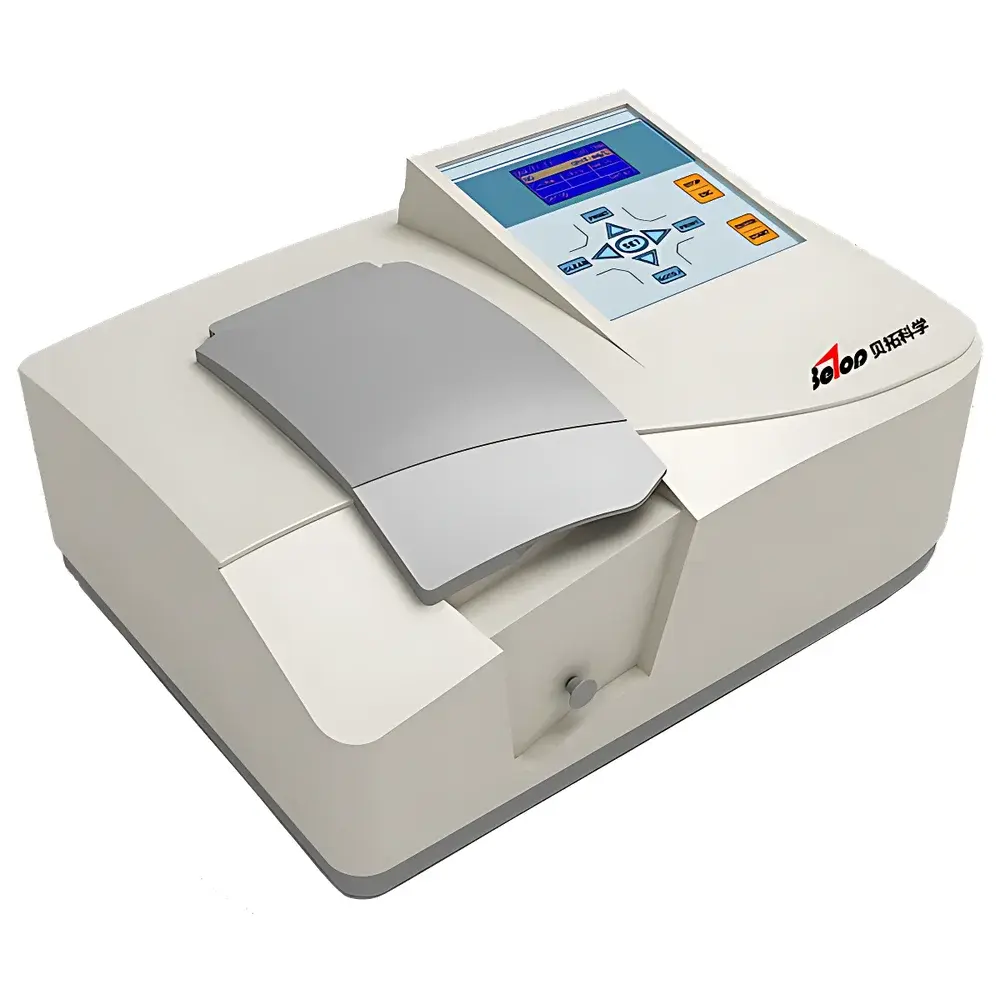
Betop Scientific Lambda-22 Single-Beam Visible Spectrophotometer
| Brand | Betop Scientific |
|---|---|
| Origin | Guangdong, China |
| Manufacturer Type | Manufacturer |
| Product Origin | Domestic |
| Model | Lambda-22 |
| Optical Design | Single-Beam |
| Detector Type | Photodiode Array (PDA) |
| Wavelength Range | 320–1100 nm |
| Spectral Bandwidth | 4 nm |
| Wavelength Accuracy | ±0.8 nm |
| Wavelength Repeatability | ≤0.2 nm |
| Stray Light | ≤0.1% T at 220 nm and 360 nm |
| Automation Level | Automatic Wavelength Scanning |
| Display | Dot-Matrix LCD |
| Sample Compartment | Accommodates Cuvettes from 5 mm to 100 mm Pathlength |
| Lamp Type | Long-Life Deuterium Lamp (D₂) with Flange-Mounted Base |
| Data Storage | Internal Non-Volatile Memory with Power-Fail Protection |
| Connectivity | RS-232 or USB (Optional) for PC Integration |
Overview
The Betop Scientific Lambda-22 is a single-beam visible spectrophotometer engineered for reliable absorbance and transmittance measurements across the 320–1100 nm spectral range. Based on classical Beer–Lambert law principles, it employs a fixed-grating monochromator coupled with a photodiode array (PDA) detector to deliver stable, reproducible photometric data. Its single-beam optical architecture—while requiring manual reference blanking—offers mechanical simplicity, reduced alignment sensitivity, and robust long-term stability ideal for routine laboratory environments. Designed for educational laboratories, quality control units, and field-deployable analytical workflows, the Lambda-22 prioritizes operational reliability over ultra-high resolution, making it especially suitable for applications where consistent baseline performance, ease of maintenance, and cost-effective ownership are critical.
Key Features
- Integrated dot-matrix LCD display with intuitive menu navigation and real-time spectral visualization
- Automatic wavelength scanning and calibration routines—including auto-zero, dark-current correction, and wavelength verification—minimizing operator dependency
- Flange-mounted, long-life deuterium lamp design enabling lamp replacement without optical realignment or recalibration
- Optically rigid baseplate and precision-machined optical support structure, incorporating selected imported optical and electronic components for thermal and mechanical stability
- Universal sample compartment accommodating standard cuvettes (5 mm to 100 mm pathlength), compatible with optional accessories including multi-cell changers, fiber-optic probes, and temperature-controlled holders
- Internal non-volatile memory preserving measurement data, calibration logs, and spectral traces—even after power interruption—supporting audit-ready documentation practices
- Low stray light performance (≤0.1% T at 220 nm and 360 nm), achieved via optimized optical baffling and high-efficiency grating coatings, ensuring accurate quantitation in low-transmittance regions
Sample Compatibility & Compliance
The Lambda-22 supports standard quartz, glass, and plastic cuvettes across a wide pathlength spectrum, enabling flexible method development for diverse sample matrices—from aqueous pharmaceutical solutions to turbid food extracts and colored environmental samples. Its optical design complies with fundamental requirements outlined in ISO 6425 (spectrophotometer performance testing), ASTM E275 (description of ultraviolet and visible spectrophotometers), and USP (Spectrophotometry and Light-Scattering). While not inherently 21 CFR Part 11 compliant in standalone mode, the instrument’s digital output interface and deterministic calibration traceability enable integration into GLP/GMP-compliant workflows when paired with validated PC software and documented SOPs.
Software & Data Management
The optional PC-based quantitative analysis software extends the Lambda-22’s functionality beyond basic photometry. It enables time-scan (kinetic) measurements, multi-point standard curve generation (linear, quadratic, and cubic regression), concentration mapping, and customizable report templates exportable to PDF, CSV, or Excel formats. All raw spectral data and metadata—including date/time stamps, operator ID fields, and instrument configuration parameters—are recorded with timestamped audit trails. The software supports batch processing, outlier detection, and comparative overlay of up to eight spectra—facilitating method transfer validation and inter-laboratory consistency checks.
Applications
The Lambda-22 serves as a foundational tool across multiple scientific domains: quantitative determination of active pharmaceutical ingredients (APIs) per USP monographs; enzyme kinetics assays in biochemistry education labs; colorimetric analysis of nitrate, phosphate, or heavy metals in environmental water testing; protein concentration estimation via Bradford or BCA assays; quality assurance of dyes, pigments, and food colorants; and routine purity assessment of organic synthesis intermediates. Its 4 nm spectral bandwidth and ±0.8 nm wavelength accuracy meet the minimum specifications required for most pharmacopoeial UV-Vis methods and undergraduate curriculum standards.
FAQ
What is the maximum cuvette pathlength supported by the Lambda-22?
The instrument accommodates cuvettes with pathlengths ranging from 5 mm to 100 mm, including standard 10 mm square cells and specialized long-path flow cells.
Does the Lambda-22 require external calibration standards for wavelength verification?
No—built-in holmium oxide and didymium glass filters (optional accessory) can be used for internal wavelength validation per ISO 6425 recommendations.
Can the Lambda-22 perform kinetic measurements without a PC?
Kinetic (time-scan) mode is only available via the optional PC software; the standalone unit supports static absorbance/transmittance readings and fixed-wavelength time-series via manual triggering.
Is the deuterium lamp user-replaceable without technical service intervention?
Yes—the flange-mount lamp design allows field replacement without optical collimation or wavelength recalibration, reducing downtime and service costs.
How is data integrity maintained during unexpected power loss?
All measurement data, calibration settings, and system logs are stored in non-volatile flash memory, ensuring retention independent of mains power availability.




