
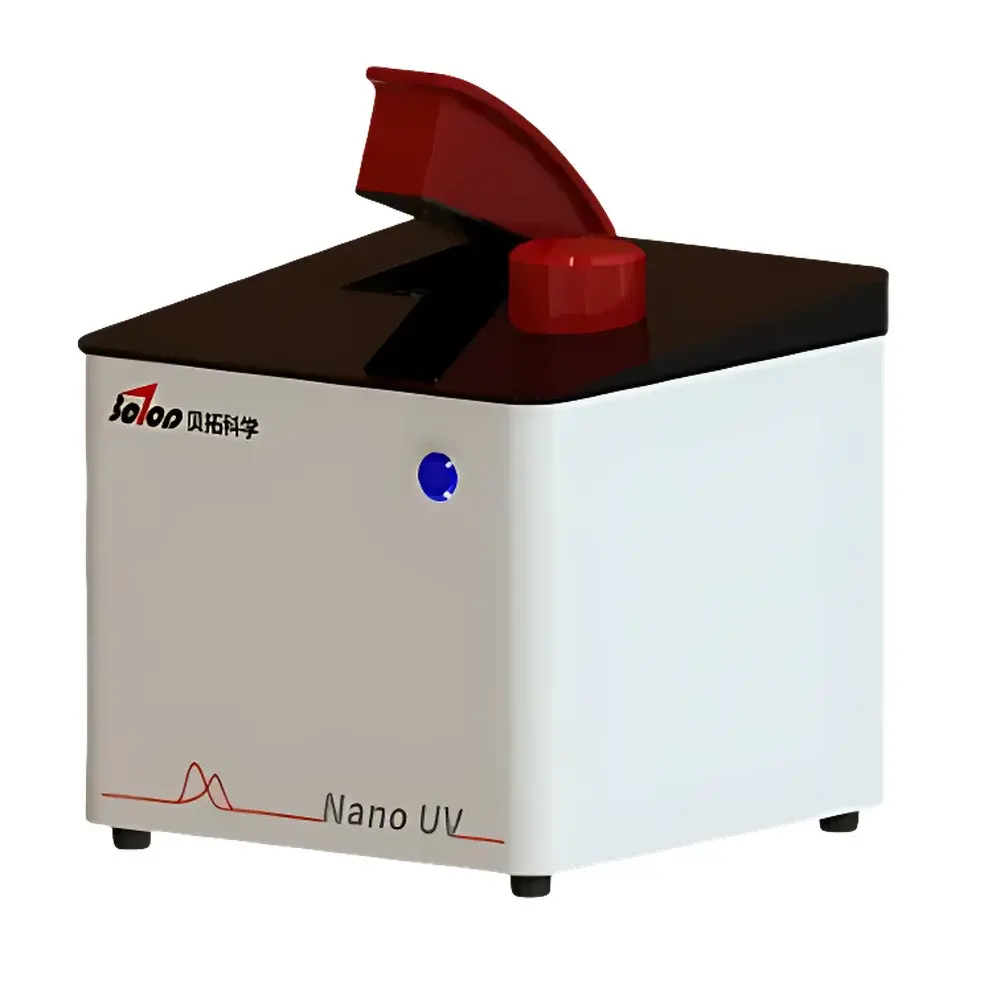
Betop Scientific NanoUV Ultra-Micro Spectrophotometer
| Brand | Betop Scientific |
|---|---|
| Origin | Guangdong, China |
| Manufacturer Type | OEM/ODM Manufacturer |
| Product Origin | Domestic (China) |
| Model | NanoUV |
| Wavelength Range | 200–850 nm |
| Wavelength Accuracy | ±1.0 nm (at 302 nm, 25°C) |
| Absorbance Linearity | 0–1.5 A (cuvette mode) |
| Absorbance Accuracy | ±3% at 0.97 A (25°C, reported in Abs/mm) |
| Detection Modes | Nano-volume (1–2 µL) and Cuvette (10 mm pathlength) |
Overview
The Betop Scientific NanoUV Ultra-Micro Spectrophotometer is a compact, benchtop UV-Vis spectrophotometer engineered for rapid, accurate quantification and quality assessment of nucleic acids, proteins, and other light-absorbing biomolecules at ultra-low volumes. It operates on the principle of absorption spectroscopy, utilizing a high-stability xenon flash lamp and a precision grating monochromator to deliver discrete wavelength scans across a continuous 200–850 nm spectral range. Unlike traditional cuvette-based systems requiring 50–100 µL sample volumes, the NanoUV integrates a dual-path optical design: a fixed 1-mm pathlength for nano-volume measurements (1–2 µL directly deposited on a quartz pedestal) and a standard 10-mm pathlength for conventional cuvette analysis. This architecture eliminates dilution errors and minimizes sample consumption—critical for precious or low-yield preparations such as CRISPR guide RNA, single-cell lysates, or purified monoclonal antibodies.
Key Features
- Dual-Mode Optical Path: Switch seamlessly between nano-volume (1–2 µL, 1-mm effective pathlength) and cuvette (10-mm pathlength, 0–1.5 A linear range) measurement modes without hardware reconfiguration.
- High Wavelength Fidelity: Achieves ±1.0 nm wavelength accuracy at 302 nm under controlled 25°C ambient conditions—validated per ISO 8579-1:2020 guidelines for spectrophotometric instrument calibration.
- Thermally Stabilized Optics: Internal temperature regulation maintains optical alignment and detector response stability, reducing drift during extended batch runs or multi-day calibration cycles.
- Low-Stray-Light Design: Optimized optical baffling and order-sorting filters suppress stray light to <0.05% at 220 nm, ensuring reliable detection of low-concentration DNA samples with A260/A280 ratios down to 1.7.
- Embedded Touch Interface: Integrated 7-inch capacitive touchscreen with preloaded analysis workflows—including Nanodrop-style nucleic acid QC, Bradford/Lowry protein assays, and custom extinction coefficient entry.
Sample Compatibility & Compliance
The NanoUV supports native liquid samples without dilution or derivatization, including aqueous buffers (e.g., TE, PBS), low-salt eluates from spin columns, and clarified lysates. It is compatible with standard 1-cm quartz cuvettes (pathlength verified per ASTM E275-22) and accepts microvolume deposits on hydrophobic-treated quartz pedestals. All firmware and data handling comply with GLP documentation requirements: audit trails record operator ID, timestamp, measurement parameters, and raw absorbance spectra. Instrument validation packages include IQ/OQ documentation templates aligned with ISO/IEC 17025:2017 and support for FDA 21 CFR Part 11–compliant electronic signatures when paired with Betop’s optional LIMS integration module.
Software & Data Management
Betop’s NanoUV Control Suite (v3.2+) provides local data storage, CSV/PDF export, and real-time spectral overlay. Raw absorbance vs. wavelength datasets are stored in vendor-neutral .jdx format compliant with JCAMP-DX v5.01 standards. The software enforces automatic baseline correction using air-reference scans prior to each measurement cycle and applies NIST-traceable photometric calibration curves derived from cerium(IV) sulfate and potassium dichromate reference standards. For regulated environments, optional network licensing enables centralized user permission management, encrypted database backups, and automated report generation with embedded digital signatures—fully traceable to individual instrument serial number and firmware revision.
Applications
- Quantitative assessment of dsDNA, ssDNA, RNA, and oligonucleotides (A260 calculation with built-in extinction coefficients per IUPAC nomenclature)
- Protein concentration determination via A280 (Trp/Tyr), A205, or colorimetric assays (Bradford, BCA)
- Quality control of purified antibodies (A280/A320 turbidity correction)
- Verification of PCR/qPCR master mix integrity and primer stock purity
- Monitoring enzymatic reaction kinetics via time-resolved absorbance at fixed wavelengths (e.g., NADH oxidation at 340 nm)
FAQ
What is the minimum detectable concentration for double-stranded DNA?
The NanoUV achieves a theoretical limit of detection of ~2 ng/µL dsDNA (based on 1.0 mm pathlength and 0.02 A signal-to-noise ratio at 260 nm), assuming optimal sample clarity and absence of UV-absorbing contaminants.
Does the instrument require external calibration standards for routine use?
No—factory-installed photometric and wavelength calibrations remain stable for 12 months under normal operation; annual verification with NIST-traceable standards is recommended per ISO/IEC 17025 internal audit protocols.
Can the NanoUV be integrated into an automated laboratory workflow?
Yes—RS-232 and USB device-mode interfaces support bidirectional communication with third-party LIMS and robotic liquid handlers; API documentation is provided under NDA for OEM integration.
Is the nano-volume pedestal replaceable, and what is its service life?
The fused-silica pedestal is field-replaceable and rated for >10,000 measurements when cleaned according to SOP-BT-NANO-04 (isopropanol wipe + nitrogen purge).
How does the NanoUV handle highly viscous or particulate-containing samples?
Nano-volume mode is not recommended for samples with viscosity >10 cP or visible particulates; cuvette mode with centrifuged supernatant is advised to prevent pedestal contamination and optical scattering artifacts.
Related Products





