
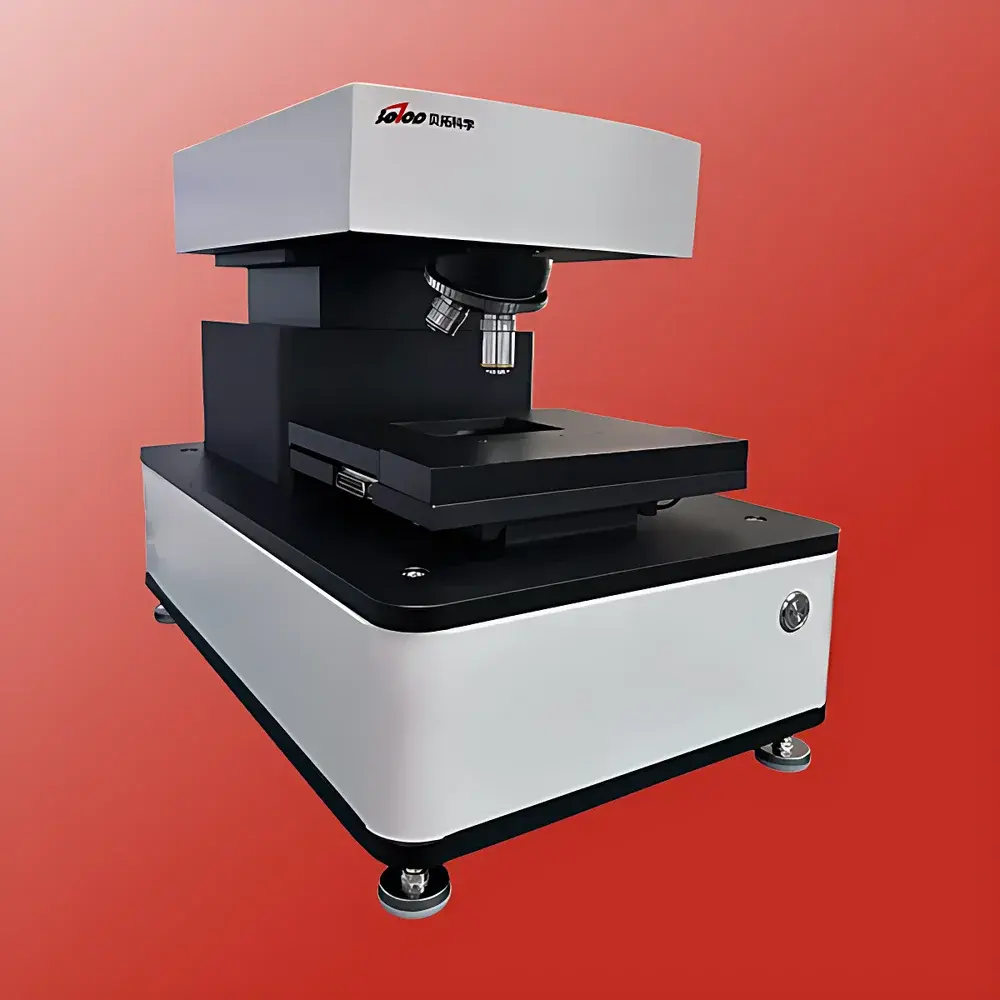
Betop Scientific TeachRam FIB Automated Integrated Micro-Raman Spectrometer
| Brand | Betop Scientific |
|---|---|
| Origin | Guangdong, China |
| Manufacturer Type | Direct Manufacturer |
| Instrument Type | Confocal Micro-Raman Spectrometer |
| Excitation Wavelength | 532 nm (785 nm optional) |
| Spectral Range | 100–3000 cm⁻¹ |
| Spectral Resolution | 6 cm⁻¹ |
| Spatial Resolution | XY = 0.08 µm, Z = 0.05 µm |
| Minimum Wavenumber | 80 cm⁻¹ |
| Spectral Repeatability | < 0.01 nm/°C |
Overview
The Betop Scientific TeachRam FIB is an engineered confocal micro-Raman spectrometer integrating high-resolution optical microscopy with precision Raman spectroscopy in a single, compact platform. Based on free-space optical coupling—eliminating signal loss associated with fiber-optic delivery—the system delivers superior photon throughput and long-term spectral stability. It employs a stabilized 532 nm laser source (with 785 nm available as an optional excitation wavelength) to induce inelastic scattering from molecular vibrational modes, enabling non-destructive, label-free chemical identification and structural characterization at the micrometer scale. Designed for both routine analytical laboratories and academic research environments, the TeachRam FIB supports quantitative mapping, point-spectrum acquisition, and real-time spectral monitoring under ambient or controlled conditions. Its rigid monolithic architecture minimizes thermal drift and mechanical misalignment, ensuring reproducible data across extended measurement sessions.
Key Features
- Three-Axis Motorized Stage: High-precision XYZ translation and autofocus capability enable rapid, repeatable positioning and focal plane optimization—critical for depth profiling and confocal sectioning.
- Free-Space Optical Path: Eliminates coupling losses inherent in fiber-based systems; improves light collection efficiency by >40% compared to equivalent fiber-coupled configurations.
- Real-Time Imaging & Spectral Acquisition: Synchronized CCD/CMOS imaging and Raman spectral capture allow visual correlation of morphological features with molecular signatures.
- Comprehensive Onboard Spectral Processing: Includes real-time baseline correction (asymmetric least squares), Gaussian/Lorentzian peak fitting, Savitzky-Golay smoothing, intensity normalization, and spectral deconvolution algorithms.
- Calibration Flexibility: Supports both single-point and multi-point wavenumber calibration routines using standard reference materials (e.g., silicon, cyclohexane), ensuring traceable accuracy across the full spectral range.
- Thermally Stable Optomechanical Design: Aluminum alloy housing with passive thermal management maintains spectral repeatability below 0.01 nm/°C—meeting requirements for GLP-compliant method validation.
Sample Compatibility & Compliance
The TeachRam FIB accommodates solid, powder, thin-film, and liquid samples mounted on standard microscope slides or specialized substrates (e.g., gold-coated Si wafers, ITO glass). Its confocal aperture enables depth-resolved analysis down to sub-micron layers, supporting ISO 17025-aligned material verification workflows. The instrument complies with CE safety directives (2014/35/EU, 2014/30/EU) and meets electromagnetic compatibility (EMC) Class B requirements for laboratory use. Software includes audit-trail logging and user-access controls compatible with FDA 21 CFR Part 11 readiness when deployed with validated IT infrastructure.
Software & Data Management
Betop’s proprietary RamanView™ software provides intuitive workflow-driven operation—from hardware initialization and auto-alignment to hyperspectral mapping and multivariate analysis (PCA, cluster analysis). All raw spectra are stored in vendor-neutral HDF5 format with embedded metadata (laser power, integration time, objective magnification, stage coordinates). Export options include ASCII, CSV, and JCAMP-DX for interoperability with third-party chemometric tools (e.g., MATLAB, Python scikit-learn, Unscrambler X). Batch processing scripts support automated QA/QC reporting per ASTM E1840-22 guidelines for spectral instrument performance verification.
Applications
- Materials Science: Phase identification in 2D materials (graphene, MoS₂), stress/strain mapping in semiconductor heterostructures, and defect analysis in perovskite thin films.
- Pharmaceutical Development: Polymorph screening, API-excipient interaction studies, and tablet coating uniformity assessment per USP <1120>.
- Environmental Monitoring: Microplastic identification in water filtration matrices and contaminant speciation in soil particulates.
- Forensic Analysis: Non-invasive pigment and dye characterization in questioned documents, fibers, and paint chips.
- Catalysis Research: In situ observation of surface adsorbates and reaction intermediates during heterogeneous catalytic cycles.
- Geosciences & Mineralogy: Quantitative mineral phase mapping in polished rock sections and fluid inclusion analysis.
FAQ
What excitation wavelengths are supported?
Standard configuration uses a 532 nm diode-pumped solid-state (DPSS) laser; 785 nm is available as a factory-installed option to minimize fluorescence interference in organic and biological samples.
Is the system compatible with external environmental chambers?
Yes—the motorized stage and optical head support integration with temperature-controlled stages (-196 °C to +600 °C) and gas-tight sample cells for in situ/operando measurements.
Can spectral libraries be imported or customized?
RamanView™ supports user-defined spectral libraries in common formats (SPA, SPC, TXT) and allows creation of project-specific reference sets with metadata tagging for regulatory traceability.
What maintenance is required for long-term spectral stability?
Annual recalibration using certified NIST-traceable standards (e.g., SRM 2241) is recommended; no consumables or alignment tools are required due to the fixed optical path design.
Related Products





