
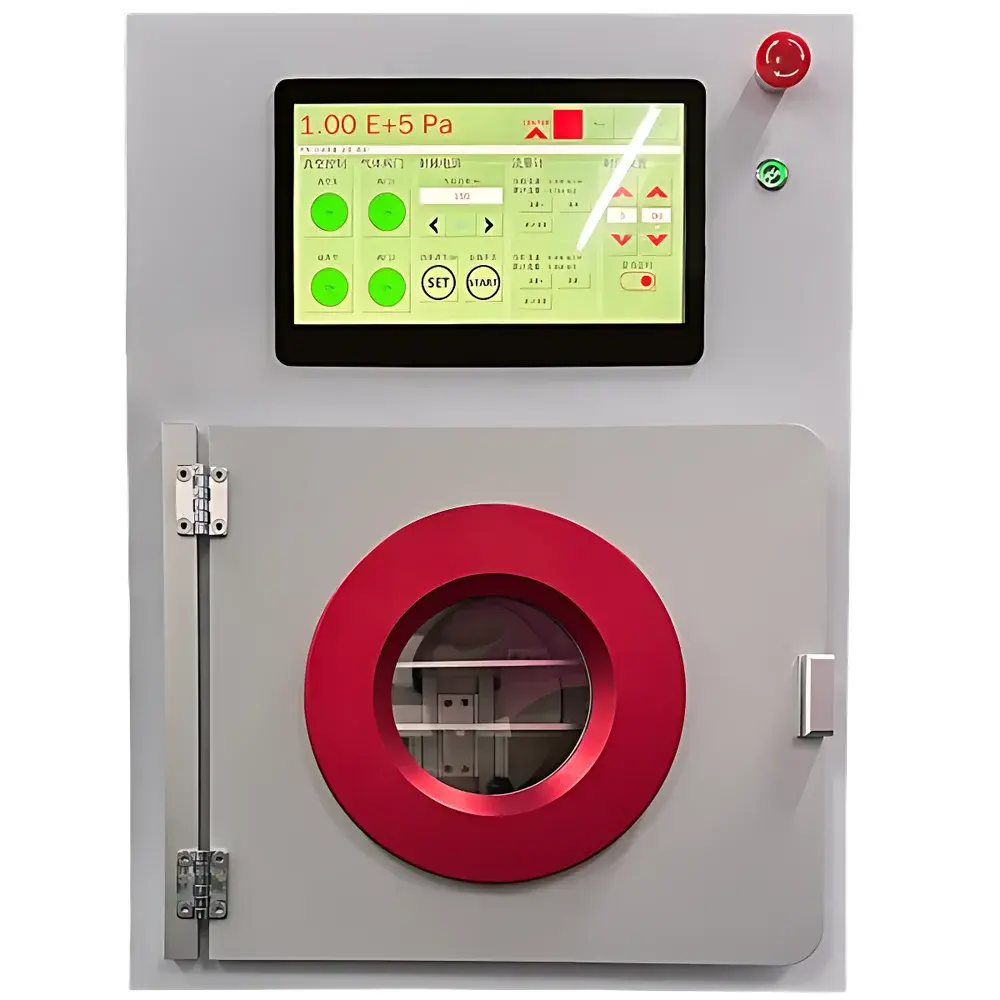
Betop Scientific VPC100A Automated RF Plasma Cleaner
| Brand | Betop Scientific |
|---|---|
| Origin | Guangdong, China |
| Manufacturer Type | Direct Manufacturer |
| Country of Origin | China |
| Model | VPC100A |
| RF Frequency | 13.56 MHz |
| Power Range | 0–300 W (adjustable) |
| Chamber Volume | 10 L |
| Dimensions (W×D×H) | 76 × 55 × 82 cm |
| Chamber Material | 316 Stainless Steel |
| Gas Inlets | 2 channels |
| Control Mode | Fully Automatic |
| Plasma Type | Capacitively Coupled Radiofrequency (CCP) Plasma |
| Vacuum Level Range | 20–60 Pa |
| Ultimate Vacuum | ≤0.5 Pa (no-load) |
| Pump-Down Time | ≤40 s (no-load) |
| Venting Time | ≤20 s |
| Electrode Configuration | Adjustable parallel-plate aluminum electrodes |
| Gas Flow Control | Dual Mass Flow Controllers (MFCs), 0.3–3 L/min, ±1% accuracy |
| Rated Power Consumption | 1 kW |
| Input Voltage | AC 220 V |
| Net Weight | ~130 kg |
Overview
The Betop Scientific VPC100A Automated RF Plasma Cleaner is a benchtop-capable, vacuum-based plasma surface treatment system engineered for precision cleaning, activation, and functionalization of solid substrates in research and quality control laboratories. It operates on the principle of capacitively coupled radiofrequency (CCP) plasma generation at 13.56 MHz — an ISM band frequency widely adopted for its stable plasma ignition, controllable ion energy distribution, and compatibility with regulatory-compliant process documentation. Under controlled low-pressure conditions (20–60 Pa), inert or reactive process gases (e.g., Ar, O₂, N₂, or Ar/O₂ mixtures) are ionized to produce a non-thermal plasma containing energetic electrons, ions, radicals, and UV photons. This reactive species ensemble enables highly selective surface modification without bulk thermal damage — removing sub-monolayer organic contaminants, breaking C–C/C–H bonds, introducing polar functional groups (e.g., –OH, –COOH), and increasing surface energy for improved wettability and adhesion. Unlike microwave or atmospheric-pressure plasma systems, the VPC100A’s RF-driven CCP architecture ensures uniform plasma density across the electrode gap, reproducible treatment outcomes, and minimal sample charging — critical for delicate substrates such as semiconductor wafers, optical lenses, polymer films, and biomedical devices.
Key Features
- Robust 316 stainless steel vacuum chamber (10 L volume) with electropolished interior for corrosion resistance, ultra-high vacuum integrity, and compliance with ISO 14644-1 Class 5 cleanroom-compatible operation.
- Adjustable parallel-plate aluminum electrodes enabling precise gap control (20–100 mm range) to optimize plasma uniformity for samples of varying thickness and geometry — from 2-inch wafers to irregularly shaped components.
- Integrated dual-channel mass flow controllers (MFCs) with ±1% full-scale accuracy and 0.3–3 L/min range, supporting independent regulation of two process gases for tunable chemistries (e.g., oxygen for ashing, argon for physical sputtering, nitrogen for amine functionalization).
- Automated sequence control via embedded microprocessor: vacuum pump initiation → pressure stabilization → gas injection → RF power ramp-up → timed plasma exposure → automatic venting — all executed with single-button activation and real-time parameter logging.
- RF generator and impedance matching network implemented as modular units, facilitating field maintenance, calibration traceability, and electromagnetic compatibility (EMC) conformity per IEC 61326-1.
- Human-centered interface featuring high-contrast LCD display, tactile membrane keys, and intuitive menu navigation — requiring no programming expertise for routine operation or method recall.
Sample Compatibility & Compliance
The VPC100A accommodates substrates up to 150 mm in diameter or equivalent planar area, including silicon wafers, glass slides, PET/PC films, ceramic sensors, metal foils, and 3D-printed polymeric parts. Its gentle, non-ablative plasma chemistry preserves dimensional stability and mechanical integrity while achieving >99.9% removal efficiency for photoresist residues, fingerprint oils, silicone lubricants, and adventitious hydrocarbons — validated per ASTM F2238 (Standard Guide for Plasma Cleaning of Surfaces) and ISO 15730 (Plasma treatment of plastics prior to bonding). The system meets CE marking requirements for machinery safety (2006/42/EC) and electromagnetic compatibility (2014/30/EU). Vacuum and gas delivery subsystems comply with ISO 2852 (vacuum component cleanliness) and CGA G-4.1 (gas handling safety). For regulated environments, optional audit trail firmware supports 21 CFR Part 11-compliant electronic records when paired with validated PC-based data acquisition software.
Software & Data Management
While the VPC100A operates autonomously via its onboard controller, optional Ethernet/RS-485 connectivity enables integration into laboratory information management systems (LIMS) or supervisory control platforms. Process logs — including timestamped vacuum pressure curves, RF forward/reflected power traces, gas flow profiles, and cycle completion status — are exportable in CSV format for QA/QC review. Firmware supports up to 20 user-defined protocols with password-protected access levels, ensuring method consistency across shifts and operators. All stored parameters retain factory-calibrated MFC and pressure transducer coefficients, satisfying GLP documentation requirements for instrument qualification (IQ/OQ/PQ).
Applications
- Pre-bonding surface activation of PDMS, PMMA, and cyclic olefin copolymer (COC) microfluidic chips to enhance irreversible plasma bonding yield.
- Removal of organic monolayers from gold-coated SPR biosensor surfaces prior to thiol-based self-assembled monolayer (SAM) formation.
- Enhancement of hydrophilicity on PTFE membranes for controlled filtration studies without altering pore morphology.
- Cleaning of electron microscopy stubs and TEM grids to eliminate carbon contamination and improve imaging signal-to-noise ratio.
- Pre-deposition conditioning of ITO-coated glass substrates to increase nucleation density and reduce pinhole defects in subsequent sputtered or evaporated thin films.
- Decontamination of reusable surgical instruments and endoscopic components under validated low-temperature plasma sterilization protocols (EN 1422:2012 Annex D).
FAQ
What vacuum pump is recommended for optimal performance?
A two-stage oil-sealed rotary vane pump rated for ≤0.5 Pa ultimate vacuum and ≥10 m³/h pumping speed is recommended; dry scroll pumps may be used where oil-free operation is required.
Can the VPC100A operate with reactive gases like oxygen or hydrogen?
Yes — the dual-MFC configuration supports O₂, H₂, NH₃, CF₄, and SF₆, provided appropriate gas cabinet safety interlocks and exhaust scrubbing are in place per local chemical hygiene plans.
Is remote monitoring or automation integration possible?
Yes — optional Modbus RTU or TCP/IP communication modules enable PLC-level integration and centralized fleet monitoring in multi-instrument labs.
How is process repeatability ensured across different operators?
All critical parameters (pressure setpoint, RF power, gas composition, exposure time) are stored as encrypted protocol files; operator actions are logged with timestamps and user IDs for full traceability.
Does the system support validation documentation for ISO 13485 or GMP environments?
Yes — factory-provided IQ/OQ documentation packages, along with calibration certificates for MFCs and Pirani gauges, are available upon request to support quality system audits.



