
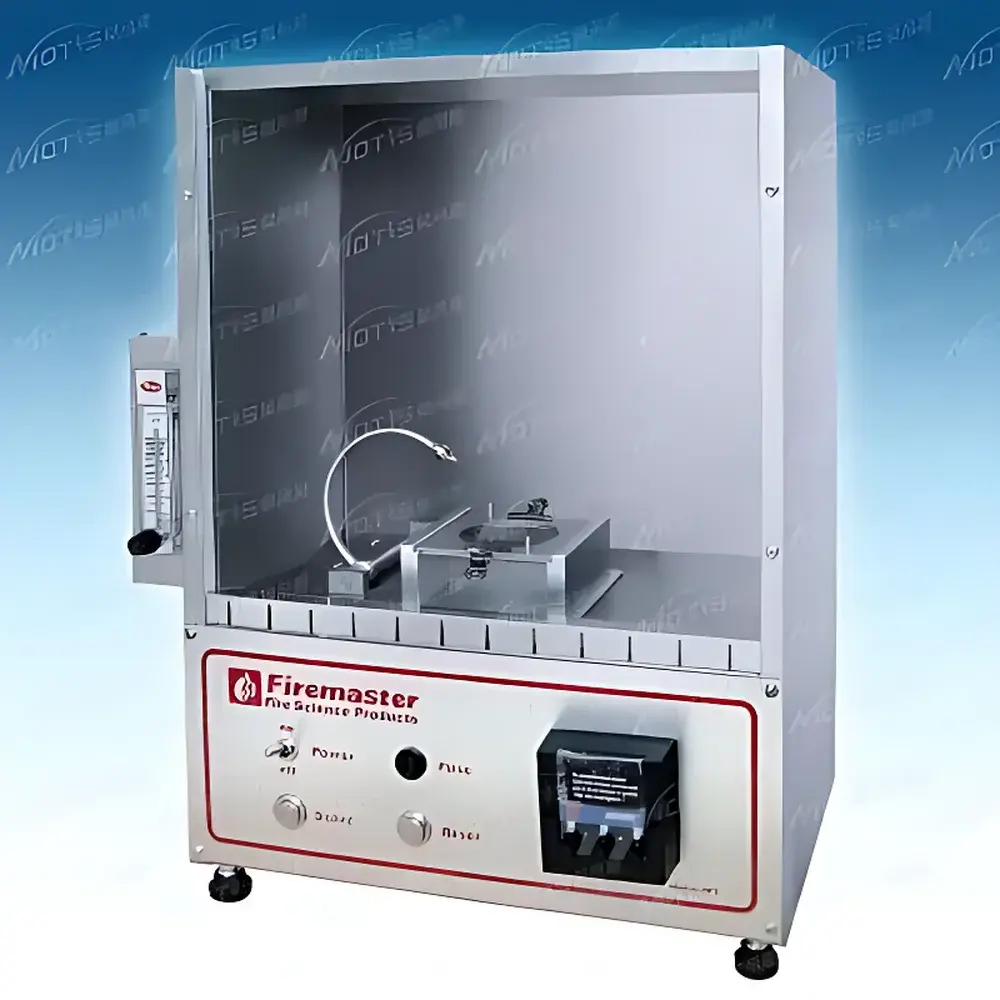
BFT MOTIS Bedding Blanket Combustion Test Chamber
| Origin | Shanghai, China |
|---|---|
| Manufacturer Type | Authorized Distributor |
| Origin Category | Domestic (China) |
| Model | BFT |
| Pricing | Available Upon Request |
| Compliance | ASTM D4151 |
| Construction | Stainless Steel Enclosure with Tempered Glass Viewing Window |
| Ignition Source | No. 18 Needle Burner (Adjustable Flame Height) |
| Timing Resolution | 0.01 s |
| Accessories | Standardized Brushing Device, Sample Holder Assembly, Stainless Steel Specimen Clamps |
Overview
The BFT MOTIS Bedding Blanket Combustion Test Chamber is a precision-engineered apparatus designed specifically for evaluating the surface flame spread behavior and flame resistance of woven and nonwoven textile materials used in bedding applications—particularly blankets, quilts, and comforters. It operates on the principle of controlled, standardized ignition under defined thermal exposure conditions, in strict accordance with ASTM D4151, “Standard Test Method for Flammability of Blankets.” This test method quantifies flame propagation by measuring the extent of charring, hole formation, or discoloration on standardized filter paper placed beneath the horizontally mounted specimen during a fixed-duration flame impingement. The chamber’s architecture ensures reproducible airflow, thermal boundary conditions, and operator safety—critical for generating data suitable for regulatory submissions, quality assurance protocols, and material development validation.
Key Features
- Robust stainless steel enclosure with front-mounted tempered glass viewing window, providing full visual access while maintaining structural integrity and heat containment during testing.
- No. 18 needle-type burner assembly, compliant with ASTM D4151 specifications, delivering a stable, laminar propane-air flame with adjustable height (typically 16 mm ± 1 mm above the specimen surface).
- Digital high-resolution timer with 0.01-second resolution and automatic start/stop triggering synchronized to burner ignition and extinguishment.
- Programmable ignition duration control (user-selectable from 1 to 60 seconds), enabling precise replication of standardized exposure intervals per test protocol.
- Included brushing device engineered to standardize nap orientation and surface density prior to testing—critical for consistent flame interaction across pile and looped fabrics.
- Dedicated sample holder frame and stainless steel clamping system ensuring rigid, wrinkle-free specimen mounting at specified tension and alignment angles as required by ASTM D4151.
Sample Compatibility & Compliance
The BFT MOTIS chamber accommodates rectangular textile specimens measuring 152 mm × 305 mm (6 in × 12 in), cut parallel to warp and weft directions. It supports both flat and low-pile fabrics, including cotton, polyester, wool blends, and flame-retardant-treated synthetics. All mechanical and thermal parameters—including burner geometry, airflow clearance, and specimen elevation—are calibrated and verified against ASTM D4151 Annex A1 verification procedures. The system meets essential requirements for laboratory accreditation under ISO/IEC 17025 for textile flammability testing. While not inherently GLP- or FDA-regulated, its design supports traceable operation when integrated into documented quality systems requiring audit-ready instrumentation logs and calibration records.
Software & Data Management
This standalone mechanical test chamber does not incorporate embedded firmware or proprietary software. All operational controls are manual or electromechanical, ensuring deterministic repeatability without software-induced variability. Timing, ignition sequence, and observation-based evaluation remain human-executed per ASTM D4151 Section 8. However, laboratories may integrate external digital documentation tools—including calibrated video recording systems, time-stamped image capture, and LIMS-compatible reporting templates—to support 21 CFR Part 11–compliant electronic recordkeeping. Calibration certificates for the timing module and burner alignment gauge are provided with initial commissioning and recommended annually.
Applications
- Pre-market evaluation of domestic and commercial blanket products for compliance with U.S. Consumer Product Safety Commission (CPSC) regulations referencing ASTM D4151.
- Comparative assessment of flame-retardant finish efficacy across fabric batches or post-wash durability studies.
- Root-cause analysis of nonconformances in flammability testing—e.g., inconsistent char length attributed to nap variation, uneven tension, or burner misalignment.
- Internal R&D screening for new fiber blends or coating formulations intended for flame-resistant bedding applications.
- Third-party certification lab execution of accredited flammability testing for UL, Intertek, or SGS certification pathways.
FAQ
Does this instrument comply with any international standards beyond ASTM D4151?
ASTM D4151 is the primary and internationally recognized benchmark for blanket flammability. While ISO 6941 and BS 5438 address related textile ignition behaviors, they are not directly applicable to blanket-specific surface flame spread; therefore, ASTM D4151 remains the definitive standard for this application.
Is calibration service available for the timing module and burner alignment?
Yes—certified calibration services, including NIST-traceable timer verification and burner height/centering validation using optical alignment gauges, are available through authorized technical support partners.
Can the chamber be modified to accommodate vertical specimen orientation?
No—the BFT MOTIS chamber is engineered exclusively for horizontal specimen mounting as mandated by ASTM D4151. Vertical configurations require separate apparatuses such as ASTM D6413-compliant vertical flame testers.
What maintenance is required between tests?
After each test cycle, users must remove ash residue from the specimen holder and burner tip, inspect the glass viewport for soot accumulation, and verify burner orifice cleanliness using compressed air or fine-gauge wire—procedures outlined in the operator manual.



