
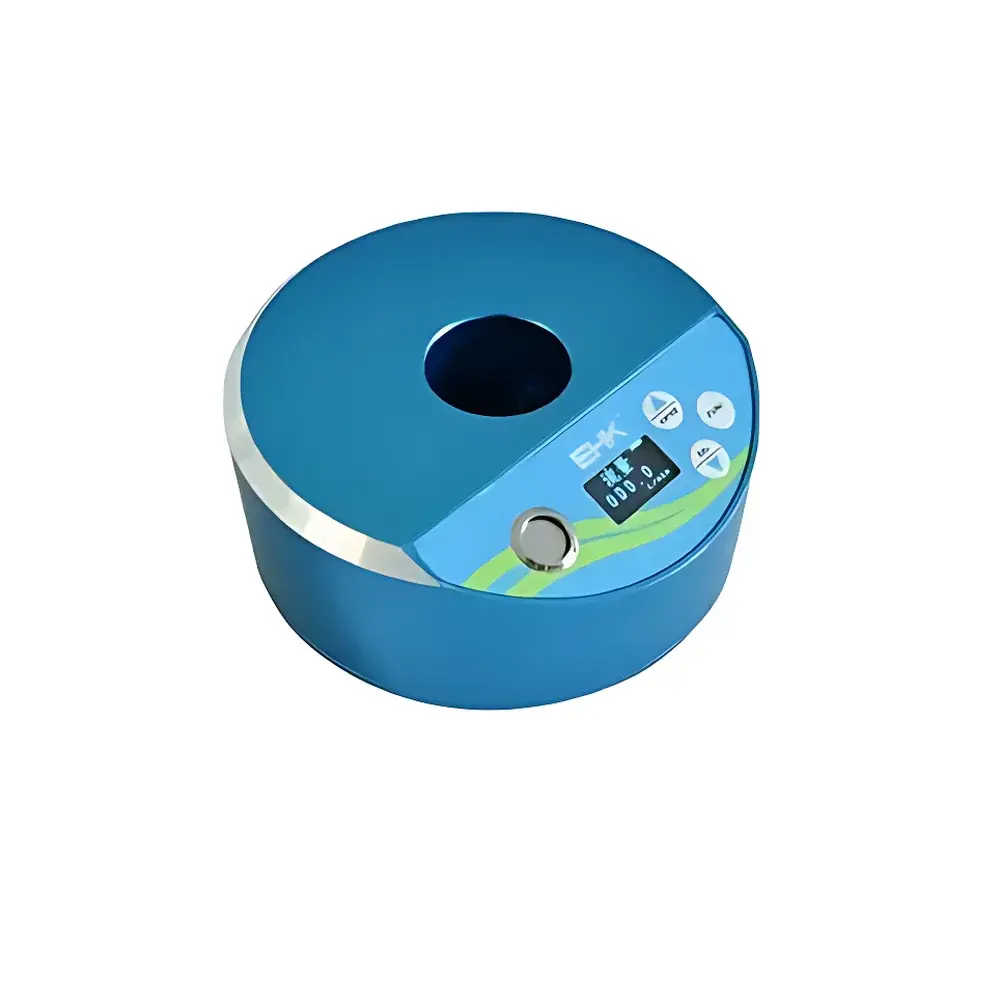
BHK HK-100NT Air Microbial Sampler Flow Calibrator with Patented Low-Resistance Vane Sensor
| Brand | BHK |
|---|---|
| Origin | Guangdong, China |
| Model | HK-100NT |
| Flow Range | 20–250 L/min |
| Flow Measurement Accuracy | ±1% |
| Timing Range | 0–9999 s |
| Operating Temperature | 0–65 °C |
| Operating Humidity | Ambient (non-condensing) |
| Sensor Type | Low-pressure-drop, high-sensitivity vane anemometer |
| Dimensions | Ø112 mm × 50 mm |
| Weight | 550 g |
| Compatible Sampler Head Diameter | 65–105 mm |
| Power | Rechargeable Li-ion battery |
| Display | Color LCD with real-time AVG/MAX/MIN/Calibration value/Battery status |
Overview
The BHK HK-100NT Air Microbial Sampler Flow Calibrator is a precision-engineered metrological instrument designed specifically for the traceable calibration and verification of slit-to-plate or micro-orifice impactor-type air microbial samplers. It operates on the principle of low-torque vane anemometry—leveraging a patented low-pressure-drop rotating vane sensor to measure volumetric airflow without introducing significant backpressure into the sampling train. This design ensures minimal interference with the operational dynamics of the device under test (DUT), preserving its native flow profile during calibration—a critical requirement for ISO 14698-1 compliant environmental monitoring in controlled pharmaceutical and biotech manufacturing environments. Unlike conventional thermal mass flow meters or pitot-based systems, the HK-100NT’s mechanical vane architecture delivers stable, repeatable readings across its full 20–250 L/min range, with metrological traceability validated against national standard reference flowmeters per JJG 711–2022 (Chinese National Verification Regulation for Gas Flow Meters). Its compact form factor (Ø112 × 50 mm) and lightweight construction (550 g) enable field-deployable, on-site calibration without requiring bench-top integration.
Key Features
- Patented low-resistance vane sensor minimizes pressure drop (<0.15 kPa at 120 L/min), preventing flow attenuation in sensitive impactor samplers during calibration.
- Real-time flow display showing instantaneous value, MAX/MIN/AVG over measurement interval, and user-adjustable calibration offset—all simultaneously visible on a high-contrast color LCD.
- Built-in self-calibration mode: allows accredited calibration laboratories to perform field adjustments against certified reference standards using intuitive △/▽/FUNC key navigation.
- Rechargeable lithium-ion battery supports >12 hours of continuous operation; no disposable batteries required.
- Aerospace-grade anodized aluminum housing provides ESD-safe, corrosion-resistant durability and easy surface decontamination—essential for cleanroom and ISO Class 5–8 environments.
- Universal head compatibility: accommodates sampler inlet diameters from 65 mm to 105 mm, covering major commercial impactors including MAS-100, BioStage, SAS Super 180, and equivalent domestic models.
Sample Compatibility & Compliance
The HK-100NT is explicitly engineered for calibration of micro-orifice impactor air samplers used in viable particle monitoring per ISO 14698-1:2003 (Biocontamination control) and EU GMP Annex 1 (2022 revision). It supports routine verification of sampling flow consistency prior to environmental monitoring campaigns in Grade A–D cleanrooms, sterile manufacturing suites, and microbiological testing laboratories. While not itself a certified reference standard, its ±1% full-scale accuracy (verified per national metrological institute protocols) meets the performance threshold recommended by PDA Technical Report No. 13 (Revised 2021) for secondary flow verification instruments. The unit complies with GB/T 2423.1–2008 (cold test), GB/T 2423.2–2008 (dry heat), and IEC 61326-1:2013 (EMC for laboratory equipment). It does not require external gas certification and is suitable for use in non-explosive atmospheres only.
Software & Data Management
The HK-100NT operates as a standalone, embedded-system calibrator with no proprietary software dependency. All measurement data—including timestamped MAX/MIN/AVG values and calibration history—are retained in non-volatile memory and viewable directly on-device. For audit trail compliance under FDA 21 CFR Part 11 or EU Annex 11, users may manually record calibration events in paper-based or electronic logbooks, noting instrument ID, reference standard ID, date/time, operator, ambient conditions (T/RH), and deviation correction applied. Future firmware updates (delivered via USB-C interface) will support CSV export of session logs for integration into LIMS or QMS platforms—though no cloud connectivity or remote access functionality is implemented, preserving data integrity and network security.
Applications
- Routine pre-use verification of impactor sampler flow rate before environmental monitoring in pharmaceutical Grade A laminar airflow hoods and isolators.
- Periodic calibration validation in QC microbiology labs performing USP , , or EP 2.6.12 tests.
- Third-party calibration service providers conducting on-site verification for GMP-audited facilities.
- Research institutions validating novel air sampler designs against ISO 14698-2 test methods.
- Hospital infection control units verifying portable samplers used in operating theaters and ICU air quality assessments.
FAQ
Is the HK-100NT suitable for calibrating centrifugal or filtration-based air samplers?
No. It is optimized exclusively for micro-orifice impactor and slit-to-plate samplers where low backpressure and dynamic flow fidelity are essential. Centrifugal or membrane-filter samplers impose different load characteristics and require alternative calibration approaches.
Does the device include NIST-traceable calibration documentation?
Each unit ships with a factory calibration certificate referencing CNAS-accredited primary standards. Full traceability to China’s National Institute of Metrology (NIM) is available upon request for accredited calibration services.
Can the HK-100NT be used in humidified or HEPA-filtered air streams?
Yes—provided relative humidity remains below 85% RH and condensation is absent. The anodized aluminum body and sealed sensor housing resist moisture ingress under typical cleanroom HVAC conditions.
What is the recommended recalibration interval?
Annual recalibration is advised per ISO/IEC 17025 requirements; however, frequency should be risk-assessed based on usage intensity, environmental exposure, and internal quality procedures.
How is measurement uncertainty determined for this instrument?
Combined standard uncertainty is ≤±0.86% (k=2) at 100 L/min, derived from sensor linearity, temperature coefficient, timebase stability, and reference standard uncertainty—fully documented in the technical manual.
Related Products







