
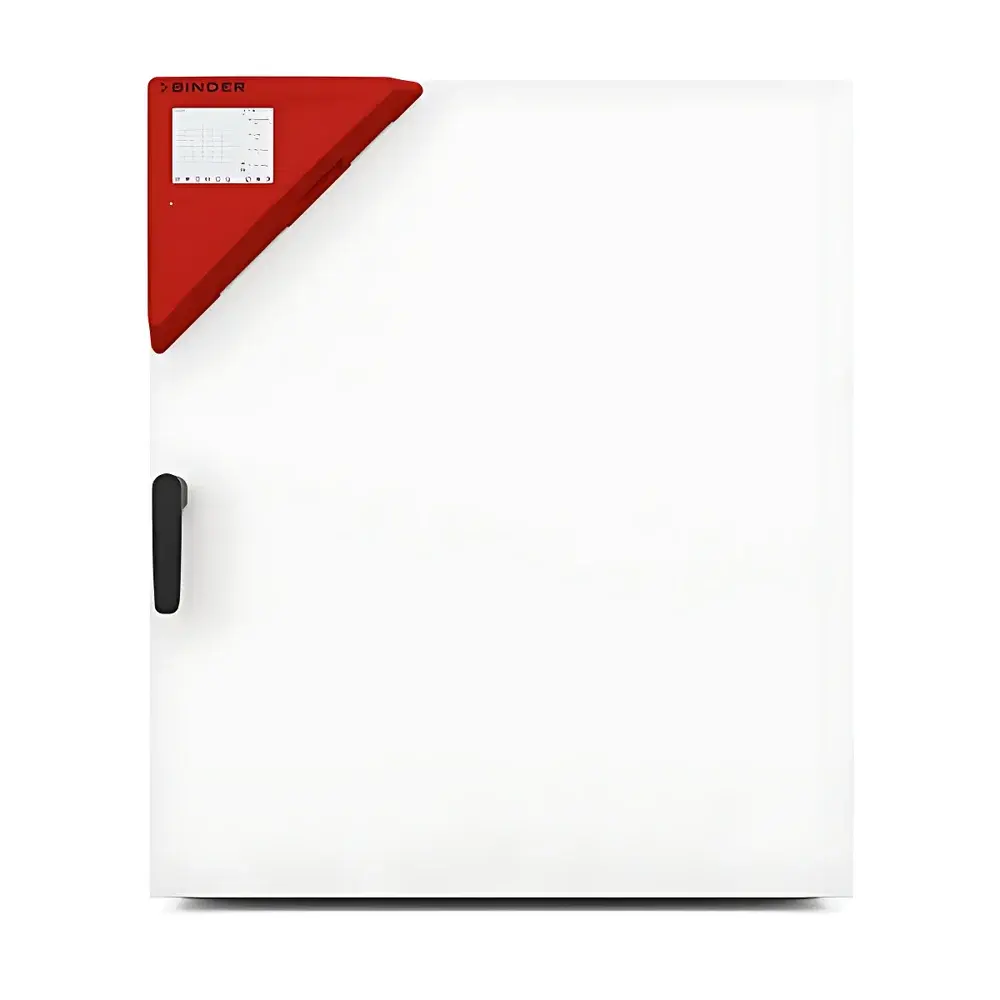
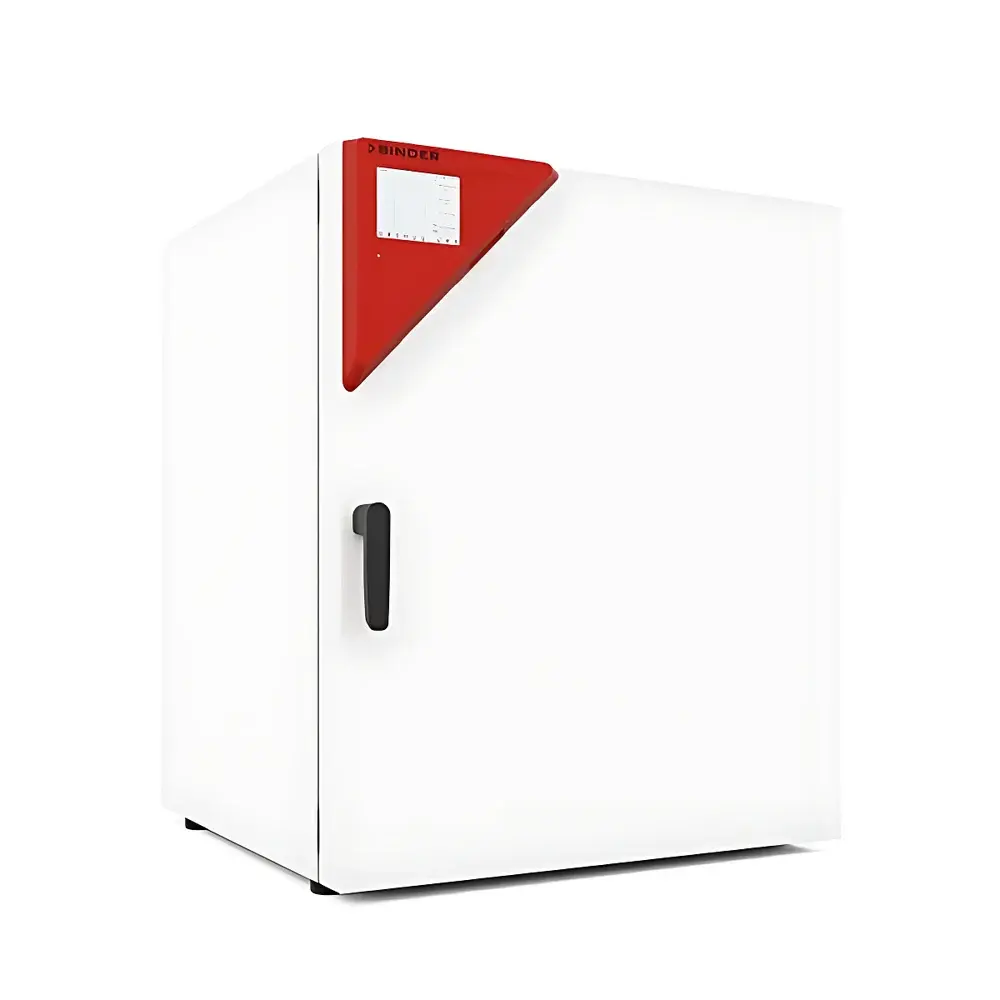
BINDER M 260 Forced-Convection Drying Oven with APT.line™ Preheating Chamber and Multi-Stage Programmable Controller
| Brand | BINDER |
|---|---|
| Origin | Germany |
| Manufacturer | BINDER GmbH |
| Model | M 260 |
| Temperature Range | Ambient +14 °C to 300 °C |
| Temperature Fluctuation | ±0.4 K at 150 °C |
| Temperature Uniformity | ±1.5 °C at 150 °C |
| Interior Dimensions (W×D×H) | 650 × 780 × 505 mm |
| Exterior Dimensions (W×D×H) | 810 × 962 × 786 mm |
| Interior Material | Stainless Steel (AISI 304) |
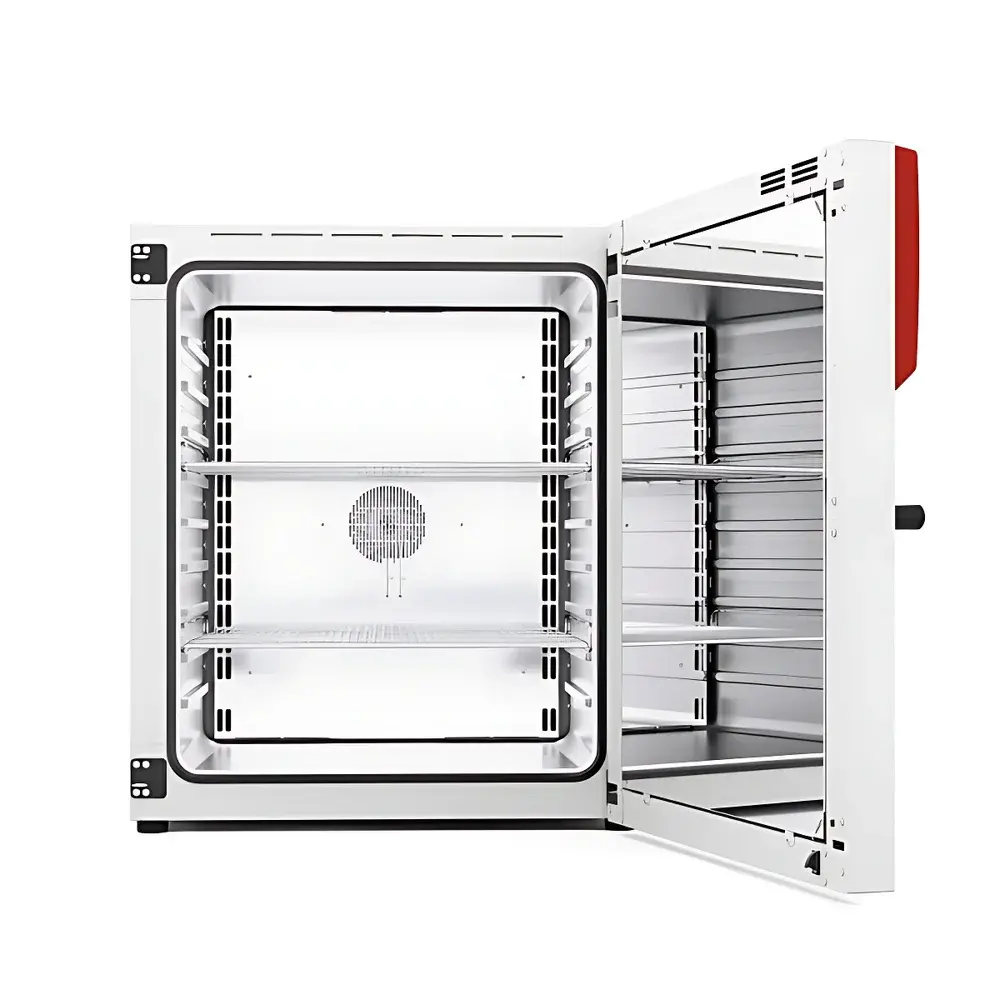
| Heating Method | Forced-air convection with adjustable-speed fan |
| Insulation | High-efficiency mineral wool insulation |
| Safety Class | Independent adjustable temperature safety device Class 2 (DIN 12880) and Class 3.1 (DIN 12880) |
| Control System | Touchscreen controller with time-segment and real-time programming |
| Data Logging | Internal recorder with USB export (CSV format) |
| Communication Interface | Ethernet port for network integration |
| Operating Ambient Temperature | 22 ±3 °C |
| Fan Speed | Continuously adjustable |
| Exhaust Valve | Manual electromechanical control |
| Backup Sensor | Redundant Pt100 sensor for fault-tolerant operation |
Overview
The BINDER M 260 is a high-precision forced-convection drying oven engineered for reproducible thermal treatment in demanding laboratory and industrial quality assurance environments. Designed and manufactured in Germany, it implements BINDER’s proprietary APT.line™ preheating chamber technology — a thermally isolated air jacket surrounding the working chamber that actively regulates supply air temperature before it enters the interior. This architecture eliminates cold spots, suppresses thermal gradients caused by door openings or load variation, and ensures stable setpoint attainment across the full volume. The oven operates within a calibrated temperature range from ambient +14 °C up to 300 °C, supporting applications including gravimetric moisture analysis, polymer aging per ISO 188 and ASTM D573, pharmaceutical stability testing (ICH Q1A), and residual solvent removal under GLP-compliant conditions. Its robust stainless steel (AISI 304) interior, high-density mineral wool insulation, and precisely balanced airflow distribution meet stringent requirements for thermal consistency and energy efficiency.
Key Features
- APT.line™ preheating chamber technology for superior temperature uniformity (±1.5 °C at 150 °C) and minimal fluctuation (±0.4 K at 150 °C)
- Adjustable-speed centrifugal fan enabling precise control of air velocity and heat transfer dynamics
- Dual independent temperature safety systems: Class 2 (mechanical override) and Class 3.1 (electronic, user-adjustable limit) per DIN 12880
- Intuitive 7-inch color touchscreen controller supporting both time-segment programming (up to 10 segments) and real-time parameter adjustment
- Redundant Pt100 sensor architecture with automatic failover to ensure uninterrupted process integrity
- Manual electromechanical exhaust valve for controlled vapor evacuation during drying or outgassing procedures
- Two chrome-plated, height-adjustable shelves included; additional shelf kits available for customized load configuration
- Ethernet interface (TCP/IP) for remote monitoring, alarm notification, and integration into LIMS or SCADA environments
Sample Compatibility & Compliance
The M 260 accommodates heterogeneous sample loads—including Petri dishes, crucibles, glassware stacks, polymer coupons, and coated substrates—without compromising thermal homogeneity. Its large usable volume (252 L) and optimized airflow path minimize edge effects and ensure compliance with ISO 14644-1 (cleanroom-compatible operation when used with optional HEPA filter kit), ASTM E145 (standard specification for gravity-convection and forced-convection ovens), and EN 61000-6-3 (EMC emission limits). For regulated environments, the internal data logger records timestamped temperature values at user-defined intervals (1 s to 60 min), exporting CSV files via USB for audit-ready traceability. The controller supports configurable visual and acoustic alarms, and all safety thresholds are password-protected to prevent unauthorized modification—aligning with FDA 21 CFR Part 11 principles for electronic records and signatures where local validation protocols apply.
Software & Data Management
No proprietary software installation is required: the built-in web server enables direct browser-based access to real-time temperature curves, event logs (door openings, alarms, program starts/stops), and calibration history via Ethernet. Measurement data from the internal recorder can be exported in open-format CSV files compatible with Excel, MATLAB, JMP, or statistical process control (SPC) platforms. Optional BINDER CDS (Control & Documentation Software) provides advanced features including automated report generation, multi-oven fleet monitoring, and electronic signature workflows compliant with GxP documentation standards. All firmware updates are delivered via secure HTTPS download and validated checksum verification prior to installation.
Applications
- Moisture content determination per AOAC 950.46, ISO 5477, and USP <731>
- Accelerated aging of elastomers, adhesives, and composite materials per ISO 188 and ASTM D865
- Drying of filter papers, precipitates, and ceramic green bodies in analytical chemistry workflows
- Pre-conditioning of test specimens prior to tensile, impact, or dielectric testing
- Residual solvent removal in API synthesis and coating formulation development
- Stability studies under ICH Q1A(R3) long-term and accelerated storage conditions
- Thermal desorption of volatile organic compounds (VOCs) from environmental samples
FAQ
What is the purpose of the APT.line™ preheating chamber?
The APT.line™ chamber actively preconditions supply air using an independently heated air jacket, eliminating thermal lag and ensuring rapid, uniform temperature distribution regardless of load size or position.
Can the M 260 be validated for GMP use?
Yes—the unit supports IQ/OQ documentation packages, includes factory calibration certificates (traceable to DAkkS), and offers optional 3Q validation support kits with protocol templates and performance qualification test scripts.
Is external ventilation required for operation?
Not inherently—but an exhaust duct connection is recommended when processing volatile, toxic, or corrosive substances to maintain safe lab air quality and comply with local occupational exposure limits.
How is temperature uniformity verified across the chamber?
BINDER performs 9-point mapping per VDI/VDE 2655 Sheet 1 during final factory testing; users may replicate this using calibrated PT100 probes and third-party validation software.
Does the controller support password-protected user roles?
Yes—administrator, operator, and viewer profiles can be assigned with granular permissions for program editing, safety limit changes, and data export functions.



