
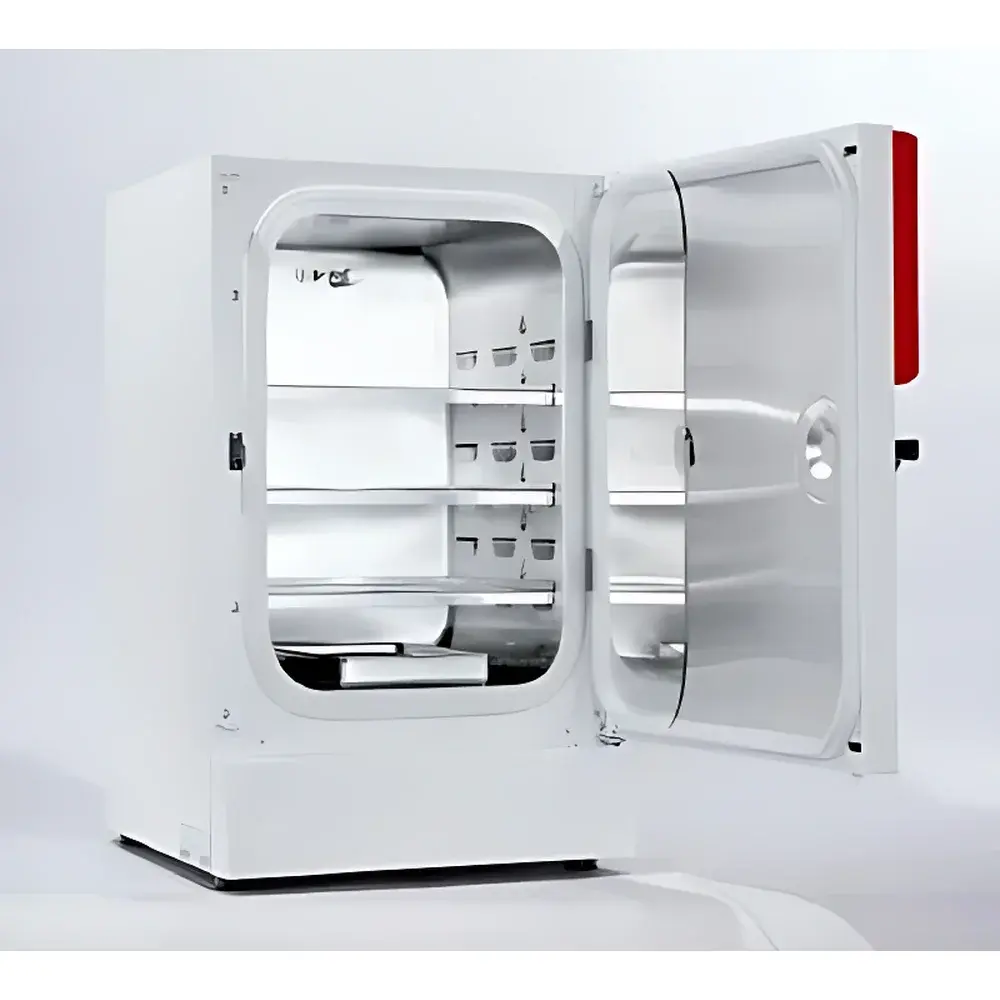
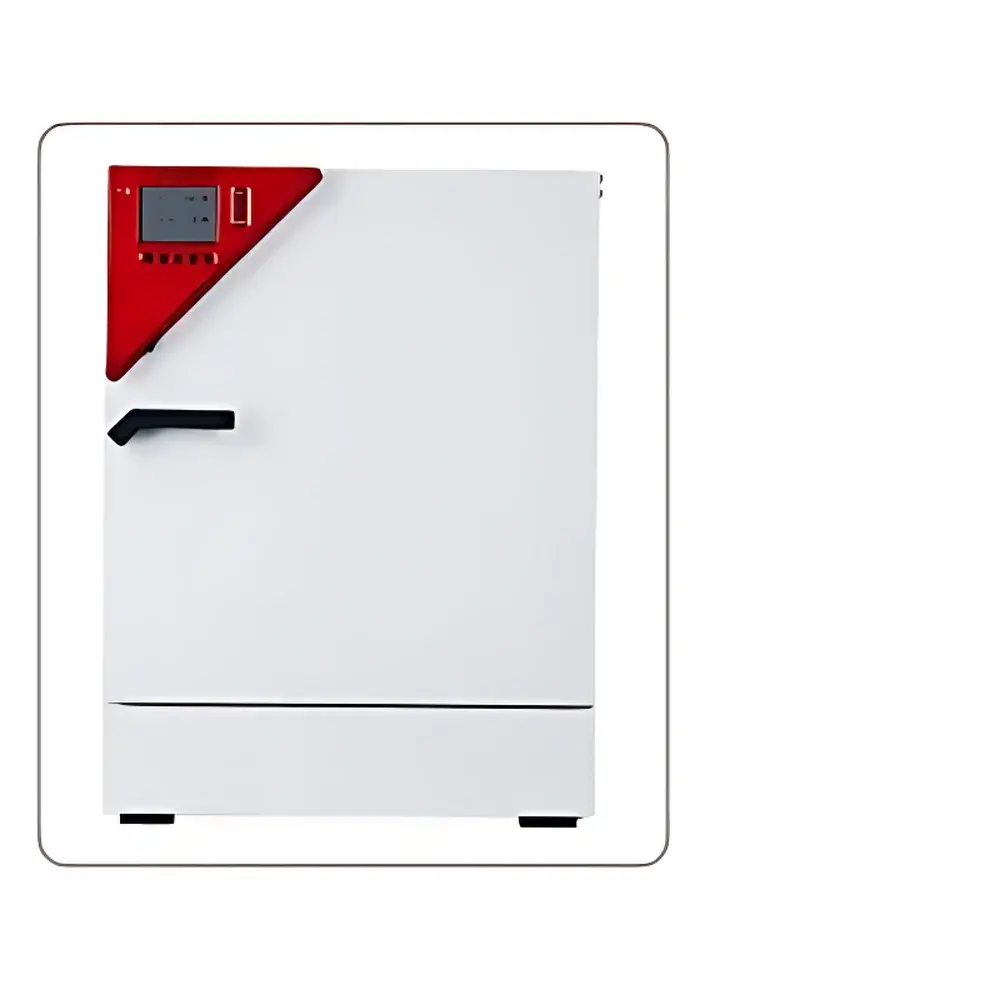
Binder CO2 Incubator Series (APT-Line® & Permadry®)
| Brand | BINDER |
|---|---|
| Origin | Germany |
| Model | CB-S Series (e.g., CB150, CB210) |
| Chamber Volume | 150 L / 210 L |
| Temperature Range | Ambient +7 °C to 60 °C |
| Temp. Uniformity | ±0.3 °C (at 37 °C, ISO 1534-1 compliant) |
| Temp. Stability | ±0.1 °C |
| CO₂ Control Range | 0–20 % vol. |
| CO₂ Accuracy | ±0.1 % vol. (IR sensor) |
| Humidity Control | >95 % rH (Permadry® dual-chamber condensation system) |
| Sterilization | Dry-heat at 180 °C for ≥2 h (GLP/GMP-compliant) |
| Insulation | Triple-wall vacuum-insulated chamber |
| Door Seal | Dual-point hermetic sealing |
| Interface | RS422 port for APT-COM® software integration |
| Compliance | ISO 1534-1, DIN EN 61000-6-3, FDA 21 CFR Part 11 (via APT-COM® audit trail) |
Overview
The BINDER CO₂ Incubator Series (CB-S models) is a precision-engineered life science instrument designed for reliable, long-term cell culture under strictly controlled atmospheric and thermal conditions. Utilizing the patented APT-Line® air-jacket technology—where heated air circulates within an outer insulating jacket rather than directly inside the chamber—the incubator eliminates internal fans, thereby preventing turbulence, desiccation, and cross-contamination risks associated with forced convection. This passive, uniform heat distribution ensures exceptional spatial temperature homogeneity (±0.3 °C at 37 °C per ISO 1534-1) and rapid thermal recovery (95 % relative humidity without condensation—even during prolonged operation or ambient temperature fluctuations—by precisely controlling dew point and recirculating condensed moisture in a closed-loop configuration.
Key Features
- APT-Line® air-jacket architecture: Eliminates internal fans, enabling laminar thermal environment and minimizing shear stress on sensitive adherent and suspension cultures.
- Permadry® dual-chamber humidification: Actively regenerates moisture at defined dew points; prevents chamber wall condensation and ensures uniform humidity distribution across full volume.
- 180 °C dry-heat sterilization cycle: Validated for complete microbial decontamination (including spores), fully compliant with GLP and GMP requirements for aseptic cell banking and therapeutic manufacturing.
- Triple-wall vacuum insulation: Provides superior thermal retention—critical during power interruption—and reduces external heat ingress by >85 % compared to conventional foam-insulated units.
- Dual-point hermetic door seal: Maintains chamber integrity during sterilization and routine operation, preventing CO₂ leakage and ambient air infiltration.
- MB1 touchscreen controller: Intuitive interface for simultaneous monitoring and control of temperature, CO₂, and humidity; supports user-defined protocols and event logging.
Sample Compatibility & Compliance
The CB-S series accommodates standard tissue culture formats—including T-flasks, multiwell plates, roller bottles, and Petri dishes—without compromising environmental stability. Its fanless design and absence of internal water pans eliminate aerosol generation and biofilm risk, making it suitable for primary human cell lines, stem cells, and co-culture systems requiring low-stress microenvironments. All models comply with ISO 1534-1:2021 (incubators for microbiology and cell culture), DIN EN 61000-6-3 (EMC emission standards), and support FDA 21 CFR Part 11 compliance when used with validated APT-COM® software (electronic signatures, audit trails, and data integrity controls). Routine performance qualification (PQ) and installation qualification (IQ) documentation packages are available per ICH Q5A and EU Annex 1 guidelines.
Software & Data Management
The RS422 interface enables seamless integration with BINDER’s APT-COM® software suite, supporting real-time remote monitoring, automated data export (CSV/Excel), and comprehensive electronic recordkeeping. APT-COM® provides configurable alarm thresholds, trend visualization for temperature/CO₂/humidity parameters, and full audit-trail functionality—including user login history, parameter changes, and sterilization cycle logs—required for GLP audits and regulatory submissions. Data encryption, role-based access control, and backup-to-network-drive capability ensure alignment with ISO/IEC 27001 information security practices.
Applications
- Mammalian cell culture for biopharmaceutical production (e.g., CHO, HEK293, hybridoma lines)
- Stem cell expansion and differentiation studies under hypoxic or normoxic CO₂ setpoints
- Long-term organoid maintenance requiring ultra-stable humidity and minimal thermal drift
- Regulatory-compliant cell banking (Master/Working Cell Banks) per USP and Ph. Eur. 5.2.12
- Microbiology applications involving capnophilic organisms (e.g., Neisseria, Campylobacter)
- Quality control testing in contract development and manufacturing organizations (CDMOs)
FAQ
What validation support is provided for GMP environments?
BINDER supplies IQ/OQ/PQ documentation templates, factory-verified calibration certificates traceable to DKD/DAkkS standards, and APT-COM® 21 CFR Part 11 configuration guides.
Can the incubator operate continuously at 41 °C with 10 % CO₂ and >95 % rH?
Yes—thermal and gas stability are maintained across the full specified operating envelope, including elevated temperatures and extended runtime (>30 days) without recalibration.
Is the 180 °C sterilization cycle programmable and logged?
Yes—the MB1 controller stores full cycle parameters (time, ramp rate, dwell duration, temperature profile) with timestamped digital records exportable via APT-COM®.
How does the Permadry® system prevent contamination from standing water?
By eliminating open-water reservoirs and using sealed, temperature-controlled condensation chambers, Permadry® removes the primary vector for microbial growth inherent in traditional humidification designs.
Are spare parts and service available globally?
BINDER maintains certified service centers in North America, EMEA, and APAC; all critical components—including IR sensors, heating elements, and door gaskets—are stocked and replaceable under field-service protocols.





