
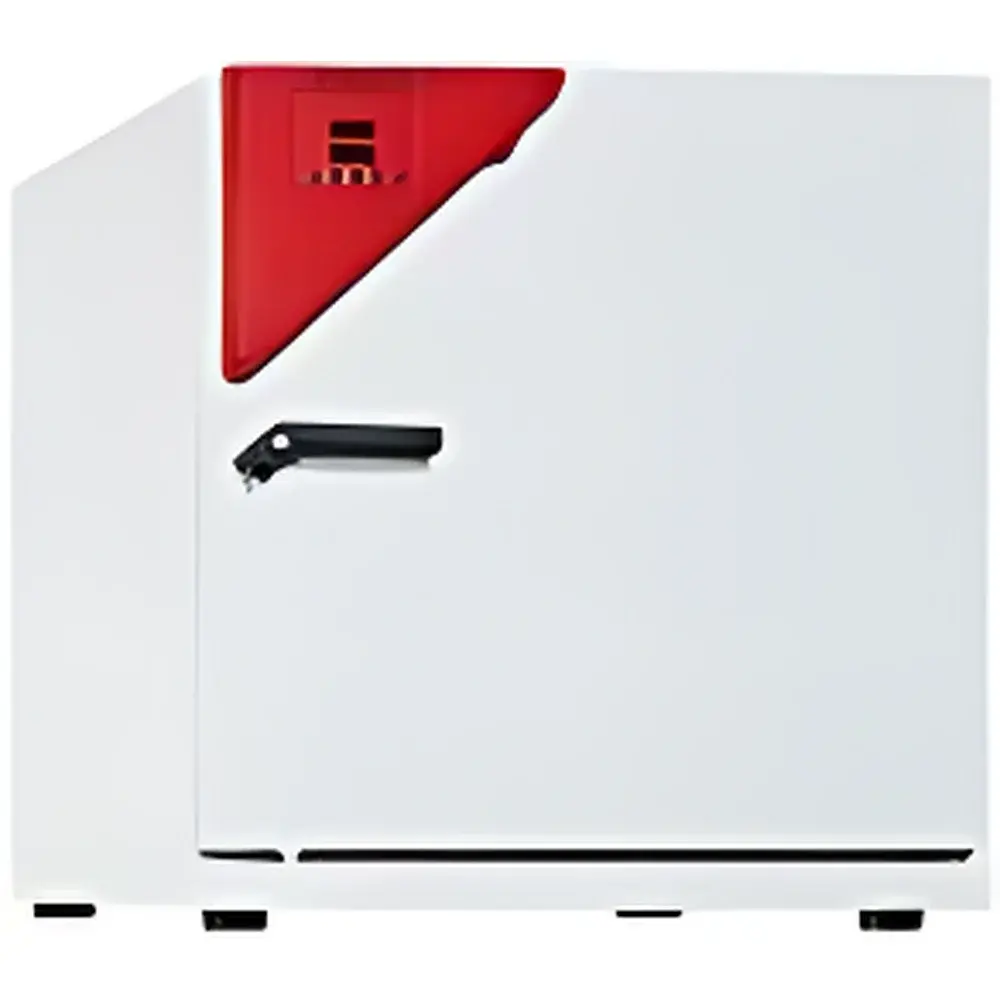
BINDER FD/ED/FED Precision Drying Ovens
| Brand | BINDER |
|---|---|
| Origin | Germany |
| Model Series | FD / ED / FED |
| Temperature Range | +5 °C to 300 °C above ambient |
| Controller | Microprocessor-based PID (ED/FD) or Programmable Ramp/Soak Controller with 2×10-step or 1×20-step profiles (FED-FP) |
| Display | LED |
| Timer | 0–99 h 59 min |
| Communication Interface | RS422 for APT-COM software integration |
| Chamber Volume Options | Multiple standard sizes (custom configurations available) |
| Compliance | Designed and manufactured in accordance with DIN EN 61000-6-3, DIN EN 61000-6-2, and IEC 61010-1 safety standards |
Overview
The BINDER FD/ED/FED series represents a family of precision drying ovens engineered for reproducible thermal processing in research laboratories, quality control environments, and regulated industrial settings. These ovens operate on forced-air convection principles, utilizing BINDER’s proprietary APT.Line® preheating chamber technology — a thermally decoupled outer jacket that surrounds the main working chamber. This architecture actively preconditions incoming air before it enters the chamber, eliminating cold spots and minimizing thermal lag during setpoint transitions. As a result, the FD/ED/FED series achieves exceptional temperature uniformity (±0.3 °C at 130 °C, typical), high repeatability (<0.1 °C inter-batch deviation under standardized load conditions), and rapid stabilization after door opening — critical attributes for moisture loss determination, gravimetric analysis, polymer curing, and stability testing per ICH Q1 guidelines.
Key Features
- APT.Line® preheating chamber technology ensures uniform airflow distribution and minimizes thermal gradients across the entire usable volume — validated per DIN 12880 Annex B.
- Microprocessor-controlled PID regulation (FD/ED models) or programmable ramp/soak logic (FED-FP models) with dual-profile memory (2×10-step or 1×20-step sequences) enables complex thermal protocols such as drying-curing-cooling cycles.
- RS422 serial interface supports bidirectional communication with BINDER’s APT-COM II software for remote monitoring, data logging, alarm management, and electronic signature-capable audit trails compliant with FDA 21 CFR Part 11 requirements.
- Double-walled stainless steel construction with mineral wool insulation delivers energy efficiency and stable thermal containment; inner chamber surfaces are electropolished stainless steel (1.4301) for corrosion resistance and easy decontamination.
- Integrated overtemperature protection (independent mechanical safety thermostat) and door-open detection ensure compliance with IEC 61010-1 Class II safety specifications.
Sample Compatibility & Compliance
The FD/ED/FED series accommodates a broad range of sample types including powders, granules, filter papers, metal coupons, polymer films, and pharmaceutical dosage forms. Chamber volumes span from 23 L (FD 53) to 616 L (FED 780), with optional perforated or solid shelves, shelf load ratings up to 25 kg per level, and configurable airflow baffles. All models are CE-marked and conform to DIN EN 61000-6-2 (immunity) and DIN EN 61000-6-3 (emissions). For GLP/GMP environments, optional validation packages include IQ/OQ documentation templates, traceable calibration certificates (DKD/DAkkS-accredited), and 21 CFR Part 11-compliant firmware upgrades.
Software & Data Management
APT-COM II software provides real-time graphical monitoring of chamber temperature, program progression, and system status. Logged data (timestamped, with user ID and event tags) is exportable in CSV or XML format for integration into LIMS or ELN platforms. The software supports automated report generation aligned with ISO/IEC 17025 clause 7.8.2 and includes configurable alarm thresholds, email/SMS notifications (via optional gateway), and encrypted local database storage. Firmware updates preserve historical calibration records and maintain full traceability across device lifecycle phases.
Applications
- Moisture content determination (ASTM D2216, ISO 11465)
- Residue-on-ignition assays and ashing preparation (USP <281>)
- Thermal aging studies of elastomers and composites (ASTM D573, ISO 188)
- Drying of chromatography media and catalyst supports
- Pre-conditioning of test specimens prior to tensile or impact testing (ISO 291, ASTM D618)
- Stability-indicating storage for reference standards and drug substances (ICH Q5C)
FAQ
What distinguishes APT.Line® technology from conventional forced-air ovens?
APT.Line® uses an independently heated outer jacket to precondition supply air, reducing thermal inertia and improving spatial uniformity — especially under variable load or frequent access conditions.
Can the FED-FP model execute multi-stage temperature ramps without manual intervention?
Yes — the programmable controller stores two independent profiles, each supporting up to ten ramp/soak steps, or one extended profile with twenty sequential segments, with dwell time, rate, and target temperature fully definable.
Is validation support available for regulated pharmaceutical applications?
BINDER provides IQ/OQ protocol templates, factory calibration reports, and optional 21 CFR Part 11-compliant firmware — all aligned with Annex 15 of the EU GMP Guide and FDA guidance on computerized systems.
How does the oven handle thermal recovery after door opening?
APT.Line® architecture reduces recovery time by up to 40% compared to standard convection ovens at 130 °C, verified using PT100 sensor arrays per VDI/VDE 2655 Sheet 2.
Are chamber volume and shelf configuration customizable?
Standard models offer fixed internal dimensions; however, BINDER offers engineered modifications including reinforced shelving, inert gas purging ports, and custom interior linings upon request — subject to technical feasibility review.



