
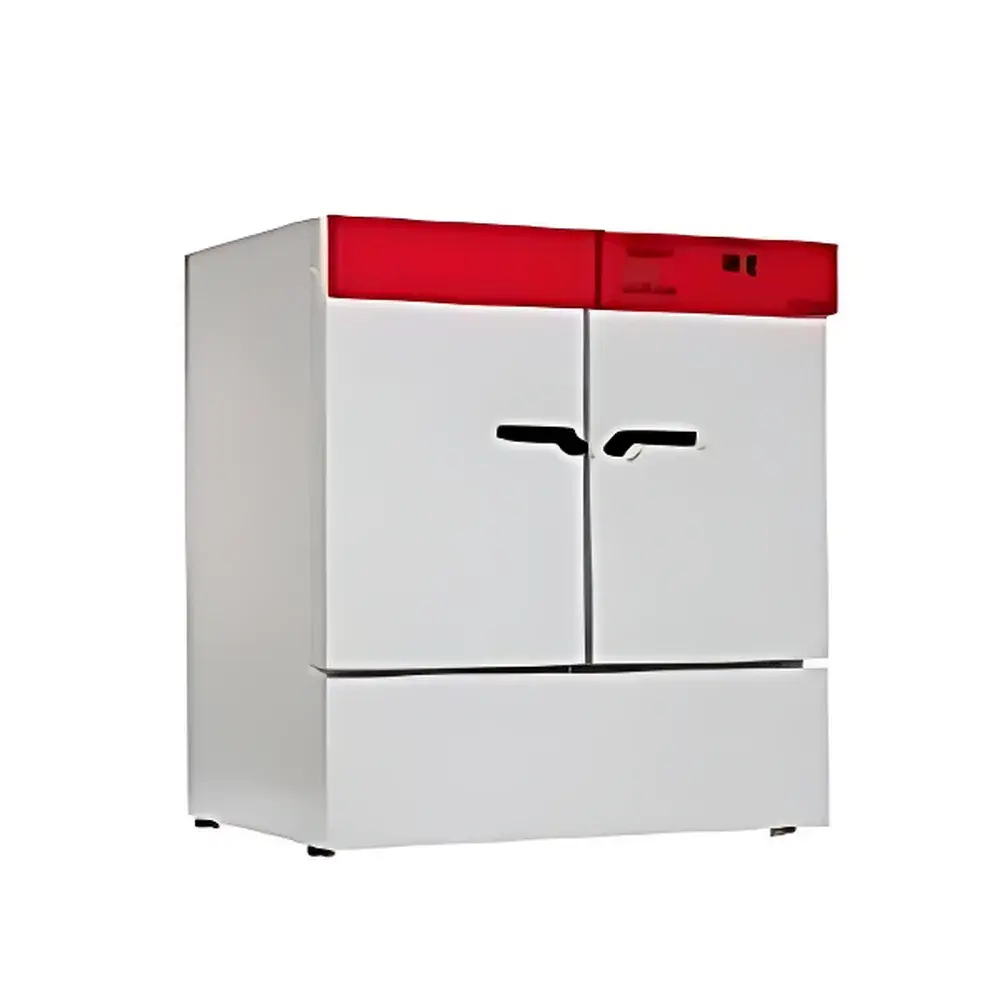
Binder KBW Plant Growth Chamber
| Brand | BINDER |
|---|---|
| Origin | Germany |
| Model | KBW |
| Temperature Range (without lighting) | –9.9 to 60 °C |
| Cooling System | Patented DCT (Direct Cooling Technology) with eco-friendly refrigerant |
| Air Circulation | Digital adjustable turbo fan + APT.Line™ preheating chamber technology |
| Lighting Options | Removable fluorescent lamps |
| Internal Volume Options | 240 L, 400 L, 720 L |
| Compliance | Designed to meet ISO 13485-aligned manufacturing practices |
| Controller | Microprocessor-based PID controller with LED display |
| Airflow Architecture | Symmetrical, open-loop convection system ensuring uniform thermal distribution and dynamic stability |
Overview
The Binder KBW Plant Growth Chamber is an engineered environmental simulation system designed for reproducible, long-term cultivation of photoperiod-sensitive plant material under tightly controlled climatic conditions. Built upon BINDER’s decades of expertise in precision incubation technology, the KBW integrates advanced thermal management—specifically the APT.Line™ preheating chamber architecture and DCT (Direct Cooling Technology)—to eliminate thermal gradients and ensure spatial temperature uniformity across the entire working volume. Its measurement principle relies on closed-loop PID-controlled air heating and refrigeration, coupled with symmetrical forced convection, enabling stable setpoint maintenance within ±0.3 °C (at 20 °C, load-free, per DIN 12880). Unlike standard incubators, the KBW is purpose-configured for photosynthetic organisms: its modular lighting interface supports spectral flexibility, intensity calibration, and photoperiod programming—critical for studies in plant physiology, phenotyping, seed germination, and circadian rhythm research.
Key Features
- APT.Line™ preheating chamber technology ensures homogeneous temperature distribution by pre-conditioning supply air before entering the inner chamber, minimizing wall-to-wall thermal deviation.
- DCT cooling system utilizes an environmentally compliant refrigerant (R-290) and enables rapid, precise sub-ambient temperature control down to –9.9 °C—uncommon in standard plant chambers.
- Microprocessor-based PID controller with intuitive LED interface provides real-time monitoring of temperature, lighting status, and system diagnostics; supports password-protected parameter locking for SOP compliance.
- Digital adjustable turbo fan allows user-defined airflow velocity—optimizing gas exchange for CO2-enriched or low-humidity protocols without compromising thermal stability.
- Modular lighting design accommodates standardized T5/T8 fluorescent tubes; optional daylight (6500 K) or cool-white (4000 K) spectra are available with factory-calibrated irradiance output (measured in µmol·m−2·s−1 at shelf level).
- Three internal volume configurations (240 L, 400 L, 720 L) share identical control architecture and thermal performance specifications—enabling scalable experimental replication across facility tiers.
Sample Compatibility & Compliance
The KBW chamber is validated for use with intact plants, seedlings, tissue cultures, and algae suspensions requiring diurnal light–dark cycles and narrow thermal tolerances. Its stainless-steel interior (AISI 304), rounded corners, and seamless welds support routine decontamination via hydrogen peroxide vapor (HPV) or alcohol-based agents—aligning with biosafety Level 1 (BSL-1) laboratory hygiene standards. While not certified as medical devices, the KBW’s manufacturing process adheres to ISO 13485 principles, and its data logging capability (via optional USB or Ethernet interface) supports audit-ready environmental records compliant with GLP (Good Laboratory Practice) and GMP (Good Manufacturing Practice) frameworks. Temperature and lighting event logs include timestamps, operator IDs, and change history—meeting foundational expectations of FDA 21 CFR Part 11 for electronic record integrity where locally mandated.
Software & Data Management
The KBW operates natively via its embedded controller but integrates with BINDER’s optional C-Control software suite for remote supervision, multi-chamber synchronization, and automated reporting. C-Control enables export of time-stamped CSV files containing temperature, lighting state, fan speed, and alarm events—structured for import into LIMS or statistical analysis platforms (e.g., R, Python pandas). Data retention is configurable up to 30 days onboard; external storage via USB drive extends archival capacity. All logged parameters are subject to immutable audit trails: modifications require dual authentication, and system-level changes trigger automatic log entries—including firmware updates and calibration adjustments.
Applications
- Controlled-environment phenotyping of crop genotypes under defined photoperiods and temperature regimes.
- Standardized seed germination assays per ISTA (International Seed Testing Association) guidelines.
- Long-term acclimation studies assessing stomatal conductance, chlorophyll fluorescence (Fv/Fm), and biomass partitioning.
- Pre-clinical cultivation of medicinal plant tissues for secondary metabolite profiling (e.g., alkaloids, terpenoids).
- Support of CRISPR-edited plant line stabilization prior to greenhouse transfer.
- Teaching laboratories requiring robust, serviceable platforms for undergraduate plant physiology curricula.
FAQ
Does the KBW support CO2 enrichment?
No—the KBW is not equipped with integrated CO2 sensors or injection ports. For CO2-controlled plant growth, consider BINDER’s CO2-capable models (e.g., CB series) or third-party retrofit solutions validated for chamber compatibility.
Can lighting intensity be calibrated traceably?
Yes—optional PAR (Photosynthetically Active Radiation) sensors with NIST-traceable calibration certificates are available as accessories; integration requires C-Control software configuration.
What is the maximum allowable ambient room temperature for stable operation at 4°C?
For reliable sub-ambient performance, ambient conditions should remain ≤25 °C with adequate ventilation clearance (≥10 cm rear/side, ≥30 cm top). Higher ambient temperatures reduce cooling capacity and extend stabilization time.
Is the KBW suitable for sterile tissue culture work?
While the chamber supports aseptic technique via UV-compatible interior surfaces and smooth welds, it lacks HEPA filtration or positive-pressure laminar flow—thus classified as a non-sterile growth environment. Sterile handling must occur upstream in biosafety cabinets.
How frequently does the system require preventive maintenance?
BINDER recommends annual verification of temperature uniformity (per DIN 12880), fan calibration, and lighting output decay assessment—especially when operating >8 h/day under full-spectrum illumination.




