
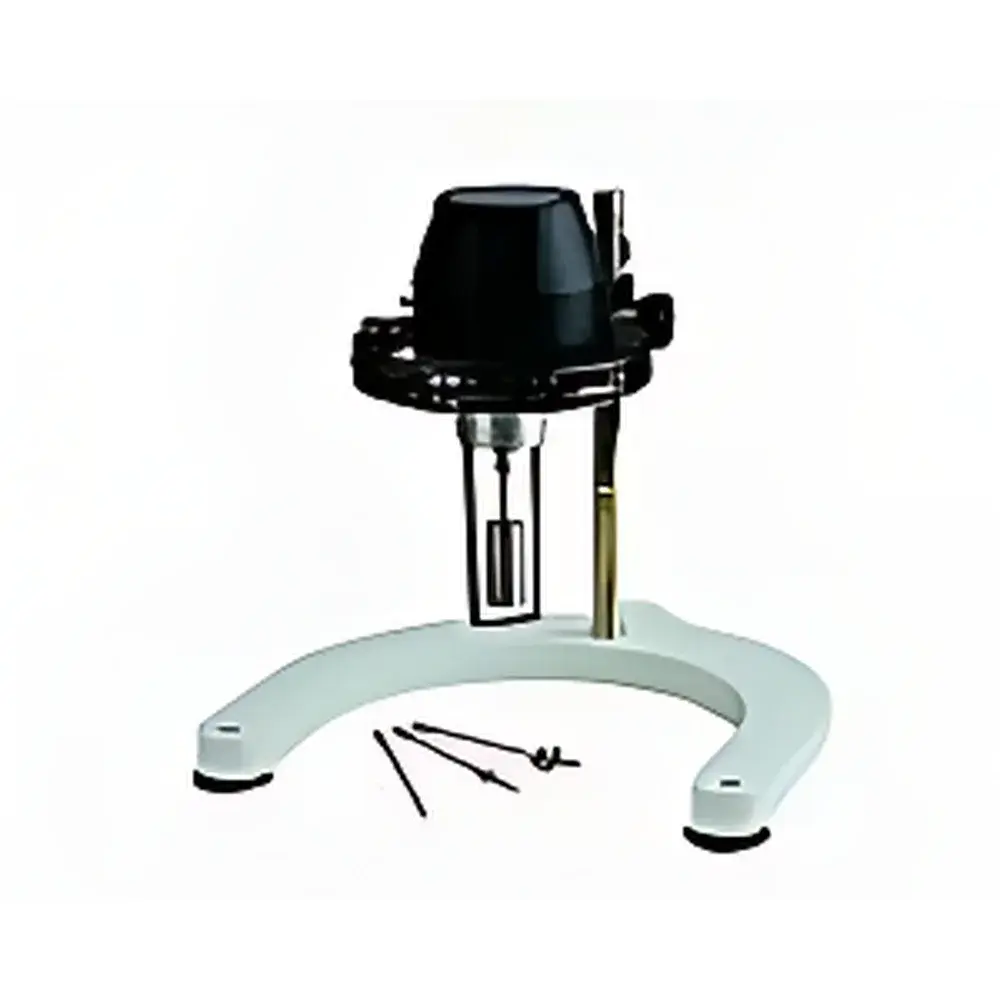
Truelab NDJ-4 High-Viscosity Analog Rotational Viscometer
| Brand | Truelab |
|---|---|
| Origin | Shanghai, China |
| Manufacturer Type | Authorized Distributor |
| Country of Origin | China |
| Model | NDJ-4 High-Viscosity |
| Instrument Category | Rotational Viscometer (Analog, Spindle-Based) |
| Form Factor | Benchtop (Non-Portable) |
| Operating Environment | Ambient Temperature (15–30 °C) |
| Viscosity Range | 10–2,000,000 mPa·s |
| Speed Settings | 0.3, 0.6, 1.5, 3, 6, 12, 30, 60 rpm |
| Spindles | No. 1–4 (standard) |
| Accuracy (Newtonian fluids) | ±5% full scale |
| Display | Analog dial with mechanical pointer |
| Dimensions | 275 × 265 × 445 mm |
| Weight | ~12.5 kg |
| Power Supply | AC 220 V ± 10%, 50 Hz |
Overview
The Truelab NDJ-4 High-Viscosity Analog Rotational Viscometer is a precision-engineered benchtop instrument designed for reliable measurement of dynamic viscosity in highly viscous Newtonian and near-Newtonian fluids. Based on the classical Couette principle—where torque required to rotate a spindle immersed in a sample at controlled angular velocity is proportional to fluid resistance—the NDJ-4 delivers stable, repeatable readings across an extended range from 10 to 2,000,000 mPa·s. Unlike capillary or falling-ball viscometers, this rotational system enables direct shear-rate-dependent characterization under steady-state conditions, making it suitable for quality control laboratories evaluating structural integrity, process consistency, and batch-to-batch uniformity in industrial formulations. Its robust mechanical architecture, calibrated analog readout, and standardized spindle geometry ensure long-term metrological stability without dependency on software calibration drift or firmware updates.
Key Features
- Eight discrete rotational speeds (0.3–60 rpm) provide flexible shear-rate selection for empirical flow profiling across diverse material classes.
- Dedicated high-torque drive mechanism optimized for viscous media—including polymer melts, heavy greases, mastics, and uncured resins—without stalling or slippage.
- Interchangeable spindles (No. 1–4, with optional No. 0) allow range extension and improved resolution in low-shear regimes typical of thixotropic or yield-stress materials.
- Mechanical analog display eliminates electronic noise susceptibility and ensures operational continuity during power fluctuations or electromagnetic interference common in manufacturing environments.
- Modular base design facilitates integration with optional accessories: thermostatic water baths (e.g., Truelab TC-200 series), cryogenic circulation units, and custom sample cups compliant with ASTM D1084 and ISO 2555.
- Compliance-ready construction supports traceable calibration using NIST-traceable standard oils (e.g., Cannon N47, N1000) and documented verification per ISO/IEC 17025 internal audit requirements.
Sample Compatibility & Compliance
The NDJ-4 accommodates samples with yield stress up to ~100 Pa and apparent viscosity exceeding 10⁶ mPa·s when used with appropriate spindle geometry and dwell time. It is routinely applied to edible oils, margarines, chocolate masses, pharmaceutical ointments (USP ), solvent-based coatings, epoxy pastes, and silicone gels. While not intrinsically temperature-controlled, the instrument is compatible with external temperature regulation systems meeting ASTM D445 and ISO 3104 specifications. All spindle geometries conform to DIN 53019-1 dimensional tolerances. Documentation includes factory calibration certificate, spindle identification chart, and compliance summary aligned with GLP documentation practices for regulated industries.
Software & Data Management
As an analog instrument, the NDJ-4 does not incorporate embedded digital interfaces or proprietary software. However, its consistent analog output allows seamless integration into laboratory data acquisition workflows via optional analog-to-digital converters (e.g., National Instruments USB-6009) and third-party platforms such as LabVIEW, MATLAB, or custom Python-based logging tools. Manual recording protocols support 21 CFR Part 11-compliant audit trails when paired with controlled logbooks and signature-verified calibration records. Truelab provides standardized test report templates compatible with LIMS environments requiring structured viscosity metadata (sample ID, spindle, speed, ambient temp, operator, date/time).
Applications
- Quality assurance of lubricating greases and gear oils per ASTM D1092 and ISO 6743-9.
- Batch release testing of topical pharmaceutical gels and creams under USP rheological criteria.
- Process validation of adhesive formulations during curing kinetics studies.
- Evaluation of thermal stability in food emulsions subjected to accelerated shelf-life testing.
- Raw material screening for polymer processing aids and filler dispersion homogeneity.
- Teaching laboratories demonstrating fundamental rheological concepts including shear thinning, hysteresis, and viscosity–temperature relationships.
FAQ
Is the NDJ-4 suitable for non-Newtonian fluid characterization?
Yes—when combined with multi-speed measurements and spindle selection, it supports qualitative assessment of shear-thinning behavior and apparent viscosity trends, though it does not compute flow curves or yield stress directly.
Can I use the NDJ-4 with temperature-controlled baths?
Yes—its mechanical design permits safe operation within externally regulated baths (±0.1 °C stability recommended) using standard immersion sleeves and depth gauges per ISO 2555 Annex B.
What calibration standards are recommended?
NIST-traceable silicone oil standards (e.g., Cannon N47, N1000, N10000) are advised for periodic verification; calibration intervals should follow risk-based assessment per ISO/IEC 17025 Clause 6.5.
Does the NDJ-4 meet FDA or EU regulatory requirements?
The instrument itself is not certified, but its use conforms to method requirements in FDA guidance documents (e.g., CDER’s “Guidance for Industry: Topical Dermatological Products”) and EU Pharmacopoeia monographs when operated within validated SOPs.
How is spindle selection determined for a given sample?
Selection follows the principle of achieving needle deflection between 20–90% of full scale; Truelab provides a detailed spindle selection matrix based on estimated viscosity and required sensitivity.



