
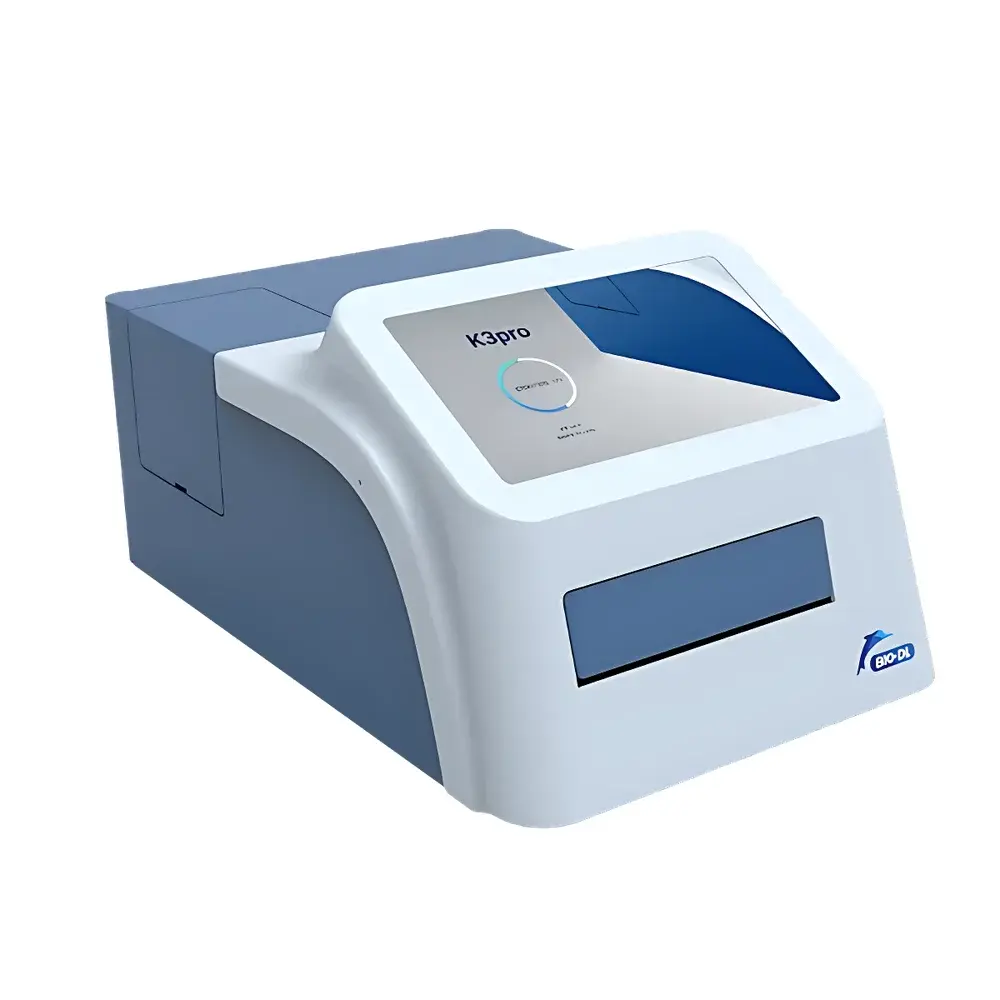
BIO-DL K3 Pro Microplate Reader
| Brand | BIO-DL |
|---|---|
| Origin | Shanghai, China |
| Model | K3 Pro Microplate Reader |
| Detection Wavelength Range | 330–900 nm |
| Filter Capacity | Up to 8 interchangeable optical filters |
| Read Time (96-well plate) | 8 s (step mode) |
| Incubation Temperature Range | Room temperature +4 °C to 55 °C |
| Shaking Speed | 3 adjustable levels |
| Absorbance Range | 0–6.0 OD |
| Display | 10-inch capacitive touchscreen |
| Detection Modes | Single-wavelength, dual-wavelength, kinetic, endpoint, multi-wavelength, dual-time point |
| Connectivity | USB, Ethernet, Wi-Fi |
| Software | BIO-DL Microplate Analysis Suite (v3.2+) |
Overview
The BIO-DL K3 Pro Microplate Reader is a high-performance absorbance-based microplate detection system engineered for precision, reproducibility, and operational flexibility in life science laboratories. Utilizing monochromatic or filter-based optical detection, the instrument measures light absorption across a broad spectral range (330–900 nm), enabling quantification of chromogenic, enzymatic, and cell-based assays—including ELISA, protein quantitation (e.g., Bradford, BCA), DNA/RNA analysis, cytotoxicity, and reporter gene expression. Its optical architecture incorporates a stable tungsten-halogen light source, precision interference filters, and a low-noise photodiode detector—designed to deliver consistent signal-to-noise ratios and high inter- and intra-assay repeatability (CV < 1.0% at 0.5 OD). The K3 Pro supports standard 96-well and 384-well microplates and is calibrated traceably to NIST-traceable standards, ensuring measurement integrity across routine QC, academic research, and regulated environments.
Key Features
- Ultra-fast read capability: Completes full 96-well plate reading in just 8 seconds using step-scan mode—optimized for high-throughput screening workflows without compromising data fidelity.
- Flexible optical configuration: Accommodates up to eight user-installable interference filters, allowing rapid reconfiguration for diverse assay chemistries (e.g., 450 nm for ELISA, 570 nm for MTT, 630 nm reference).
- Integrated environmental control: Built-in Peltier-based incubator maintains temperatures from ambient +4 °C to 55 °C with ±0.5 °C uniformity across the plate surface—critical for enzyme kinetics and cell-based assays requiring thermal stability.
- Programmable orbital shaking: Three speed settings (low/medium/high) with adjustable duration and pause intervals support homogeneous mixing prior to or during kinetic measurements.
- Wide dynamic absorbance range: Linear response from 0 to 6.0 OD enables accurate quantification across low-concentration biomarkers and highly saturated colorimetric endpoints without manual dilution or gain adjustment.
- Intuitive human-machine interface: 10-inch high-resolution capacitive touchscreen with gesture-enabled navigation and context-sensitive soft keys eliminates reliance on external peripherals during routine operation.
Sample Compatibility & Compliance
The K3 Pro is validated for use with standard flat-bottom, U-bottom, and V-bottom microplates (including black, white, and clear polystyrene variants) as well as specialized plates for luminescence-ready configurations (though absorbance-only operation is specified). It complies with IEC 61010-1:2010 for laboratory equipment safety and meets electromagnetic compatibility requirements per EN 61326-1:2013. While not certified for GMP manufacturing environments out-of-the-box, its audit-trail-capable software (with user-level access controls and electronic signature support) facilitates alignment with GLP and FDA 21 CFR Part 11 requirements when deployed with appropriate SOPs and validation protocols. The instrument supports ASTM E2518-21 (Standard Practice for Verification of Microplate Readers) and ISO 15197:2013 Annex D for analytical performance verification.
Software & Data Management
The bundled BIO-DL Microplate Analysis Suite (v3.2+) provides comprehensive data acquisition, real-time visualization, and post-acquisition processing—including curve fitting (4PL, 5PL, linear, log-log), background subtraction, well mapping, and plate layout customization. All raw absorbance values, metadata (user ID, timestamp, protocol name, filter set), and analysis parameters are stored in encrypted SQLite databases with automatic daily backup to network drives or cloud storage via configurable FTP/SFTP. Audit trails record every user action—including protocol edits, result exports, and calibration events—with immutable timestamps and operator identification. Export formats include CSV, Excel (.xlsx), PDF reports, and XML-compatible structured data for LIMS integration.
Applications
- Enzyme-linked immunosorbent assays (ELISA) across infectious disease serology, cytokine profiling, and autoantibody detection.
- Cell viability and proliferation assays (MTT, XTT, WST-1, resazurin) under controlled thermal and agitation conditions.
- Protein and nucleic acid quantification using colorimetric reagents (Bradford, Lowry, NanoDrop-compatible protocols).
- Kinetic monitoring of enzymatic reactions (e.g., β-galactosidase, alkaline phosphatase, horseradish peroxidase) with programmable interval acquisition.
- Quality control testing of biologics, vaccines, and diagnostic reagents in R&D and manufacturing support labs.
- Academic teaching labs where robustness, ease of training, and multi-user accessibility are essential.
FAQ
Does the K3 Pro support wavelength scanning or only fixed-filter detection?
The K3 Pro operates exclusively in filter-based detection mode. It does not incorporate a monochromator; instead, it relies on discrete optical filters for wavelength selection. Up to eight filters may be pre-installed and selected via software.
Is the incubator capable of cooling below ambient temperature?
No—the integrated incubator provides heating only, with a minimum setpoint of ambient temperature +4 °C. Active cooling is not supported.
Can the instrument be operated without connection to a computer?
Yes. All core functions—including protocol creation, plate reading, basic analysis, and report generation—are fully executable from the onboard touchscreen interface.
What regulatory documentation is provided for IQ/OQ/PQ validation?
A complete validation toolkit—including Installation Qualification (IQ) checklist, Operational Qualification (OQ) test scripts, and Performance Qualification (PQ) templates aligned with ASTM E2518—is supplied with each unit and accessible via the software’s “Validation Resources” module.
Are third-party software integrations supported?
The K3 Pro exposes a documented RESTful API and supports HL7 v2.x and ASTM E1384 message formats for bidirectional communication with LIMS and ELN systems. Custom drivers for LabVIEW and Python (via PySerial and HTTP clients) are available upon request.






