
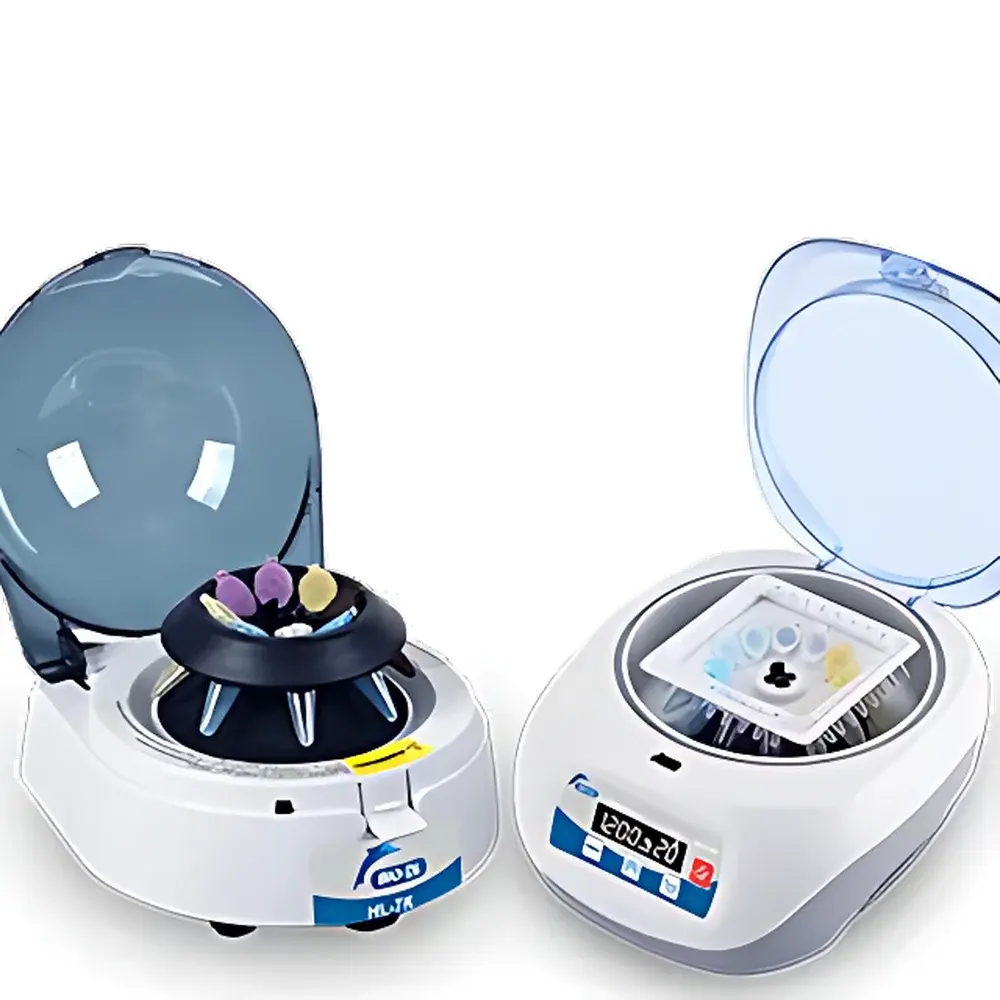
BIO-DL Mini Centrifuge
| Brand | BIO-DL |
|---|---|
| Origin | Shanghai, China |
| Model | Mini Centrifuge |
| Type | Benchtop Microcentrifuge |
| Application Scope | Microtube centrifugation, PCR tube handling, microhematocrit separation, microbial pelletization, low-volume sample processing |
| Drive System | Brushless DC motor |
| Rotor Type | Fixed-angle microcentrifuge rotor (24 × 1.5/2.0 mL tubes) |
| Max Speed | 6,000 rpm |
| Relative Centrifugal Force (RCF) | Up to 2,800 × g |
| Capacity | 24 × 1.5/2.0 mL microtubes |
| Acceleration/Deceleration Profile | Programmable soft-start and soft-stop control |
| Noise Level | ≤55 dB(A) |
| Dimensions (W × D × H) | 195 × 220 × 135 mm |
| Weight | 2.8 kg |
| Power Supply | 100–240 V AC, 50/60 Hz |
| Safety Certification | CE, ISO 13485 compliant design principles |
| Regulatory Compliance | Designed in accordance with IEC 61010-1 for laboratory equipment safety |
Overview
The BIO-DL Mini Centrifuge is a compact, brushless DC-driven benchtop microcentrifuge engineered for precision and reliability in low-volume sample processing workflows. It operates on the principle of radial acceleration to generate relative centrifugal force (RCF), enabling rapid sedimentation of particles—including cellular components, nucleic acids, and precipitated proteins—within standard 1.5 mL and 2.0 mL microcentrifuge tubes. Its fixed-angle rotor configuration ensures consistent pelleting geometry and minimizes sample resuspension during deceleration. Unlike conventional mini centrifuges relying on mechanical braking or abrupt power cutoff, this unit integrates programmable soft-start and soft-stop algorithms—reducing mechanical stress on rotor assemblies, minimizing tube wall adhesion (“walling”), and enhancing reproducibility across repeated runs. The device is optimized for applications requiring short-duration, high-frequency centrifugation cycles without thermal buildup or vibration-induced cross-contamination.
Key Features
- Brushless DC motor ensuring maintenance-free operation, extended service life, and silent performance (≤55 dB[A] at full speed)
- Soft-start and soft-stop control logic—unique among microcentrifuges in its class—to prevent sample splashing, tube deformation, and cap leakage
- Fixed-angle rotor accommodating up to 24 × 1.5/2.0 mL tubes simultaneously, with balanced load tolerance up to ±0.1 g per position
- Compact footprint (195 × 220 × 135 mm) and lightweight design (2.8 kg) for seamless integration into biosafety cabinets, PCR workstations, and mobile lab carts
- Intuitive single-knob interface with LED display showing real-time speed (rpm) and elapsed time; no software dependency for basic operation
- Automatic rotor identification and overspeed protection aligned with IEC 61010-1 functional safety requirements
Sample Compatibility & Compliance
The BIO-DL Mini Centrifuge supports polypropylene, polycarbonate, and polyethylene microcentrifuge tubes rated for ≥6,000 rpm use. It is routinely deployed in ISO/IEC 17025-accredited testing labs for sample preparation prior to HPLC, qPCR, ELISA, and flow cytometry. While not classified as a medical device under FDA 21 CFR Part 820, its construction adheres to ISO 13485-aligned quality management practices for laboratory instrumentation. The unit meets CE marking requirements for electromagnetic compatibility (EMC Directive 2014/30/EU) and low-voltage safety (LVD Directive 2014/35/EU). Its thermal profile remains stable across ambient temperatures from 10°C to 35°C, making it suitable for non-climate-controlled environments typical of field-deployed or teaching laboratories.
Software & Data Management
This model operates as a standalone instrument without embedded firmware-based data logging or network connectivity. All operational parameters are set manually via front-panel controls, eliminating cybersecurity exposure vectors and ensuring compliance with air-gapped lab environments governed by GLP or GMP Annex 11 requirements. For laboratories requiring audit trails, external documentation (e.g., paper logbooks or LIMS-integrated electronic records) is recommended to capture run timestamps, operator IDs, and tube configurations—consistent with ALCOA+ data integrity principles. No proprietary drivers or cloud services are required for routine use.
Applications
- Rapid pelleting of PCR reaction mixtures prior to thermal cycling to eliminate condensation and ensure uniform reagent distribution
- Microhematocrit separation of capillary blood samples in point-of-care diagnostics and veterinary field kits
- Concentration of bacterial or yeast cultures (OD600 normalization) before DNA extraction or protein lysis
- Clarification of lysates and supernatants in small-scale purification protocols (e.g., spin-column binding steps)
- Removal of residual ethanol or isopropanol following nucleic acid precipitation protocols
- Pre-centrifugation of adhesive-coated microplates to minimize edge effects in immunoassay development
FAQ
What tube sizes does the BIO-DL Mini Centrifuge support?
It accepts standard 1.5 mL and 2.0 mL conical-bottom microcentrifuge tubes with maximum height ≤46 mm.
Is rotor balancing required before each run?
Yes—symmetrical loading is mandatory. The rotor accepts 24 positions; minimum recommended load is 12 tubes placed in mirrored pairs.
Does the unit include a lid lock mechanism?
Yes, an interlocked safety lid prevents operation unless fully closed and engaged, complying with EN 61010-2-020 mechanical hazard provisions.
Can it be used inside a laminar flow hood?
Yes—its low heat dissipation (<2.5 W standby, <18 W peak) and absence of exhaust airflow make it compatible with Class II A2 and B2 biosafety cabinets.
What is the expected service interval for preventive maintenance?
No scheduled maintenance is required; however, biannual visual inspection of rotor threads, lid seal integrity, and motor ventilation grilles is advised per ISO/IEC 17025 clause 6.4.8.



