
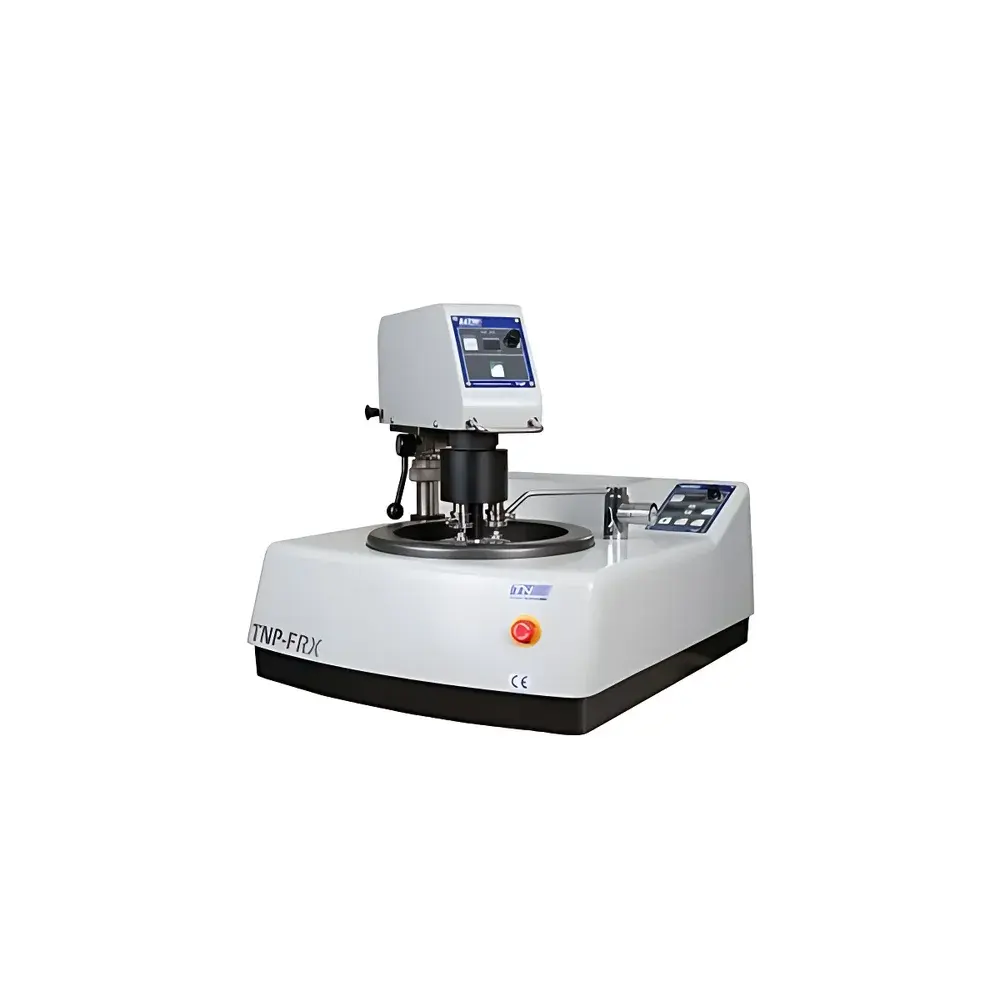
TN Testing TNP-1020FRX-A3 Single-Disc Automated Metallographic Grinder-Polisher
| Brand | TN Testing |
|---|---|
| Origin | Taiwan |
| Model | TNP-1020FRX-A3 |
| Dimensions (L×W×D) | 556 × 652 × 568 mm |
| Grinding/Polishing Disc Count | 1 |
| Disc Diameter | 200 mm |
| Disc Rotational Speed | 800 rpm |
| Enclosure Material | FRP (Fiberglass-Reinforced Polymer) |
| Water Delivery System | Stainless Steel–Ceramic Nozzle with Triangular Anti-Clogging Channel Design |
| Control Interface | Waterproof Membrane Keypad with 9-Step Programmable Presets (including disc speed, head speed, time, and coolant flow logic) |
| Base Construction | Precision-Cast Aluminum with Vibration-Damping Transmission Assembly |
| Optional Accessory | Removable Stain-Resistant Liner for Drain Spiral Groove |
Overview
The TN Testing TNP-1020FRX-A3 is a single-disc, fully automated metallographic grinder-polisher engineered for precision sample preparation in metallurgical laboratories, quality control facilities, and R&D centers. It operates on the principle of controlled mechanical abrasion and polishing—applying consistent pressure, rotational symmetry, and regulated coolant delivery to produce planar, scratch-free, and deformation-minimized cross-sections of metallic, ceramic, and composite specimens. Designed specifically for ASTM E3, ISO 14577, and EN 10360-compliant metallographic workflows, the TNP-1020FRX-A3 integrates structural rigidity, thermal stability, and ergonomic operability into a compact footprint. Its cast-aluminum base eliminates resonance-induced surface waviness common in cast-iron alternatives, while its optimized mass distribution and vibration-damping transmission system ensure sub-micron flatness reproducibility across extended grinding cycles.
Key Features
- Single 200 mm diameter grinding/polishing disc with precise 0–800 rpm variable-speed control, enabling optimal material removal rates for soft alloys (e.g., aluminum, copper) and hard-phase composites (e.g., WC-Co, TiAl).
- Quick-change disc interface: Integrated magnetic adapter plate allows tool-less attachment of diamond-impregnated, silicon carbide, or cloth-based consumables—reducing setup time and cross-contamination risk.
- Triangular anti-clogging water channel architecture: Minimizes sediment accumulation by shortening hydraulic path length, optimizing nozzle angle (±15° adjustable), and utilizing corrosion-resistant ceramic-stainless hybrid nozzles—validated under continuous 8-hour operation with 3 µm alumina slurry.
- Waterproof membrane control panel with nine programmable presets: Stores independent parameter sets—including disc RPM, optional head rotation (if equipped), cycle duration, coolant activation timing, and dwell intervals—supporting repeatable SOP execution per material class (e.g., ASTM E407 for ferrous alloys; ISO 643 for microstructure rating).
- FRP-reinforced enclosure: Chemically inert, non-porous surface resists acid etchant splashes, abrasive slurry adhesion, and UV degradation—facilitating wipe-down maintenance without solvent exposure.
- Modular removable liner (optional): Precision-machined to match the spiral drain groove geometry; features low-surface-energy finish for effortless debris release and autoclave-compatible cleaning protocols.
Sample Compatibility & Compliance
The TNP-1020FRX-A3 accommodates standard metallographic mounts (25–40 mm diameter) and unmounted specimens up to 100 mm × 100 mm × 50 mm (L×W×H). It supports all major consumable formats—including bonded diamond discs (75–200 mm), lapping films (12–200 mm), and woven/non-woven polishing cloths—with uniform pressure distribution maintained via self-centering platen geometry. The system complies with IEC 61000-6-2 (EMC immunity) and IEC 61000-6-4 (EMC emission) standards. Its programmable logic controller (PLC) architecture enables audit-ready operation logs when integrated with laboratory information management systems (LIMS), satisfying GLP documentation requirements per OECD Principles of Good Laboratory Practice and FDA 21 CFR Part 11 data integrity provisions for electronic records.
Software & Data Management
While the TNP-1020FRX-A3 operates via embedded firmware without external PC dependency, its 9-step memory bank functions as a deterministic process recorder: each preset stores timestamped parameter configurations accessible via front-panel navigation. Optional RS-485 serial interface permits integration with centralized lab automation platforms for remote parameter loading, cycle logging, and preventive maintenance scheduling. All operational events—including start/stop timestamps, emergency stop triggers, and coolant flow fault codes—are retained in non-volatile memory for ≥12 months, supporting root-cause analysis during internal QA audits or third-party accreditation reviews (e.g., ISO/IEC 17025).
Applications
- Preparation of failure analysis specimens for SEM/EDS cross-sectional imaging.
- Routine QC grinding of weld joints, heat-affected zones (HAZ), and additive-manufactured metal parts per AWS D1.1 and ASME BPVC Section IX.
- High-throughput polishing of sintered carbides prior to Rockwell A-scale hardness testing (ASTM E18).
- Surface planarization of brazed or diffusion-bonded interfaces for interfacial void quantification (ISO 13919-1).
- Standardized specimen conditioning for microhardness mapping (ASTM E384) and grain size evaluation (ASTM E112).
FAQ
Does the TNP-1020FRX-A3 support dual-speed control for both disc and specimen holder?
No—the base model features fixed-axis single-speed disc rotation. Optional motorized head units with independent 0–100 rpm rotation are available under separate configuration codes (e.g., TNP-1020FRX-A3-HR).
Is the triangular water channel design compatible with glycerol-based lubricants?
Yes—channel geometry and ceramic-nozzle wetted surfaces have been validated with viscosity ranges from 1.0 to 15.0 cSt, including aqueous slurries, oil-based lubricants, and glycerol-water mixtures (up to 30% v/v).
Can the 9 memory presets be exported or backed up externally?
Not natively—parameter sets are stored in onboard flash memory only. Export functionality requires integration with TN Testing’s optional TNSync™ LabLink module (sold separately), which provides USB-C and Ethernet connectivity for CSV log export and firmware updates.
What is the maximum recommended continuous duty cycle per session?
For optimal thermal stability and bearing longevity, continuous operation is rated at ≤6 hours per session, followed by a minimum 30-minute cooldown interval. Duty cycle validation was performed per ISO 20685-2:2021 Annex C for industrial-grade grinding equipment.



