
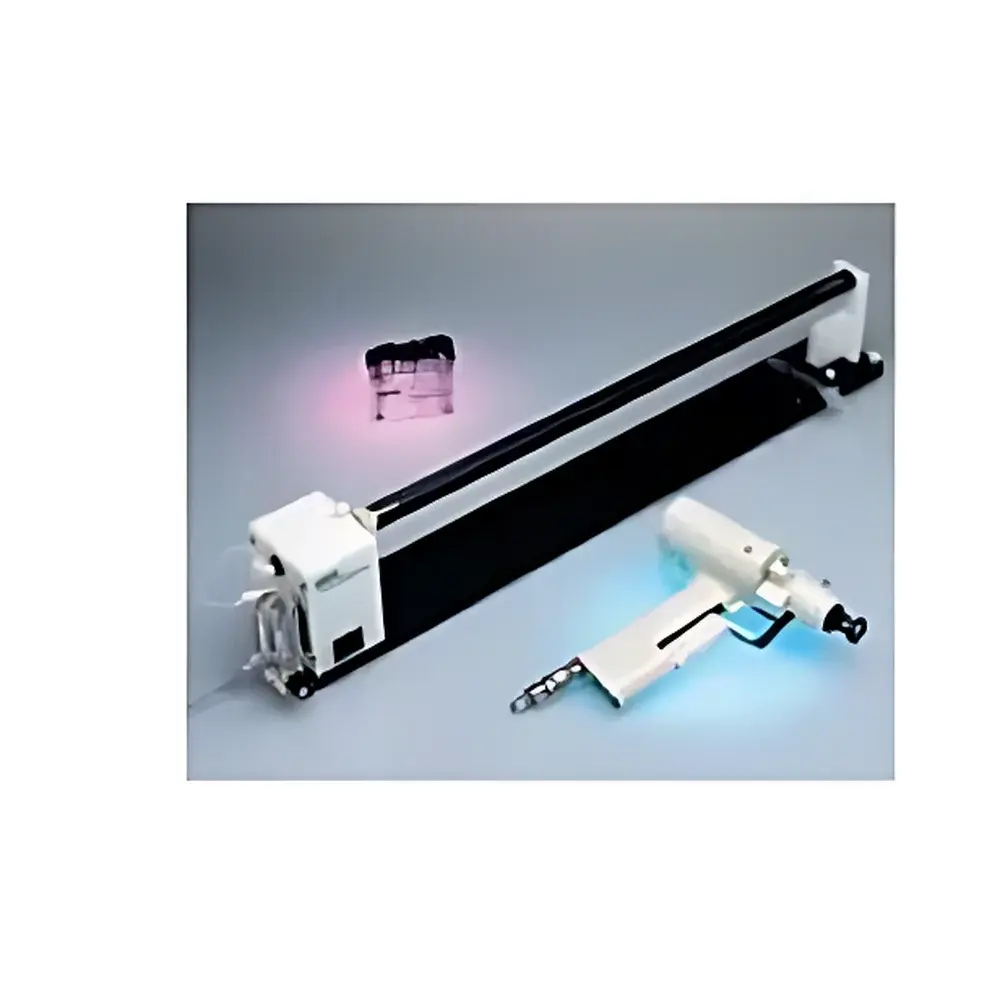
Bio-Rad Helios Gene Gun
| Brand | Bio-Rad |
|---|---|
| Model | Helios |
| Origin | USA |
| Type | Handheld Particle-Mediated Gene Delivery System |
| Operating Pressure Range | 100–600 psi |
| Safety Relief Valve Setpoint | 700 ± 35 psi |
| Max. Helium Pressure Adjustment | 800 psi |
| Power Supply | 9 V Alkaline Battery (rechargeable optional) |
| Battery Life | ≥1,000 discharges |
| Max. Discharge Current | 10 mA (gun unit) |
| Input Voltage | 100–120 V or 220–240 V AC, 50/60 Hz |
| Cartridge Spinning Speed | 30 rpm |
| Gold Particle Diameters | 0.6, 1.0, and 1.6 µm |
| PVP Coating Mass | 0.5 g per kit |
| Desiccant | Spherical drying agent (5 units) |
| Cartridge Capacity | 12 firings per chamber |
| Kit Contents | 1,000 pre-loaded cartridges, 50 ft (~26 m) gold-coated tubing, 5 gene storage vials |
Overview
The Bio-Rad Helios Gene Gun is a portable, helium-driven particle delivery system engineered for direct intracellular delivery of nucleic acids (DNA, RNA), proteins, or other macromolecules into living cells—both in vitro and in vivo. Unlike electroporation or viral transduction, the Helios system employs physical acceleration: microscopic gold or tungsten particles (0.6–1.6 µm diameter), coated with biomolecules via polyvinylpyrrolidone (PVP)-mediated precipitation, are propelled at supersonic velocity using precisely regulated helium gas pulses (100–600 psi). This ballistic transfection method bypasses endosomal entrapment and membrane fusion constraints, enabling high-efficiency delivery into hard-to-transfect primary cells, plant tissues, skin, muscle, and even intact organs in live animal models. The system operates on a modular architecture—comprising a hand-held firing unit, a cartridge preparation station, and standardized consumables—designed for reproducible, operator-independent delivery under standard laboratory environmental conditions (10–32°C, 30–80% RH).
Key Features
- Handheld, battery-powered design (9 V alkaline, ≥1,000 firings per charge) ensures mobility and operation in field or surgical settings without AC dependency.
- Adjustable helium pressure control (100–600 psi) enables optimization across diverse tissue types—from epidermal layers to deep parenchymal structures—while integrated safety relief valves (700 ± 35 psi) prevent over-pressurization.
- Dual-mode cartridge preparation station supports consistent coating and drying: centrifugal spinning at 30 rpm ensures uniform particle distribution; desiccant chambers maintain low-humidity conditions critical for PVP-mediated DNA adhesion stability.
- Modular consumables—including pre-calibrated gold microparticles (0.6, 1.0, 1.6 µm), sterile polyethylene tubing (50 ft), and gene storage vials—support GLP-compliant batch traceability and minimize inter-experiment variability.
- No high-voltage electronics in the firing head: elimination of electrical arcing risk makes the Helios suitable for use near sensitive instrumentation or in non-shielded environments.
Sample Compatibility & Compliance
The Helios Gene Gun is validated for use with mammalian cell lines (e.g., CHO, HEK293), primary neurons, keratinocytes, dendritic cells, and plant protoplasts. It has been cited in peer-reviewed studies involving murine skin immunization, rat brain transfection, and Arabidopsis thaliana leaf bombardment. All hardware components comply with IEC 61010-1 (Safety Requirements for Electrical Equipment for Measurement, Control, and Laboratory Use) and CE marking standards. The system’s mechanical pressure regulation and absence of ionizing radiation or biohazardous reagents render it exempt from NIH Guidelines Appendix B restrictions for physical transfection methods. Documentation packages support audit readiness for FDA 21 CFR Part 11–aligned workflows when paired with electronic lab notebooks (ELNs) logging cartridge lot numbers, pressure settings, and firing timestamps.
Software & Data Management
The Helios Gene Gun operates as a standalone instrument with no embedded firmware or proprietary software interface. Experimental parameters—including helium pressure (psi), cartridge batch ID, particle size, and target tissue depth—are manually recorded in laboratory notebooks or integrated into LIMS platforms via structured CSV templates. Bio-Rad provides comprehensive SOP documentation (Rev. 4.2, 2023) covering calibration verification (pressure gauge validation against NIST-traceable manometers), cartridge sterility assurance (ISO 11137–validated gamma irradiation for consumables), and maintenance logs for valve cycling performance. Optional digital pressure gauges (NIST-certified, ±0.5% full-scale accuracy) may be interfaced externally for automated data capture in GxP-regulated environments.
Applications
- Vaccine development: Delivery of plasmid-encoded antigens into epidermal Langerhans cells for DNA vaccination studies in preclinical models.
- Neuroscience research: Targeted transfection of cortical or hippocampal neurons in situ, avoiding dissociation-induced stress artifacts common in lipofection protocols.
- Plant biotechnology: Stable transformation of meristematic tissues without callus induction, accelerating trait validation in crop species.
- Cancer immunotherapy: Intratumoral delivery of CRISPR-Cas9 ribonucleoprotein complexes for localized gene editing in syngeneic mouse tumor models.
- Tissue engineering: Spatially controlled co-delivery of morphogens and transcription factors into 3D scaffold-based organoids.
FAQ
What biosafety level (BSL) is required to operate the Helios Gene Gun?
No specific BSL designation is mandated, as the system delivers non-replicating nucleic acids via inert carriers. However, BSL-2 practices are recommended when handling infectious agents or oncogenes per institutional biosafety committee guidelines.
Can tungsten particles be substituted for gold in the Helios system?
Yes—tungsten microparticles (same size ranges) are compatible but require re-optimization of helium pressure and PVP concentration due to higher density and altered surface chemistry.
Is helium gas supply included with the system?
No. Users must procure industrial-grade helium (≥99.995% purity) with a regulator capable of fine pressure control (0.1 psi resolution) and connection to CGA-580 fittings.
How is cartridge sterility maintained during preparation?
Gold-coated tubing and vials are supplied gamma-irradiated (25 kGy). The preparation station includes UV-sterilizable surfaces and optional laminar flow hood integration for aseptic handling.
Does the Helios system support quantitative delivery calibration?
Yes—Bio-Rad provides fluorescently labeled oligonucleotide reference standards and protocol Annex A for quantifying intracellular delivery efficiency via flow cytometry or qPCR normalization to spiked-in controls.




