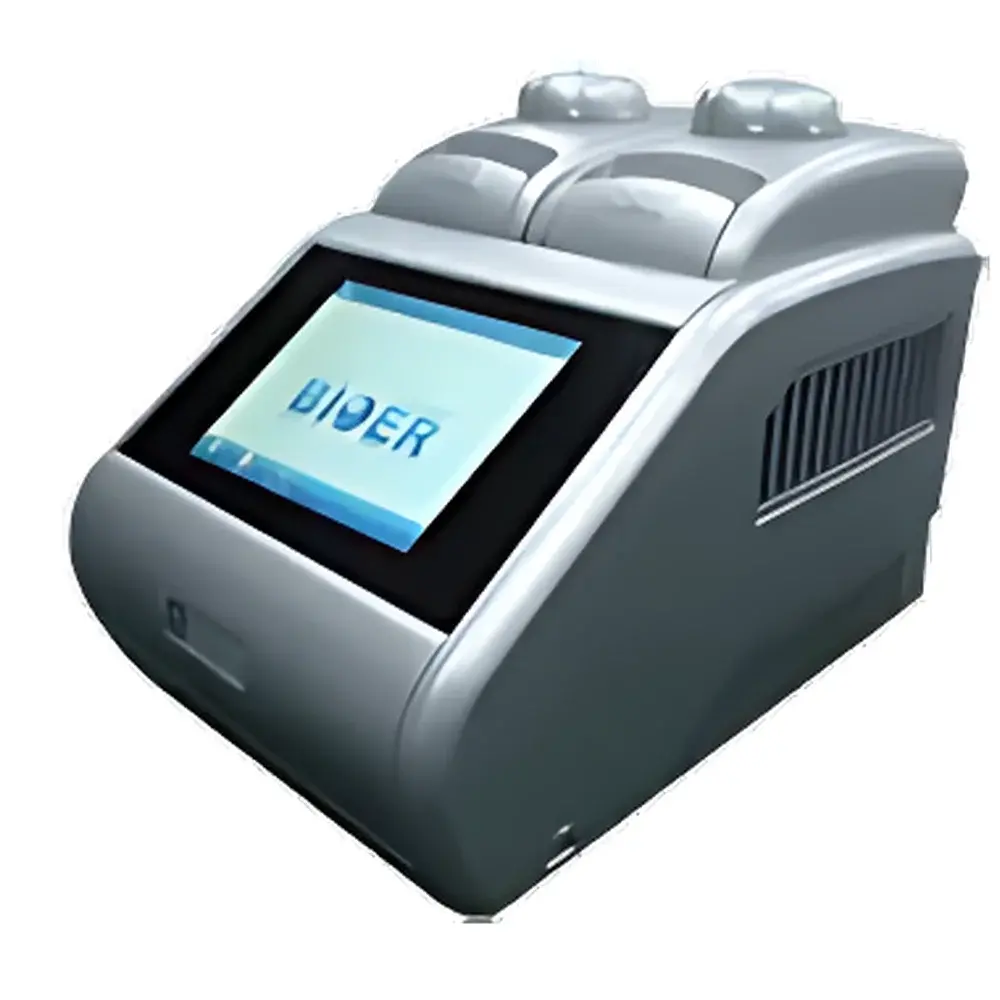
Bioer TC-EA GeneTouch Gradient PCR System
| Brand | Bioer |
|---|---|
| Origin | Zhejiang, China |
| Manufacturer Type | Authorized Distributor |
| Country of Origin | China |
| Model | TC-EA |
| Instrument Type | Gradient Thermal Cycler |
| Sample Capacity | 96-well, 384-well, 48-well (dual-format), 4-slide in situ hybridization module |
| Heating Rate | ≥4 °C/s |
| Temperature Accuracy | ≤±0.1 °C at 55 °C |
| Well-to-Well Temperature Uniformity | ≤±0.2 °C |
| Gradient Range | 1–30 °C across 12 or 24 columns |
| Temperature Range | 4–105 °C |
| Dimensions (L×W×H) | 368 × 250 × 285 mm |
| Net Weight | 10.5 kg |
Overview
The Bioer TC-EA GeneTouch Gradient PCR System is a modular, high-precision thermal cycler engineered for reproducible nucleic acid amplification across diverse molecular biology workflows. Based on Peltier-driven solid-state thermoregulation and optimized heat-sink architecture, the system delivers rapid thermal ramping (≥4 °C/s) and exceptional spatial and temporal temperature control—critical for demanding protocols including touchdown PCR, nested PCR, long-range PCR, and multiplex amplification. Its modular design centers on a single universal host platform (TC-EA) that accommodates five interchangeable reaction modules—B-96GA (96-well gradient), B-384GA (384-well gradient), B-48DA (dual-format 48×2-well), B-4IA (4-slide in situ hybridization), and B-3048UA (hybrid 48×0.2 mL + 30×0.5 mL)—enabling seamless transition between standard, high-throughput, dual-volume, and tissue-based applications without hardware reconfiguration.
Key Features
- Modular Flexibility: Five field-replaceable modules install and lock in under 60 seconds—no tools, no calibration reset—ensuring full traceability and operational continuity across assay types.
- Precision Thermal Control: Achieves ≤±0.1 °C accuracy at 55 °C and ≤±0.2 °C above 90 °C, with ≤±0.2 °C well-to-well uniformity across full plate formats—meeting ISO/IEC 17025 requirements for accredited testing laboratories.
- Intelligent Gradient Functionality: Supports programmable 12-column (96-well) or 24-column (384-well) linear gradients with adjustable span (1–30 °C), enabling empirical optimization of annealing temperatures in a single run.
- Human-Centered Interface: 6.5-inch capacitive color touchscreen with intuitive icon-driven UI; supports multi-language display and contextual help overlays aligned with CLSI EP23-A guidelines for instrument usability validation.
- Remote Operational Oversight: Native Android/iOS application enables real-time monitoring of cycling status, temperature profiles, and alarm logs—fully compatible with institutional IT security policies and TLS 1.2 encrypted data transmission.
Sample Compatibility & Compliance
The TC-EA accommodates standardized consumables per ANSI/SBS specifications: 96-well plates (ANSI SLAS-1-2016), 384-well plates (ANSI SLAS-4-2016), and certified in situ hybridization slides (ISO 15189 Annex B). All modules maintain consistent thermal coupling to ensure cross-platform result comparability—validated per ASTM E2581-22 for thermal cycler performance verification. The system meets CE IVD (Class B), RoHS 3, and FCC Part 15 Subpart B compliance. For regulated environments, audit trail functionality—including user login, protocol modification timestamps, and cycle parameter history—is configurable to align with FDA 21 CFR Part 11 and EU Annex 11 requirements when paired with Bioer’s optional LIMS integration package.
Software & Data Management
The embedded firmware supports protocol creation, editing, and version-controlled storage (up to 1,000 programs). Export formats include CSV (cycle-by-cycle temperature/time), PDF (summary report with signature field), and XML (for interoperability with LabVantage, STARLIMS, and Thermo Fisher SampleManager). All data files are digitally signed using SHA-256 hashing to prevent tampering. Optional Bioer CloudLink software provides centralized fleet management, remote firmware updates, and automated backup to network-attached storage (NAS) or validated cloud repositories compliant with HIPAA and GDPR data residency rules.
Applications
The TC-EA serves as a primary amplification platform in clinical diagnostics labs performing infectious disease screening (e.g., SARS-CoV-2, HPV, HBV), oncology biomarker detection (BRAF, EGFR, KRAS), and pharmacogenomic profiling (CYP2C19, VKORC1). In academic and biotech settings, it supports CRISPR gRNA validation, cDNA library preparation, qPCR pre-amplification, and NGS target enrichment. The B-4IA in situ module facilitates spatial transcriptomics workflows requiring precise thermal control over fixed tissue sections—validated for compatibility with RNAscope™ and BaseScope™ probe hybridization chemistries.
FAQ
Is the TC-EA compatible with third-party PCR plates and tubes?
Yes—mechanical and thermal interfaces comply with ANSI SLAS standards; however, optimal uniformity is guaranteed only with Bioer-certified consumables (catalog numbers B-PLT-96G, B-PLT-384G, and B-TUBE-02).
Does the system support ramp rate customization per segment?
No—the TC-EA uses fixed ramp rates optimized per module design to ensure thermal stability and reproducibility; this reflects IEC 61000-4-30-compliant engineering for electromagnetic compatibility in shared lab environments.
Can gradient profiles be saved and recalled independently of main protocols?
Yes—gradient parameters (start temp, span, column assignment) are stored as integral attributes within each protocol file, enabling reuse across different modules without recalibration.
What validation documentation is provided with shipment?
Each unit ships with a Factory Calibration Certificate (traceable to NIM China), IQ/OQ test scripts, and a completed Installation Qualification checklist signed by Bioer Field Service Engineers.
Is USB export of raw thermal data supported?
Yes—USB 2.0 port enables direct download of time-stamped .CSV log files containing every 0.5-second temperature reading from all sensor zones during active cycling.