
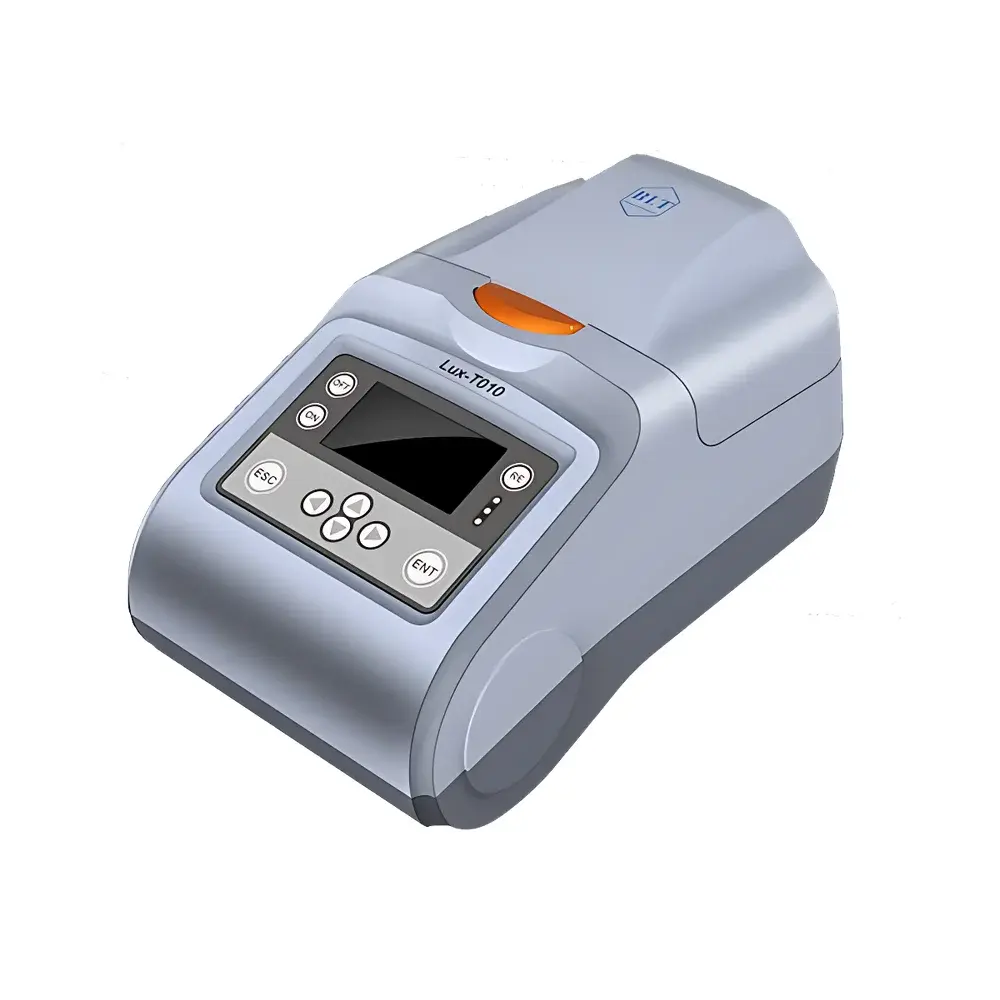
BioLight Lux-T010 Portable Water Toxicity Analyzer
| Brand | BioLight |
|---|---|
| Model | Lux-T010 |
| Origin | Guangdong, China |
| Instrument Type | Portable/HANDHELD Water Toxicity Analyzer |
| Detection Principle | Bioluminescent Bacterial Assay (Aliivibrio fischeri) |
| Detection Time | ≤ 60 s per sample |
| Power Supply | Rechargeable Li-ion battery |
| Sample Types | Drinking water, surface water, seawater, wastewater effluent/influent, industrial process water, sediment extracts |
| Target Analytes | Heavy metals (Hg, Cd, Cr, Pb, Cu, Ni), organophosphates, organonitrogen compounds, pyrethroids, polychlorinated dibenzo-p-dioxins (PCDDs), cyanide, dioxins, persistent organic pollutants (POPs), botulinum toxin, chloroform, surfactants, biocides, antibiotics |
| Compliance | Aligned with ISO 11348-3 (Water quality — Determination of the inhibitory effect of water samples on the light emission of Vibrio fischeri — Part 3: Method using freeze-dried bacteria) |
| Software Interface | On-device LCD display with data logging (up to 1,000 results) |
Overview
The BioLight Lux-T010 Portable Water Toxicity Analyzer is an engineered field-deployable instrument designed for rapid, on-site assessment of acute aquatic toxicity using standardized bioluminescent bacterial biosensing. It employs a validated freeze-dried strain of Aliivibrio fischeri (formerly Vibrio fischeri)—a marine luminous bacterium whose metabolic activity and light output are quantifiably suppressed in the presence of bioactive toxicants. This principle aligns with internationally recognized ecotoxicological endpoints defined in ISO 11348-3 and ASTM D5660, enabling direct correlation with regulatory screening thresholds for environmental hazard classification. Unlike physicochemical methods that target individual contaminants, the Lux-T010 measures integrated biological response—capturing synergistic, antagonistic, or unknown toxic effects across broad chemical classes. Its design prioritizes operational robustness under variable ambient conditions, making it suitable for emergency response, routine surveillance, and compliance verification in resource-constrained or mobile laboratory settings.
Key Features
- Field-ready architecture: Integrated rechargeable lithium-ion battery supports ≥8 hours of continuous operation; IP65-rated enclosure ensures dust/water resistance during outdoor deployment.
- Standardized bioluminescence assay: Pre-calibrated lyophilized A. fischeri reagent vials eliminate cold-chain dependency and reduce operator variability—each batch certified per ISO 11348-3 viability specifications.
- Real-time kinetic measurement: Photomultiplier tube (PMT)-based optical detection system captures luminescence decay profiles over 5–30 minutes (user-selectable), enabling EC50 estimation and dose-response modeling beyond binary pass/fail output.
- Minimal consumables footprint: Includes pre-sterilized test tubes, calibrated pipette tips, and optimized assay buffer—no external centrifugation, filtration, or pH adjustment required for most freshwater and brackish matrices.
- On-device data integrity: Internal memory stores up to 1,000 test records with timestamp, sample ID, temperature, and inhibition percentage; audit trail compliant with GLP documentation requirements.
Sample Compatibility & Compliance
The Lux-T010 accepts raw or minimally processed aqueous samples—including drinking water, municipal wastewater influent/effluent, industrial cooling water, estuarine and coastal seawater, and leachates from sediments or soils (following standard ISO 10392 solid-phase extraction protocols). Turbidity and color interference are mitigated via built-in background subtraction algorithms. For high-salinity or highly colored matrices, dilution series functionality enables automatic IC50 calculation. The system’s biological endpoint conforms to OECD Test Guideline 201 and EU Regulation (EC) No 440/2008 for acute toxicity screening. While not a replacement for confirmatory chemical analysis (e.g., ICP-MS, GC-MS), its results serve as Tier 1 triage data for regulatory reporting under national water quality frameworks aligned with WHO Guidelines for Drinking-water Quality and the EU Water Framework Directive.
Software & Data Management
Data acquisition and reporting are managed through an embedded firmware interface with intuitive icon-driven navigation. All measurements include metadata capture (operator ID, GPS coordinates optional via Bluetooth pairing, ambient temperature/humidity). Exported datasets comply with FAIR principles (Findable, Accessible, Interoperable, Reusable) via USB 2.0 port—generating timestamped CSV files compatible with LIMS integration and statistical packages (R, Python pandas). Audit logs record all calibration events, reagent lot numbers, and parameter modifications, satisfying traceability requirements under ISO/IEC 17025 and FDA 21 CFR Part 11 for electronic records in regulated environments.
Applications
- Emergency response: Rapid screening at chemical spill sites, illegal discharge investigations, and post-disaster water safety assessments.
- Wastewater treatment optimization: Monitoring toxicity shifts across treatment stages to diagnose bioreactor inhibition or disinfection byproduct formation.
- Pharmaceutical manufacturing: In-process verification of antibiotic residual removal in purified water systems per USP and .
- Food & beverage industry: Validation of rinse water biocompatibility and cleaning-in-place (CIP) efficacy.
- Academic research: High-throughput ecotoxicity profiling in environmental chemistry, nanomaterial safety assessment, and mixture toxicity studies.
FAQ
What biological endpoint does the Lux-T010 measure?
It quantifies the inhibition of bioluminescence in Aliivibrio fischeri after 15–30 minutes of exposure, expressed as percentage reduction relative to non-toxic control.
Can the Lux-T010 distinguish between specific toxicants?
No—it provides a functional, non-targeted toxicity index. Identification of causative agents requires complementary instrumental analysis (e.g., LC-HRMS, ICP-OES).
Is calibration required before each use?
A single daily performance check using certified reference toxicant (e.g., 3,5-dichlorophenol) is recommended; full recalibration is performed annually or after sensor replacement.
How are sediment or soil samples analyzed?
Solid samples must first undergo aqueous extraction per ISO 10392; the resulting eluate is then tested directly without further pretreatment.
Does the instrument meet international regulatory acceptance criteria?
Yes—its methodology is referenced in ISO 11348-3, DIN 38412-L34, and EPA Method 100.1, supporting use in compliance monitoring programs across North America, EU, and APAC jurisdictions.
Related Products







