
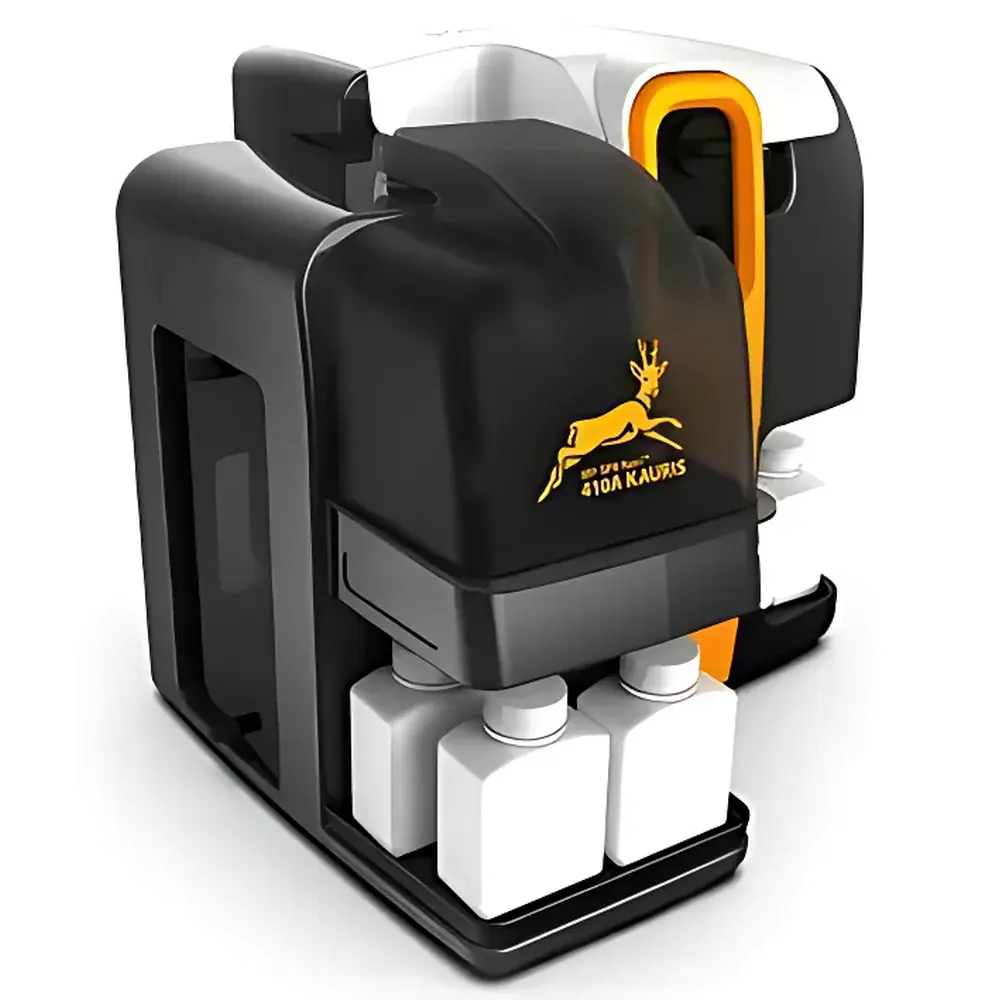
Bionavis MP-SPR Navi 410A KAURIS Multi-Parameter Surface Plasmon Resonance Analyzer
| Brand | Bionavis |
|---|---|
| Origin | Finland |
| Model | MP-SPR Navi 410A KAURIS |
| Sample Volume | 250 µL |
| Injection Volume | 50 µL |
| Analysis Time | 5–10 min |
| Temperature Control Range | 15–45 °C (ambient ±7 °C / +20 °C) |
| Angular Measurement Range | 40–78° |
| Angular Resolution | 0.001° |
| Flow Rate | 1–1000 µL/min |
| Laser Wavelengths | 670 nm (standard), optional dual-wavelength (670 nm + 785 nm) |
| Refractive Index Range (bulk) | 1.00–1.40 (expandable with multi-wavelength) |
| Thickness Measurement Range | Å to µm (material-dependent) |
| Kinetic Constants | kₐ = 10³–10⁸ M⁻¹s⁻¹, kₑ = 10⁻⁷–0.1 s⁻¹, K<sub>D</sub> = 10⁻³–10⁻¹² M |
| Sensitivity | 1 µRIU |
| minimum detectable mass | <100 Da (liquid phase), 2 Da (gas phase) |
| Short-term Noise | 0.3 µRIU |
| Baseline Drift | <1 µRIU/min |
| Detection Channels | 4 independent flow channels |
| Auto-sampler Capacity | 7 samples |
| Software | MP-SPR Navi™ Control & Data Viewer, TraceDrawer™, LayerSolver™ (optional) |
Overview
The Bionavis MP-SPR Navi 410A KAURIS is a high-precision, label-free multi-parameter surface plasmon resonance (MP-SPR) analyzer engineered for real-time, quantitative characterization of molecular interactions and thin-film properties at solid–liquid and solid–gas interfaces. Unlike conventional single-angle or single-wavelength SPR systems, MP-SPR operates on a true angular interrogation principle—employing a rotating laser and high-resolution detector to capture full SPR curves across a broad angular range (40°–78°) with 0.001° resolution. This enables simultaneous extraction of multiple optical parameters—including resonance angle, full-width-at-half-maximum (FWHM), intensity, and spectral shape—thereby decoupling refractive index (RI) changes from thickness variations in complex layered architectures. The instrument supports both kinetic and equilibrium binding analysis, layer thickness profiling, and real-time monitoring of adsorption/desorption, swelling, conformational change, and electrochemical processes—all without labeling, amplification, or immobilization artifacts. Its robust fluidic architecture, solvent-compatible flow cells, and temperature-stabilized measurement chamber (15–45 °C) ensure reproducible operation in biologically relevant matrices including undiluted serum, saliva, DMSO, ethanol, and acetonitrile.
Key Features
- Four independent, user-configurable flow channels—operable in parallel or serial mode—for comparative or sequential assays
- Integrated 7-position autosampler enabling unattended, overnight runs with minimal manual intervention
- Dual-wavelength capability (670 nm + 785 nm, L-option) for simultaneous determination of layer thickness and bulk RI—critical for anisotropic or gradient-index films
- KineticTitration™ mode: performs full affinity titrations in a single injection cycle, eliminating the need for regeneration—ideal for fragile ligands or irreversible binding systems
- Ultra-low sample consumption: 50 µL minimum injection volume; partial-loop injection reduces usage to ≤100 µL per assay
- High-dynamic-range fluidics: programmable flow rates from 1 to 1000 µL/min with integrated degassing and precision syringe pumps
- Modular sensor platform: interchangeable prism-coupled chips with no requirement for index-matching oil—enabling rapid sensor exchange and post-experiment ex situ analysis (e.g., SEM, XPS)
- Standard 4-channel PDMS flow cell (1 µL/channel); optional electrochemical (SPR321-EC) and custom-designed cells for specialized applications
Sample Compatibility & Compliance
The MP-SPR Navi 410A KAURIS is validated for use with diverse sample types spanning life science, materials science, and electrochemistry domains. It accommodates high-RI solvents (e.g., toluene, glycerol), viscous biological fluids (100% human serum, whole blood lysates, mucosal secretions), and aggressive organic media without signal degradation or system clogging. Sensor surfaces include bare and functionalized gold, silver, platinum, silicon dioxide, titanium dioxide, aluminum oxide, carboxymethyl dextran (CMD), Ni²⁺-NTA, Protein A/G, streptavidin, and regenerated avidin—supporting oriented immobilization of antibodies, peptides, nucleic acids, vesicles, and whole cells. All hardware and software comply with GLP and GMP-aligned workflows: audit trails, electronic signatures, and data integrity features are embedded in MP-SPR Navi™ Control software. While not FDA 21 CFR Part 11–certified out-of-the-box, the system supports configuration for regulated environments via user-defined SOPs, version-controlled method files, and export-ready traceable reports compliant with ISO/IEC 17025 and ASTM E2500 standards.
Software & Data Management
MP-SPR Navi™ Control and Data Viewer software provides full instrument control, real-time visualization, and raw-data export in vendor-neutral formats (CSV, HDF5). Kinetic analysis is performed using TraceDrawer™—a dedicated tool supporting global fitting of 1:1, bivalent analyte, heterogeneous ligand, and mass-transport-limited models. LayerSolver™ (optional) enables rigorous optical modeling of multilayer structures using Fresnel formalism, yielding thickness, RI, and roughness parameters with quantifiable uncertainty. All data files include embedded metadata (timestamp, temperature, flow rate, sensor ID, user annotation), ensuring FAIR (Findable, Accessible, Interoperable, Reusable) compliance. Export options include Excel, MATLAB (.mat), and GraphPad Prism-compatible formats. No mandatory service contract is required; HPLC-grade tubing and modular fluidic components allow field replacement without engineer support. System requirements: Windows 8.1/10, USB 2.0 port, 4 GB RAM, 10 GB storage (1 GB for installation, remainder for datasets).
Applications
- Pharmaceutical Development: Label-free kinetics of antibody–antigen, small-molecule–target, and nanoparticle–cell interactions under physiologically relevant conditions—including undiluted serum and primary cell lysates
- Thin-Film Materials Science: In situ characterization of anti-reflective, antimicrobial, barrier, and photonic coatings (3–100 nm metal/dielectric layers) on flexible substrates and optoelectronic devices
- Biosensor Engineering: Rational design and optimization of recognition layers for point-of-care diagnostics—validated for hydrogen detection on Pd (2 Da) and volatile organic compound sensing in gas phase
- Nanoparticle Characterization: Real-time monitoring of self-assembly, protein corona formation, cellular uptake, and triggered release on Au, SiO₂, polymeric, and lipid-based nanocarriers
- Electrochemical Integration: Synchronized SPR + potentiostat measurements for label-free, time-resolved tracking of redox-induced interfacial restructuring, ion intercalation, and catalyst activation
- Soft Matter & Biomaterials: Quantitative analysis of polymer–protein, hydrogel–drug, and extracellular matrix–receptor interactions across thicknesses up to 5 µm—supporting tissue engineering scaffold development
FAQ
What distinguishes MP-SPR from conventional SPR instruments?
MP-SPR uses true angular scanning (40°–78°) with sub-millidegree resolution to acquire full SPR curves—not just intensity shifts at fixed angles—enabling independent determination of thickness and refractive index.
Can MP-SPR operate in organic solvents without damaging the system?
Yes—the fluidic path is chemically resistant to DMSO, ethanol, acetonitrile, chloroform, and toluene; all wetted parts are PEEK, PTFE, or stainless steel.
Is regeneration of the sensor surface always required between cycles?
No. KineticTitration™ allows complete affinity analysis in one injection without regeneration—particularly valuable for covalently immobilized ligands or low-stability complexes.
How does MP-SPR handle high-viscosity or particulate-containing samples like serum?
The wide-bore inlet/outlet ports (optional) and programmable low-flow protocols (<5 µL/min) minimize clogging; centrifuged or filtered serum is routinely analyzed without preprocessing.
What level of technical support is provided for method development?
Bionavis offers application-specific protocol templates, remote instrument commissioning, and access to a peer-reviewed methods database covering >200 published assay configurations.
Related Products



