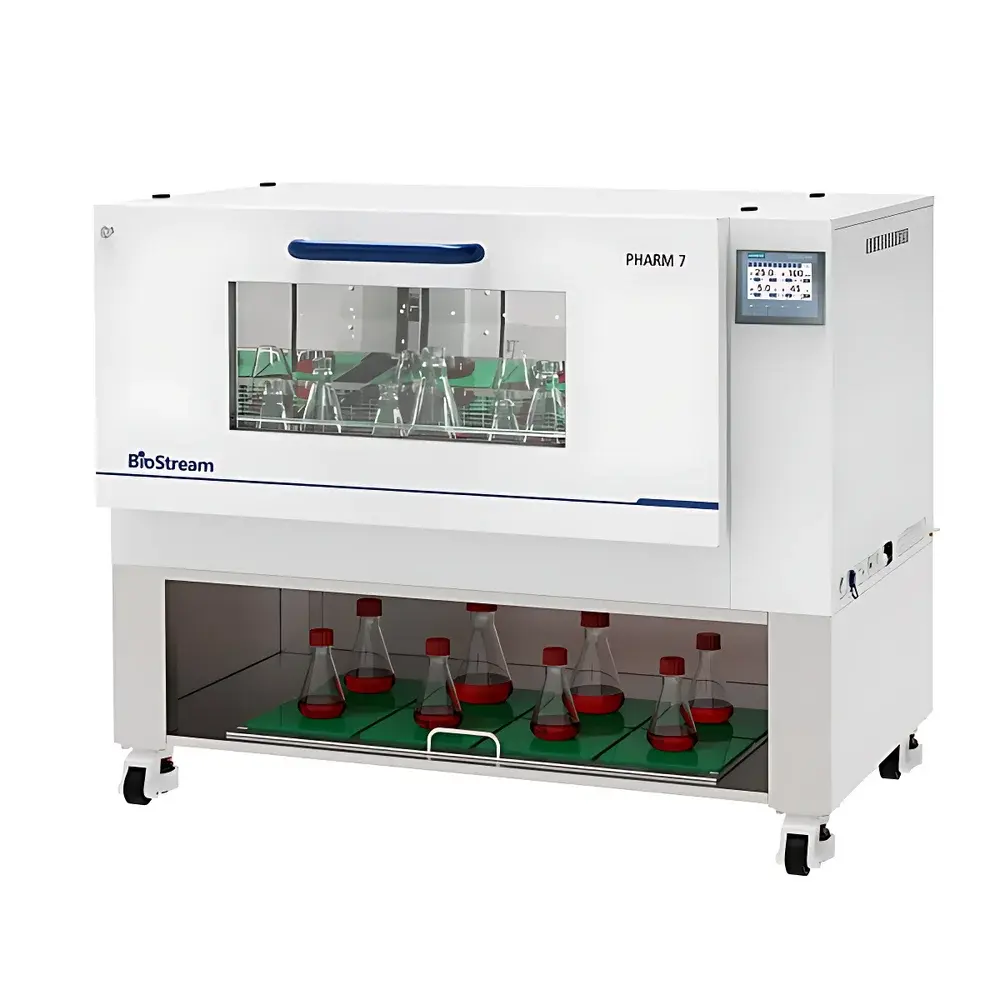
Biostream Pharm 7 Shaking Incubator
| Brand | Biostream |
|---|---|
| Origin | Netherlands |
| Model | Pharm 7 |
| Chamber Material | SS316 Stainless Steel |
| Temperature Uniformity | ±0.2°C |
| Temperature Stability | ±0.1°C |
| CO₂ Control Range | 0–20% (±1% FS) |
| Humidity Control | Direct Clean Steam Generation via 140°C SS316L Heating Plate |
| O₃ Monitoring Range | 0–100 ppm (±2% FS) |
| O₃ Generation | 4–8 g/h |
| Max Load Capacity | 35 kg per Shelf |
| Amplitude Options | 25 mm / 50 mm (microbial), 3 mm (96-well) |
| Max Speed | 1000 rpm |
| Lighting | Adjustable LED, up to 200 µmol·m⁻²·s⁻¹ |
| Compliance | GMP-Compatible Design, ISO 13485-aligned Construction, Suitable for GLP/GMP Environments |
| Communication | RS485, RJ45 (Modbus TCP/IP), USB |
| Data Logging | 60-day Internal Storage, Exportable via USB |
Overview
The Biostream Pharm 7 Shaking Incubator is an engineered platform for precision-controlled, scalable bioprocess development in regulated life science environments. Designed specifically for pharmaceutical and biotechnology applications, it integrates simultaneous control of temperature, shaking motion, CO₂ concentration, relative humidity, O₃ sterilization, and optional LED illumination — all within a fully GMP-aligned stainless-steel architecture. Its core measurement and actuation principles rely on PID-regulated thermal management, infrared CO₂ sensing with feedback-driven gas dosing, electrochemical ozone monitoring, and magnetically coupled drive technology eliminating mechanical transmission losses and heat generation. The chamber employs a forced-air circulation system with optimized duct geometry to eliminate thermal stratification, ensuring uniform conditions across the entire working volume — critical for reproducible cell expansion, microbial fermentation, and high-throughput screening under cGMP-compliant workflows.
Key Features
- SS316 stainless-steel interior with radius-rounded corners, compliant with ASME BPE surface finish standards and validated for repeated chemical disinfection and ozone sterilization.
- Hermetically sealed magnetic drive motor operating at low DC voltage (<24 V), generating negligible heat and eliminating lubricant contamination risks — essential for long-term sterile operation.
- Dual physical and electronic interlock system: top-right electronic safety lock disables rotation below 20 rpm and blocks UI access unless authorized; left-top mechanical lock provides redundant access control.
- Siemens SIMATIC HMI touchscreen controller with real-time display of temperature, RPM, CO₂, humidity (or O₂/O₃ concentration), and sterilization status — supporting multi-parameter trend logging and alarm history.
- Direct clean steam humidification using a 140°C SS316L heating plate: water droplets vaporize instantly into molecular-scale steam, preventing condensation, minimizing microbial carryover, and enabling validated sterilization of the entire humidification circuit (reservoir, tubing, filter).
- Ozone sterilization module with integrated electrochemical sensor (0–100 ppm range, ±2% FS accuracy), automatic cycle termination when safe residual levels (<0.1 ppm) are confirmed, and auditable sterilization logs traceable to FDA 21 CFR Part 11 requirements.
- Modular expansion capability: add-on units include UV-C germicidal irradiation (254 nm), programmable LED lighting (0–200 µmol·m⁻²·s⁻¹), static incubation shelves, and microplate-specific humidity retention enclosures with 0.2 µm hydrophobic filters.
Sample Compatibility & Compliance
The Pharm 7 accommodates diverse vessel formats without compromising environmental integrity: standard shake flasks (up to 5 L), test tubes, roller bottles, 96-well plates (with optional adhesive mats or humidity-retaining enclosures), and deep-well plates. Its 35 kg load capacity per shelf and dual-amplitude oscillation (3 mm for microplates; 25/50 mm for microbial cultures) support both gentle mammalian cell expansion and vigorous aerobic bacterial growth. All wetted surfaces — including humidifier reservoirs, gas manifolds, and chamber walls — are autoclavable or ozone-compatible. The system conforms to ISO 13485 manufacturing practices and supports validation protocols aligned with ICH Q5A, USP , and EU Annex 1 requirements for sterile process simulation and environmental monitoring.
Software & Data Management
Embedded firmware provides continuous 60-day parameter logging with timestamped events, alarms, and setpoint changes. Data export is supported via USB mass storage or network streaming through Modbus TCP/IP over RJ45 Ethernet — enabling integration into SCADA, MES, or LIMS platforms. Audit trails comply with ALCOA+ principles: attributable, legible, contemporaneous, original, accurate, complete, consistent, enduring, and available. Optional software packages provide remote monitoring dashboards, electronic signature workflows, and automated report generation for regulatory submissions. All communication interfaces (RS485, RJ45, USB) are electrically isolated to prevent ground-loop interference in multi-unit installations.
Applications
- Mammalian cell culture under controlled CO₂ (5%), humidity (>85% RH), and low-shear agitation — validated for CHO, HEK293, and iPSC lines with reduced shear stress versus orbital shakers.
- High-density microbial fermentation requiring precise dissolved oxygen modulation via adjustable amplitude and speed — compatible with E. coli, S. cerevisiae, and filamentous fungi.
- High-throughput screening using 96- or 384-well plates with humidity-retaining enclosures that reduce evaporation to <0.3% per 24 h at 37°C — enabling extended kinetic assays without edge effects.
- Photobioreactor studies leveraging programmable LED arrays to simulate diurnal cycles or induce photomorphogenic responses in algae, cyanobacteria, and plant tissue cultures.
- GMP-grade seed train expansion where traceability, environmental consistency, and sterilization documentation are mandatory for clinical batch release.
FAQ
Is the Pharm 7 suitable for use in ISO Class 5 cleanrooms?
Yes — its fully sealed drive unit, SS316 construction, ozone-compatible design, and absence of internal fans or exposed electronics meet ISO 14644-1 particulate emission limits when installed with appropriate HVAC integration.
Can the humidification system be validated for sterility?
Yes — the entire humidification path (5 L reservoir, PTFE tubing, SS316L heater plate, and distribution manifold) is designed for autoclaving at 121°C for 30 minutes or ozone exposure ≥10 ppm for ≥2 hours, with documented lethality validation available upon request.
What level of cybersecurity is implemented for network-connected units?
The embedded controller supports TLS 1.2 encryption for web-based interfaces, role-based user authentication, and configurable firewall rules via the Modbus TCP/IP stack — aligning with IEC 62443-3-3 SL2 requirements for laboratory instrumentation.
How is temperature uniformity verified during IQ/OQ?
Biostream provides a 9-point thermocouple mapping protocol compliant with ASTM E2874, including stability testing over 24 h at multiple setpoints (25°C, 37°C, 45°C) with data recorded at 1-minute intervals and statistical analysis per ISO/IEC 17025.
Are spare parts and calibration services available globally?
Yes — certified service centers operate across North America, Europe, and Asia-Pacific, offering on-site calibration of CO₂ sensors, ozone monitors, and temperature probes traceable to NIST or PTB standards, with documented calibration certificates issued per ISO/IEC 17025.