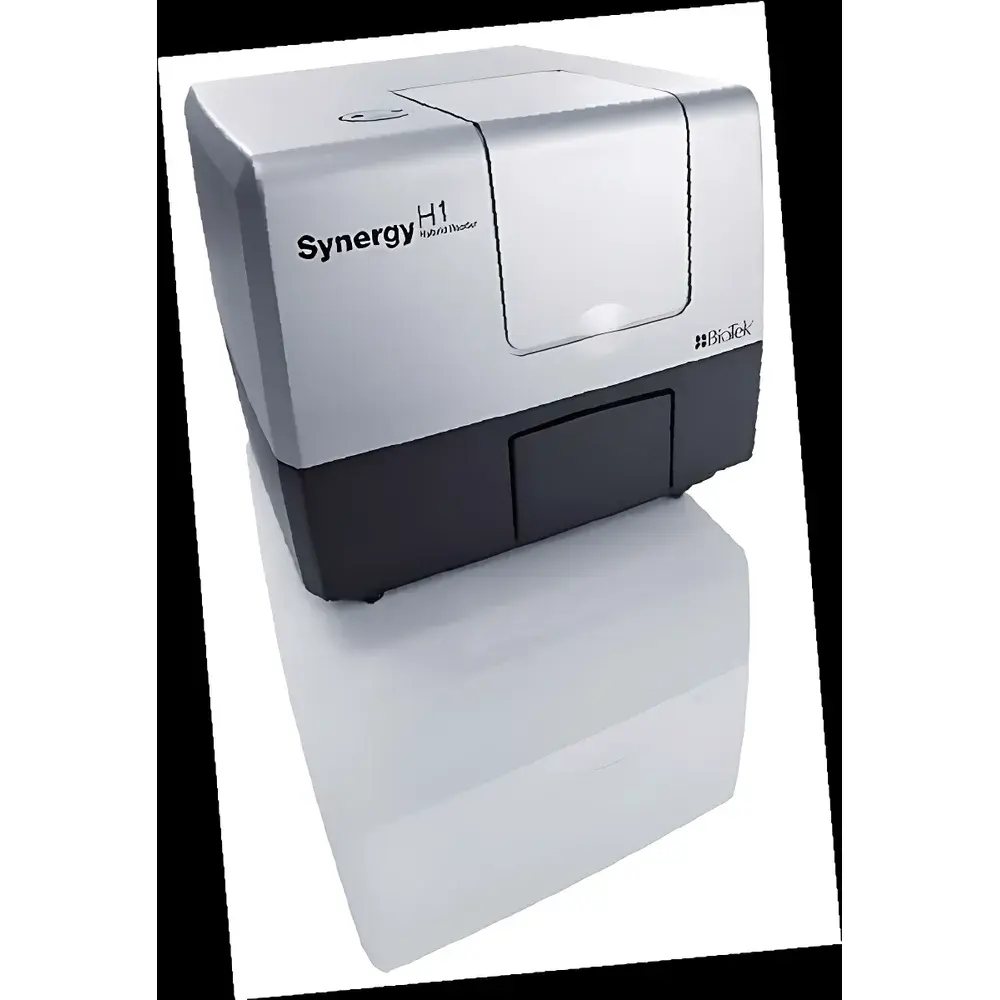
BioTek Synergy H1 Hybrid Multi-Mode Microplate Reader
| Brand | BioTek |
|---|---|
| Origin | USA |
| Model | Synergy H1 |
| Detection Modes | Absorbance, Fluorescence Intensity (Top/Bottom), Luminescence, Time-Resolved Fluorescence (TRF), Fluorescence Polarization (FP), TR-FRET, BRET |
| Wavelength Range | Monochromator: 230–999 nm (1 nm step) |
| Filter-based | 200–700 nm (850 nm optional) |
| Absorbance Range | 0.000–4.000 OD |
| Absorbance Linearity | <1% deviation (0–3.0 OD) |
| Read Speed | 96-well: 11 sec |
| 384-well | 22 sec |
| OD Resolution | 0.0001 OD |
| Fluorescence Sensitivity (Filter) | 1 pM fluorescein (0.1 fmol/well, 384-well) |
| Luminescence Sensitivity (Filter) | 10 amol ATP (flash assay) |
| Temperature Control | Ambient to 45 °C (±0.5 °C at 37 °C) |
| CO₂/O₂ Gas Control | Optional integrated module |
| Microplate Compatibility | 1–384-well plates + Take3™ micro-volume plates (2 µL) |
| Software | Gen5® v3.x with FDA 21 CFR Part 11 compliance modules, audit trail, and electronic signature support |
| Regulatory | CE, TÜV certified |
Overview
The BioTek Synergy H1 Hybrid Multi-Mode Microplate Reader is an engineered platform for quantitative life science assays requiring high flexibility, reproducibility, and regulatory readiness. Built upon a dual-optical architecture—combining a fourth-generation monochromator system with a dedicated filter- and dichroic-based detection path—the Synergy H1 delivers uncompromised performance across absorbance, fluorescence intensity (top and bottom reading), luminescence, time-resolved fluorescence (TRF), fluorescence polarization (FP), TR-FRET, and bioluminescence resonance energy transfer (BRET). Its hybrid design enables method-agnostic optimization: users select the optimal excitation/emission path—monochromator (1 nm resolution, 230–999 nm) or high-throughput filter sets (200–700 nm, up to 850 nm optional)—based on assay sensitivity, throughput, and spectral complexity. The system supports kinetic, endpoint, spectral scanning, and well-area scanning protocols, making it suitable for primary screening, mechanistic studies, and quality control in academic, pharmaceutical, and contract research laboratories.
Key Features
- Hybrid Optical Architecture: Patented dual-path design (U.S. Patent No. 8,218,141) integrates a high-efficiency monochromator and an independent filter/dichroic optical train—each with dedicated PMT detectors—ensuring optimal signal-to-noise ratio across detection modes.
- Micro-Volume Capability: Fully compatible with Take3™ Micro-Volume Plates, enabling accurate nucleic acid quantification (A260) from as little as 2 µL sample volume without dilution or transfer.
- Physiological Cell Monitoring: Optional integrated gas control module regulates and monitors CO₂ (0–20%) and O₂ (0.1–21%) concentrations in real time, synchronized with 4-Zone™ temperature control (±0.5 °C at 37 °C) and programmable orbital shaking for live-cell kinetic assays.
- Automated Liquid Handling: Dual syringe-based injectors support precise reagent dispensing (5–1000 µL, 1 µL increment; ≤2% CV at 50–200 µL) for flash-type luminescence (e.g., luciferase, ATP) and ion channel assays.
- Regulatory-Ready Platform: Gen5® software includes configurable audit trails, user access levels, electronic signatures, and full compliance with FDA 21 CFR Part 11, EU Annex 11, and GLP/GMP documentation requirements.
Sample Compatibility & Compliance
The Synergy H1 accommodates standard microplate formats from 1- to 384-well, including opaque, clear, and black-walled plates optimized for absorbance, fluorescence, or luminescence. Its compatibility with Take3™ plates extends utility to low-volume applications such as RNA integrity assessment and CRISPR guide efficiency screening. All optical components meet ISO 17025 traceability standards for photometric calibration. The instrument carries CE and TÜV certifications per IEC 61010-1 and IEC 61326-1. Optional IVD-configured models are available for clinical diagnostics use under relevant regional regulatory frameworks (e.g., IVDR in EU, CLIA in U.S.). Routine performance verification follows ASTM E2632-21 (Standard Practice for Verification of Microplate Reader Performance) and USP for luminescence assay validation.
Software & Data Management
Gen5® software serves as the unified interface for instrument control, protocol development, real-time data visualization, and advanced statistical analysis—including dose-response curve fitting (four-parameter logistic, sigmoidal), Z’-factor calculation, and kinetic modeling. Data export supports native .xlsx, .csv, and .xml formats with metadata embedding for LIMS integration. Audit trail functionality logs all user actions, parameter changes, and data modifications with timestamp, operator ID, and reason-for-change fields. Role-based permissions enforce separation of duties (e.g., analyst vs. administrator), while electronic signature workflows satisfy 21 CFR Part 11 Subpart C requirements for electronic records and signatures in regulated environments.
Applications
The Synergy H1 supports a broad spectrum of validated life science workflows: DNA/RNA quantification and purity assessment (A260/A280); enzyme kinetics (e.g., kinase, protease, phosphatase assays); cell viability and cytotoxicity (MTT, resazurin, LDH); reporter gene assays (luciferase, GFP); calcium flux and membrane potential (FP, FLIPR-compatible dyes); protein-protein interactions (TR-FRET, BRET); immunoassays (ELISA, AlphaScreen®); and high-content phenotypic screening (e.g., spheroid metabolism, mitochondrial stress tests). Its modular architecture allows seamless adaptation to evolving assay needs—from early discovery to process analytical technology (PAT) deployment in biomanufacturing.
FAQ
Does the Synergy H1 support GLP-compliant data acquisition?
Yes—Gen5® software provides full 21 CFR Part 11 compliance, including electronic signatures, audit trails, and secure user authentication.
Can the instrument perform simultaneous top- and bottom-read fluorescence measurements?
No—top and bottom readings are sequential, but switching is automated and configurable within assay protocols.
Is calibration traceable to NIST standards?
Yes—absorbance and fluorescence calibration kits are available with NIST-traceable reference materials and documented uncertainty budgets.
What is the maximum plate height supported with the optional gas control module installed?
The system accommodates plates up to 21.5 mm in height, including stackable plates and plates with integrated sensors.
Are firmware updates provided free of charge during the warranty period?
Yes—BioTek provides no-cost firmware and Gen5® software updates for the duration of the standard 2-year warranty, including security patches and regulatory enhancements.