
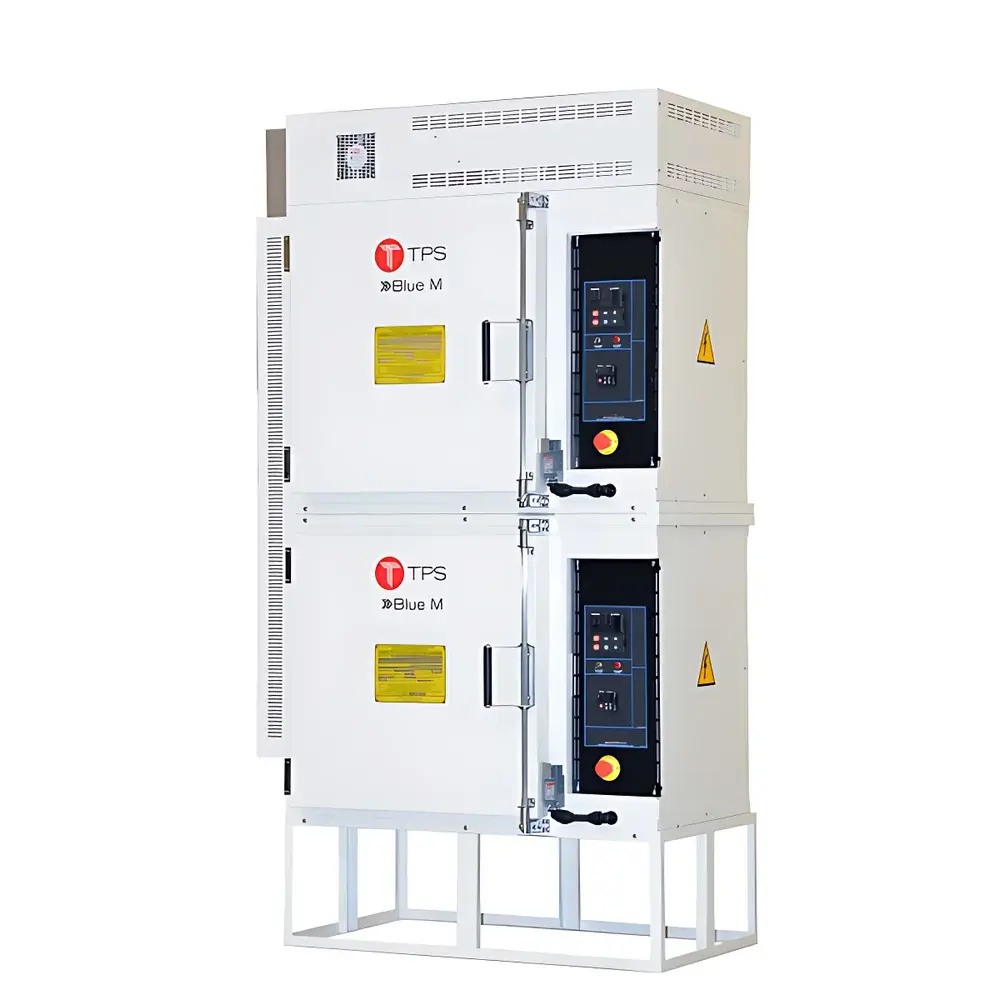
Blue M CSP Safety Oven
| Brand | Blue M |
|---|---|
| Origin | USA |
| Model | CSP Safety Oven |
| Type | Benchtop Forced-Air Safety Oven |
| Max Temperature | 343°C |
| Temperature Uniformity | ±1.5% of setpoint at stability |
| Control Accuracy | ±0.25% of setpoint |
| Heating Method | Horizontal or Vertical Forced-Air Circulation |
| Internal Dimensions | 480 × 381 × 457.2 mm (18.9" × 15" × 18") or 457.2 × 381 × 480 mm (18" × 15" × 18.9") |
| Internal Volume | 85 L (3.0 ft³) per chamber |
| Power Input | 7 kW @ 240 V / 1Φ / 60 Hz |
| Exhaust System | Integrated Volatile Fume Exhaust with TempLimit® Overtemperature Protection |
| Construction | Heavy-gauge cold-rolled steel exterior, 304 stainless steel interior with helical arc-welded seams, silicone rubber gasketed door, open-coil nickel-chromium heating elements, solid-state power relays |
| Compliance | NFPA 86–2023 Compliant for Class A Solvent-Handling Applications |
| Safety Features | Explosion-relief panel (rear wall), grounded metal enclosure cage, manual-reset high-limit controller, J-type thermocouple sensor, panel-mounted status indicators |
Overview
The Blue M CSP Safety Oven is an NFPA 86–2023–compliant benchtop forced-air oven engineered for safe thermal processing of solvent-laden or volatile-laden samples in industrial R&D, quality control, and pilot-scale manufacturing environments. Unlike standard laboratory ovens, the CSP series integrates structural and operational safeguards specifically designed to mitigate ignition risks associated with flammable vapors—making it suitable for applications including rapid-cure coating evaluation, solvent drying, epoxy and adhesive curing, and multi-batch thermal conditioning where hazardous off-gassing is anticipated. Its core operating principle relies on precisely controlled, uniform forced-air convection (available in horizontal or vertical airflow configurations), coupled with redundant temperature monitoring and fail-safe exhaust management. The oven’s architecture adheres to Class A requirements under NFPA 86 for ovens handling combustible atmospheres, including mandatory explosion-relief paneling, grounded metal containment, intrinsically safe wiring practices, and non-sparking internal components.
Key Features
- Structural compliance with NFPA 86–2023 for Class A solvent-handling ovens, verified through third-party design review and factory-assembled safety systems
- Robust construction: heavy-gauge cold-rolled steel exterior with 304 stainless steel interior chamber, helical arc-welded seams for gas-tight integrity, and high-temperature silicone rubber door gasket ensuring positive seal under thermal cycling
- Dual-stage temperature control system featuring a primary J-type thermocouple sensor and independent TempLimit® mechanical overtemperature cutoff with manual reset—both calibrated to NIST-traceable standards
- Open-coil nickel-chromium heating elements mounted outside the chamber cavity to prevent direct contact with volatile vapors; powered via solid-state relays for stable, zero-crossing switching and extended component life
- Integrated volatile fume exhaust assembly with dedicated duct port (NPT 2″), pressure-balanced airflow design, and optional connection to facility exhaust or activated carbon scrubber systems
- Explosion-relief panel mounted on rear wall within grounded metal enclosure cage—designed to vent overpressure outward without compromising structural integrity or personnel safety
- Configurable airflow orientation: single-chamber models support horizontal or vertical convection paths; stackable dual-chamber variants maintain independent thermal zones with shared exhaust routing
Sample Compatibility & Compliance
The CSP Safety Oven accommodates a broad range of sample formats—including coated panels, resin-filled molds, solvent-soaked filters, and multi-part assemblies—within its 85 L (3.0 ft³) working volume. Chamber dimensions (480 × 381 × 457.2 mm or 457.2 × 381 × 480 mm) allow flexible rack and tray loading while maintaining minimum clearance for unobstructed air circulation. All internal surfaces are electropolished 304 stainless steel to resist corrosion from organic solvents (e.g., acetone, xylene, MEK) and acidic/alkaline residues. The unit meets UL 746C for polymeric material flammability ratings and is certified for use in Class I, Division 2 hazardous locations when installed per NEC Article 500 guidelines. Documentation includes full NFPA 86 alignment reports, electrical schematics, and traceable calibration records—supporting GLP/GMP audit readiness and FDA 21 CFR Part 11–aligned validation protocols.
Software & Data Management
While the CSP Safety Oven operates via analog/digital hybrid controls (no embedded microprocessor), its instrumentation supports external data acquisition via 4–20 mA or 0–10 V analog outputs from the primary temperature controller and overtemperature limiter. Optional RS-485 Modbus RTU interface enables integration with SCADA, LIMS, or MES platforms for real-time logging, alarm forwarding, and electronic batch record generation. All temperature events—including setpoint changes, deviation alerts, and manual reset activations—are captured with timestamps and operator ID fields when paired with compliant supervisory software. Audit trails comply with ALCOA+ principles and support 21 CFR Part 11 requirements when deployed with validated access controls, electronic signatures, and immutable log archiving.
Applications
- Rapid thermal cure profiling of automotive and aerospace coatings under controlled solvent-evaporation conditions
- Residual solvent removal from pharmaceutical film coatings and medical device adhesives prior to packaging validation
- Accelerated aging studies of polymer composites exposed to cyclic thermal stress in the presence of volatiles
- Pre-drying of moisture-sensitive catalysts and battery electrode slurries where inert atmosphere compatibility is not required but vapor containment is critical
- QC release testing of epoxy encapsulants used in electronics manufacturing, per IPC-CC-830B and MIL-STD-883H thermal endurance criteria
- Environmental stress screening of printed circuit board assemblies following JEDEC J-STD-020 reflow simulation profiles
FAQ
Does the CSP Safety Oven qualify for NFPA 86 Class A certification?
Yes—the CSP series is fully engineered and documented to meet all structural, ventilation, and safety interlock requirements of NFPA 86–2023 for Class A ovens handling flammable vapors.
Can it be integrated into a central exhaust system?
Yes—each unit includes a 2-inch NPT exhaust port with static pressure rating up to 0.5″ w.c.; ducting must be non-combustible and grounded per NFPA 91.
Is validation documentation provided?
Standard delivery includes IQ/OQ templates, calibration certificates (NIST-traceable), NFPA 86 compliance summary, and electrical safety test reports.
What maintenance intervals are recommended?
Heating element resistance checks every 6 months; door gasket inspection and thermocouple verification annually; exhaust duct cleaning per facility hygiene schedule.
Are custom internal fixtures available?
Yes—Blue M offers configurable shelf racks, perforated trays, and sample holders fabricated from 304 SS or Inconel 600 for high-temperature or chemically aggressive applications.



