
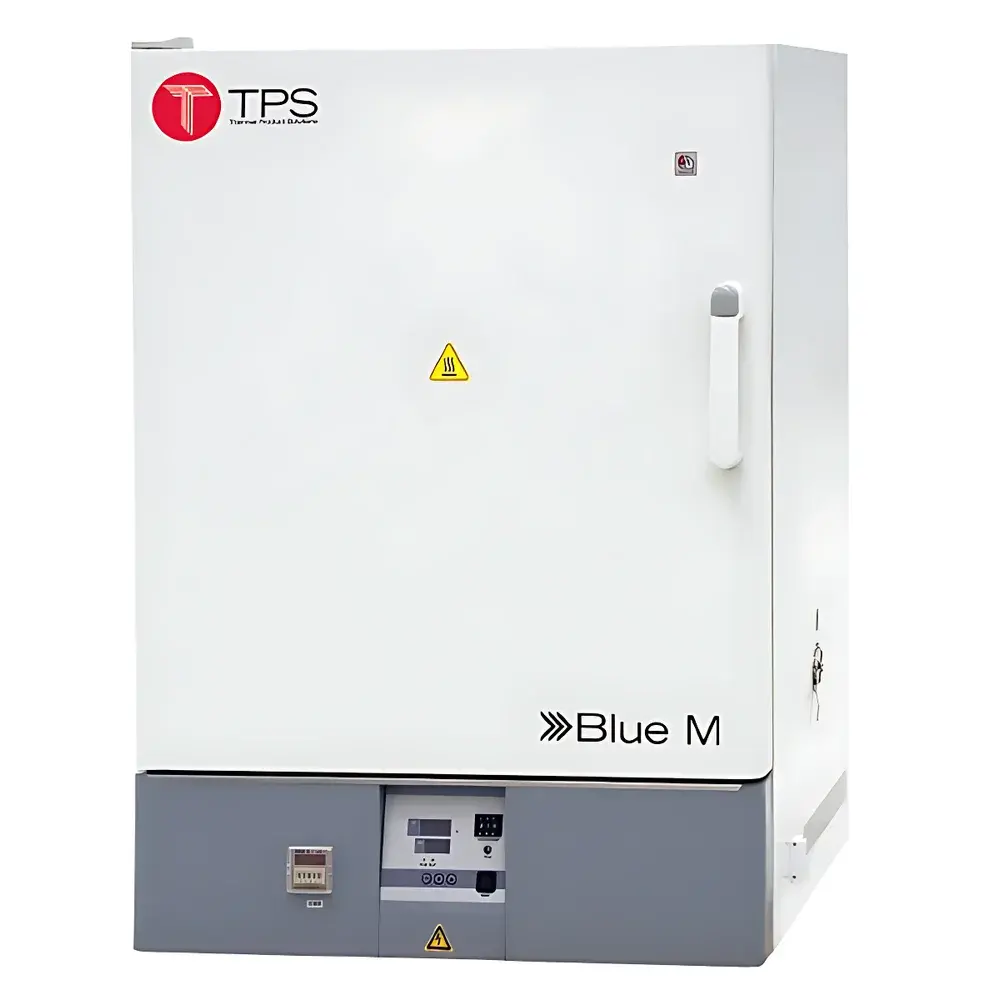
Blue M GO Series Gravity Convection Oven
| Brand | Blue M |
|---|---|
| Origin | USA |
| Type | Benchtop/General-Purpose Gravity Convection Oven |
| Temperature Range | Ambient +10°C to 260°C (50°F to 500°F) |
| Temperature Uniformity | ≤±3% |
| Temperature Stability | ≤±1°C |
| Max Power | 3 kW |
| Heating Method | Vertical Upward Gravity Convection |
| Internal Dimensions | 300 × 300 × 300 mm to 600 × 500 × 750 mm |
| Construction | Stainless Steel Interior, Powder-Coated Exterior |
| Controller | Digital PID with Setpoint Operation |
| Compliance | Designed for GLP-compliant environments |
Overview
The Blue M GO Series Gravity Convection Oven is a precision-engineered thermal processing instrument designed for applications where forced-air circulation would compromise sample integrity—such as drying lightweight particulates, curing delicate coatings, conditioning polymer films, or stabilizing reference standards. Unlike mechanical convection ovens, this series relies exclusively on natural buoyancy-driven airflow: heated air rises vertically from the bottom heating elements through perforated stainless steel shelves, creating laminar, low-turbulence convection without fans or blowers. This gravity-driven thermal architecture eliminates vibration, particle resuspension, and localized overheating—critical for ASTM D1654 (corrosion testing), ISO 17025-accredited moisture loss assays, and USP residual solvent determination. The oven’s chamber geometry, wall insulation profile, and vertical thermal gradient management are optimized to deliver consistent heat distribution across all volume configurations—from compact GO-27 (0.95 ft³) to large-capacity GO-225 (7.9 ft³)—within ≤±3% uniformity and ≤±1°C stability at setpoint.
Key Features
- Stainless steel interior chamber with seamless welded corners and rounded edges for easy cleaning and corrosion resistance
- Powder-coated mild steel exterior with reinforced structural frame for long-term dimensional stability
- Vertical upward gravity convection path engineered to minimize thermal stratification and maximize cross-chamber consistency
- Digital PID temperature controller with intuitive keypad interface, real-time display, and programmable ramp/soak profiles
- Independent overtemperature protection circuit (mechanical backup thermostat) calibrated to trip 15°C above maximum operating setpoint
- Two standard perforated stainless steel shelves included; optional third/fourth shelves available with adjustable spacing (0.95″ to 2″ increments)
- UL-listed electrical system with NEMA 1 enclosure rating; 115 V or 230 V single-phase input options per model
Sample Compatibility & Compliance
The GO Series accommodates diverse sample formats—including Petri dishes, crucibles, glassware, metal trays, and porous substrates—without risk of displacement or surface abrasion. Its fanless design meets requirements for ASTM E145 Class II (gravity convection) classification and supports ISO/IEC 17025 method validation protocols where airflow artifacts must be excluded. All models are constructed to comply with UL 61010-1 and CSA C22.2 No. 61010-1 safety standards. When integrated with Blue M’s optional Ethernet-enabled data logger (sold separately), the system supports audit-trail generation, electronic signatures, and 21 CFR Part 11–compliant record retention for regulated QC/QA labs operating under GMP or GLP frameworks.
Software & Data Management
While the base unit operates via standalone digital PID control, Blue M offers an optional RS-485 or Ethernet communication module enabling integration into centralized laboratory information management systems (LIMS). With certified firmware, users can configure automated temperature logging at user-defined intervals (1 s to 60 min), export CSV-formatted datasets with timestamps and sensor IDs, and generate calibration verification reports traceable to NIST-certified reference thermometers. Firmware updates maintain backward compatibility and include enhanced alarm logic—for example, simultaneous monitoring of chamber temperature, overtemp cutoff status, and door-open duration.
Applications
- Moisture content analysis per AOAC 950.46 and ASTM D2231 for pharmaceutical excipients and food-grade powders
- Thermal aging of elastomers and composites in accordance with ASTM D573 and ISO 188
- Drying of filter papers and gravimetric collection media prior to particulate mass measurement (EPA Method 201A)
- Curing of conformal coatings on PCB assemblies without delamination or flux migration
- Pre-conditioning of reference materials used in inter-laboratory proficiency testing programs
- Stabilization of hygroscopic standards before volumetric titration or Karl Fischer water determination
FAQ
What distinguishes gravity convection from mechanical convection in thermal processing?
Gravity convection uses natural thermal buoyancy to circulate air, eliminating fan-induced turbulence and particle disturbance—ideal for lightweight, friable, or electrostatically sensitive samples.
Can the GO Series be validated for ISO/IEC 17025 compliance?
Yes—its documented temperature uniformity, stability, and traceable calibration support IQ/OQ/PQ protocol development when used with NIST-traceable sensors and certified procedures.
Is door-opening compensation available?
The PID controller includes adaptive recovery algorithms that reduce overshoot and accelerate return-to-setpoint after brief door openings (<15 s), though extended openings require manual re-equilibration.
Are custom shelf configurations supported?
Standard models ship with two perforated shelves; up to six shelves may be installed using factory-supplied mounting hardware and slot-compatible spacing kits.
Does Blue M provide installation and commissioning services?
Field service support—including site assessment, electrical verification, thermal mapping, and operational qualification—is available globally through authorized Blue M service partners.



