
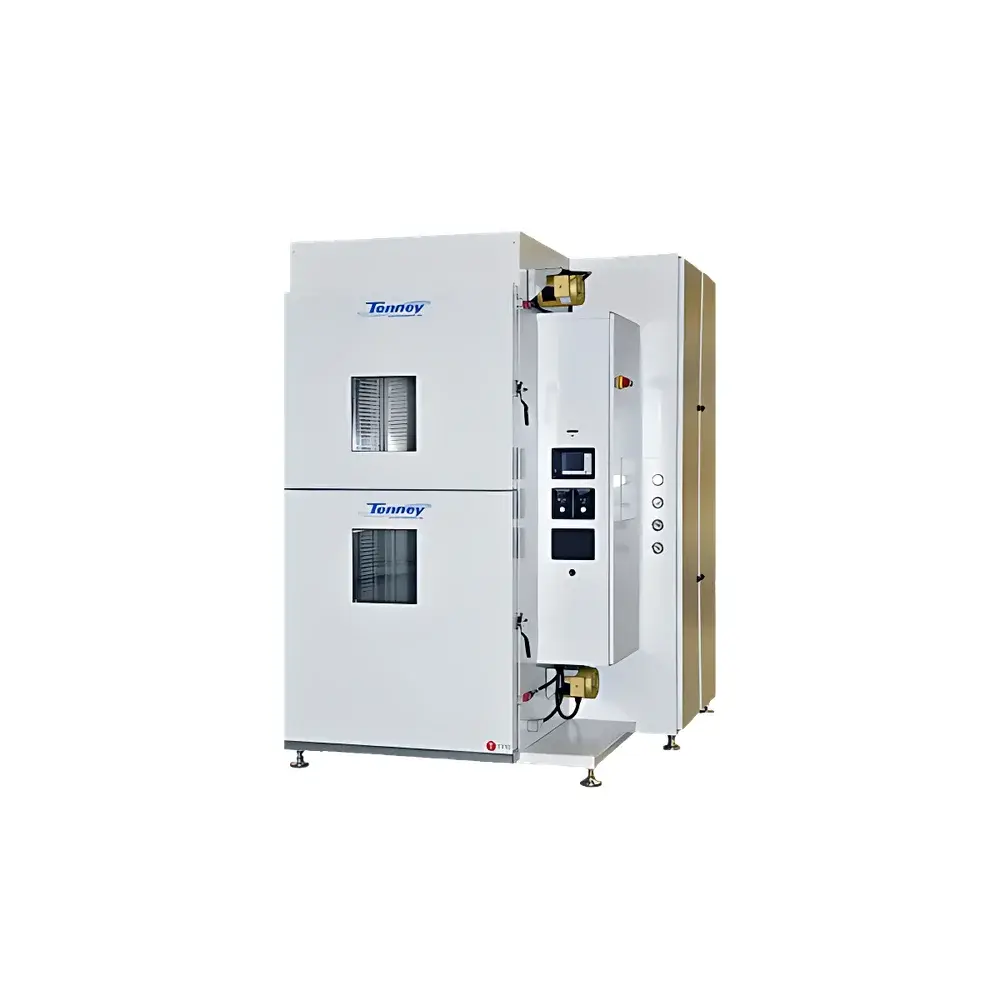
Blue M TENNEY Thermal Shock Test Chamber TS2 Series
| Brand | Blue M |
|---|---|
| Origin | USA |
| Model | TS2 Series Thermal Shock Test Chamber |
| Temperature Range | -70°C to +180°C |
| Temperature Uniformity | ±1.0°C |
| Temperature Fluctuation | ±0.5°C |
| Temperature Deviation | ±1.0°C |
| Ramp Rate | Ambient to +180°C (specification dependent on configuration) |
| Internal Dimensions (W×H×D) | 1016 mm × 2057 mm × 2007 mm to 1626 mm × 2616 mm × 2515 mm |
| Dual-Zone Configuration | Hot Zone (+40°C to +200°C), Cold Zone (-73°C to +40°C) |
| Cooling System | Cascade refrigeration with two semi-hermetic compressors |
| Heating | Nickel-chromium wire elements with horizontal airflow |
| Insulation | Ceramic fiber + polyurethane, welded stainless steel interior liner |
| Control System | Synergy Quattro touchscreen controller (320×240 color LCD), PID with auto-tuning, dual-channel capability |
| Compliance | MIL-STD-202G Method 107G Condition F |
| Safety | Dual-limit switches, over/under-temperature protection, OTP TempGard per chamber, door interlock, stainless steel mesh baskets (200 lb capacity per zone) |
Overview
The Blue M TENNEY TS2 Series Thermal Shock Test Chamber is an engineered dual-zone environmental test system designed for rigorous thermal cycling validation of mission-critical components across aerospace, defense, telecommunications, and high-reliability electronics industries. Operating on the principle of rapid, repeatable transfer between independently controlled hot and cold chambers—without intermediate ambient exposure—the TS2 delivers true thermal shock profiles defined by MIL-STD-202G Method 107G Condition F and aligned with IEC 60068-2-14. Its architecture eliminates thermal lag inherent in single-chamber ramp-and-soak systems, enabling precise simulation of real-world operational extremes such as aircraft avionics transitioning from desert ground operations to stratospheric cruise altitudes. The chamber’s structural integrity derives from a continuously welded 304 stainless steel interior liner, sealed against moisture ingress and corrosion, while its dual-stage cascade refrigeration system—comprising two semi-hermetic compressors—ensures stable sub-zero performance down to –73°C in the cold zone and rapid recovery after thermal load introduction.
Key Features
- Dual independent temperature zones: Hot chamber (+40°C to +200°C) and cold chamber (–73°C to +40°C), each with dedicated heating, cooling, and monitoring circuits
- Synergy Quattro touchscreen controller with 320×240 color LCD interface, English-language prompts, real-time clock, and support for virtually unlimited multi-step test programs
- Auto-tuning PID control with dual-channel capability—adjustable by operator to compensate for variable thermal mass loading conditions
- Horizontal forced-air circulation with adjustable louvers and low-energy nickel-chromium heating elements for uniform thermal distribution (±1.0°C uniformity)
- Cascade refrigeration system with water-cooled condensers; optional remote air-cooled condenser available for TS2 models
- Stainless steel wire mesh transfer baskets rated for 200 lb per chamber, integrated with precision limit-switch-actuated vertical transport mechanism
- Comprehensive safety architecture: Over/under-temperature cutouts, door interlock, OTP TempGard thermal guard per zone, and flash-memory-based alarm logging
- Full I/O isolation via Olympic standalone I/O controller; communication interfaces include RS-232 (standard), 10/100 Ethernet (TCP/IP), USB data export, and PCMCIA flash card slot
Sample Compatibility & Compliance
The TS2 accommodates non-hazardous, non-flammable, non-volatile test specimens only—consistent with Class II, Division 2 electrical safety requirements. Its internal dimensions (ranging from 1016 × 2057 × 2007 mm to 1626 × 2616 × 2515 mm) support large-format PCB assemblies, radar modules, and structural composites. All configurations meet MIL-STD-202G Method 107G Condition F for thermal shock qualification testing and are compatible with ASTM D3418, ISO 11359-2, and JEDEC JESD22-A104 standards. The controller firmware supports audit-ready operation under GLP and GMP frameworks, including electronic signature-capable user authentication, change history logging, and 21 CFR Part 11–compliant data integrity controls when paired with validated software packages.
Software & Data Management
Data acquisition and test orchestration are managed through the embedded Windows CE operating system, enabling seamless integration into enterprise laboratory information management systems (LIMS). Test parameters—including setpoints, actual chamber temperatures, transfer timing, and alarm events—are timestamped and stored locally on onboard flash memory or exported via USB to external media. Remote monitoring and control are supported via TCP/IP using industry-standard Modbus TCP or proprietary Blue M API protocols. The Synergy Quattro platform allows program import/export in CSV format, real-time graphing of dual-zone temperature traces, and automated report generation compliant with ISO/IEC 17025 documentation requirements. Optional IEEE-488 (GPIB) and OPC UA gateways facilitate interoperability with SCADA and MES platforms in Industry 4.0 environments.
Applications
- Qualification testing of avionics hardware per DO-160 Section 4 (Temperature Variation)
- Accelerated life testing of solder joints, conformal coatings, and encapsulated MEMS devices
- Validation of thermal interface materials (TIMs) under cyclic thermal stress
- Reliability screening of power electronics subjected to repeated thermal expansion mismatch
- Material compatibility assessment for polymer housings, elastomeric seals, and optical adhesives
- Pre-certification testing for automotive ECUs targeting AEC-Q200 Grade 0/1 specifications
FAQ
What is the minimum dwell time achievable between hot and cold zones?
Transfer time is mechanically fixed at ≤15 seconds for standard configurations; dwell time is programmable per test step with resolution to 1 second.
Can the TS2 be configured for humidity control?
No—the TS2 is a dry thermal shock system. For combined temperature/humidity shock, refer to Blue M’s THS Series chambers.
Is NIST-traceable calibration documentation included?
Factory calibration certificates (per ISO/IEC 17025) are provided; on-site NIST-traceable sensor calibration services are available as an add-on option.
What power supply options are supported?
Standard configurations accept 230V-3PH-60Hz or 460V-3PH-60Hz inputs; voltage and frequency variants require engineering review prior to order.
How is thermal uniformity verified during qualification?
Uniformity mapping is performed per ASTM E742 using nine calibrated PT100 sensors positioned per IEC 60068-3-5; full validation reports are supplied with each unit.



