
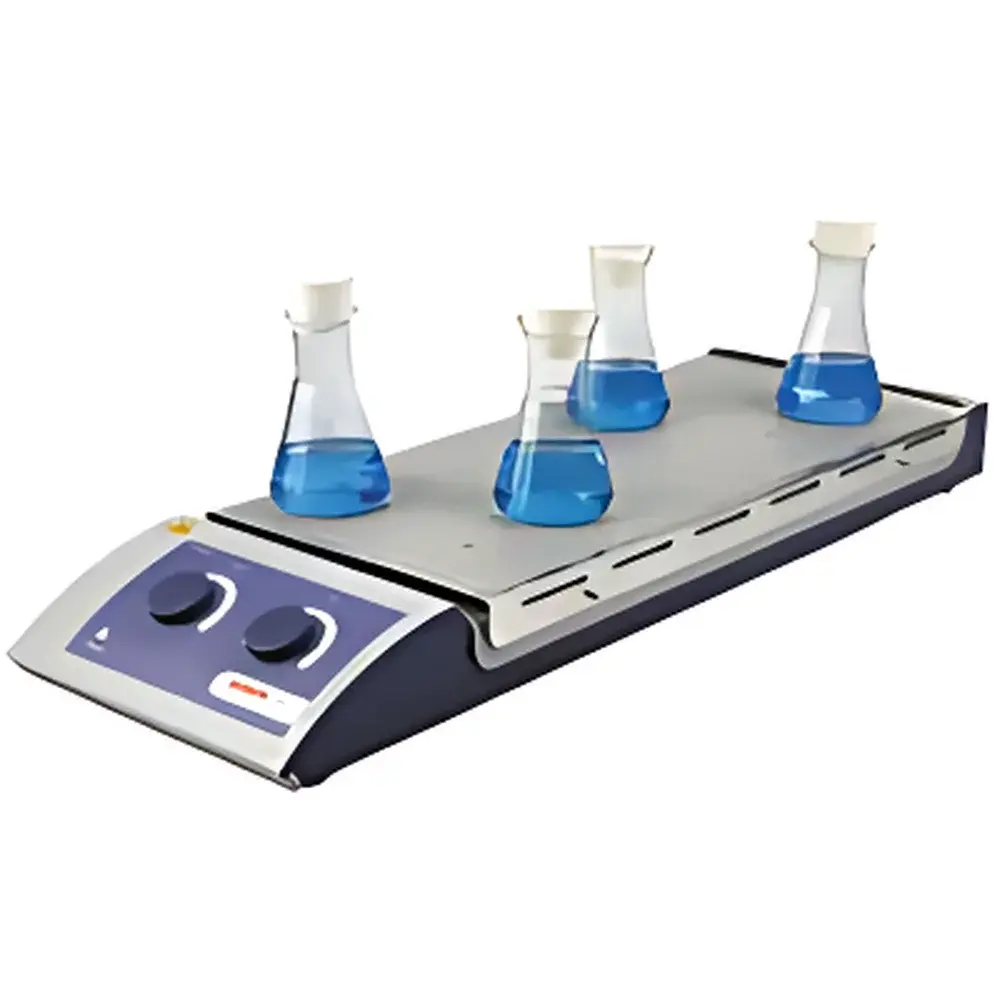
BlueSpin MS-H-S10 10-Position Standard Heated Magnetic Stirrer
| Brand | DLAB |
|---|---|
| Origin | Beijing, China |
| Model | MS-H-S10 |
| Voltage | 220 VAC |
| Frequency | 50/60 Hz |
| Total Power | 490 W |
| Heating Power | 470 W |
| Heating Temperature Range | Ambient to 120 °C |
| Safety Cut-off Temperature | 140 °C |
| Number of Stirring Positions | 10 |
| Max. Volume per Position (H₂O) | 0.4 L |
| Total Max. Volume (H₂O) | 4 L |
| Stirring Position Spacing | 90 mm |
| Speed Range | 0–1100 rpm |
| Speed Display | Analog Scale |
| Speed Deviation per Position | ≤5% |
| Max. Stir Bar Length | 30 mm |
| Motor Type | Brushless DC |
| Motor Input Power | 12 W |
| Motor Output Power | 4 W |
| Workplate Material | Stainless Steel with Silicone Resin Coating |
| Workplate Dimensions | 180 × 450 mm |
| Overall Dimensions | 182 × 552 × 65 mm |
| Weight | 3.2 kg |
| Operating Ambient Temperature | 5–40 °C |
| Max. Relative Humidity | 80% |
| Ingress Protection | IP42 |
Overview
The BlueSpin MS-H-S10 is a precision-engineered 10-position heated magnetic stirrer designed for high-throughput laboratory workflows requiring thermal control and consistent mechanical agitation across multiple samples simultaneously. Based on the proven Couette flow principle, it employs rotating magnetic fields generated by individual embedded coils beneath each position to drive standard PTFE- or glass-coated stir bars in sealed or open vessels. Unlike single-position units, the MS-H-S10 delivers synchronized rotational motion across all ten stations—ensuring identical shear profiles, mixing kinetics, and thermal histories for comparative kinetic studies, parallel synthesis, reagent preparation, or quality control batch testing. Its integrated heating system utilizes a uniform-resistance alloy plate with distributed thermal sensors and PID feedback control, maintaining ±2 °C temperature stability across the full 180 × 450 mm work surface within the 25–120 °C operating range. The unit complies with IEC 61010-1:2010 safety requirements for laboratory electrical equipment and meets EMC directive 2014/30/EU.
Key Features
- Synchronized 10-channel operation with independent yet identically controlled stirring dynamics—critical for reproducible multi-sample protocols under GLP/GMP conditions.
- Brushless DC motor architecture delivering low-noise (<45 dB(A) at 1 m), maintenance-free operation with precise speed regulation from 0 to 1100 rpm via analog dial interface.
- Uniform-heating aluminum-alloy heating plate coated with corrosion-resistant silicone resin film, offering enhanced chemical resistance and slip resistance compared to bare stainless steel.
- Integrated overtemperature protection circuitry that automatically deactivates heating at 140 °C—exceeding standard safety thresholds defined in DIN EN 60529 (IP42-rated enclosure).
- Compact footprint (552 mm width) optimized for benchtop integration; supports up to 4 L total aqueous volume (0.4 L per position) with 90 mm center-to-center spacing for standard 50–500 mL labware compatibility.
- Analog speed scale calibrated to ±3% full-scale accuracy; real-time visual feedback enables rapid parameter replication across shifts or operators without software dependency.
Sample Compatibility & Compliance
The MS-H-S10 accommodates standard cylindrical and conical glassware (e.g., 50 mL–500 mL beakers, Erlenmeyer flasks, and screw-cap vials) when paired with stir bars up to 30 mm in length. Its non-reactive silicone resin–coated stainless steel plate resists degradation from common solvents (e.g., ethanol, acetone, dilute acids/bases) and facilitates easy wipe-down cleaning between runs. The device is certified to meet ISO/IEC 17025-relevant operational consistency requirements for routine QC applications and supports traceable calibration via external PT100 probe integration (not included). It operates safely in ambient environments compliant with ISO 14644-1 Class 8 cleanroom specifications (5–40 °C, ≤80% RH).
Software & Data Management
As a standalone analog instrument, the MS-H-S10 does not incorporate digital connectivity or firmware-based data logging. This design prioritizes operational robustness, electromagnetic immunity in shared instrumentation labs, and compliance with facilities where IT-controlled devices require formal validation (e.g., FDA 21 CFR Part 11 Annex 11 environments). All parameters—including setpoint temperature and nominal speed—are manually configured and visually verified, eliminating risk of remote configuration drift or unauthorized parameter changes. For laboratories requiring audit trails, external temperature dataloggers (e.g., calibrated thermistors with USB output) may be deployed alongside the unit to record time-stamped thermal profiles per position.
Applications
- Parallel dissolution testing of pharmaceutical formulations per USP under controlled thermal conditions.
- Multi-vessel buffer equilibration in molecular biology workflows prior to chromatography or electrophoresis.
- High-volume reagent preparation (e.g., PBS, Tris-HCl, LB media) across teaching or production labs.
- Accelerated stability studies involving temperature-dependent reaction monitoring (e.g., hydrolysis kinetics, enzyme inactivation assays).
- Standardized sample homogenization for ICP-MS or AAS digest preparations where thermal input must remain consistent across replicates.
FAQ
Is the MS-H-S10 compatible with corrosive reagents such as concentrated HCl or NaOH solutions?
Yes—the silicone resin coating on the stainless steel plate provides enhanced resistance to mild to moderate concentrations of common inorganic acids and bases. However, prolonged exposure to >6 M HCl or >50% w/w NaOH is not recommended without secondary containment.
Can external temperature probes be used to verify actual sample temperature?
Absolutely. While the unit regulates plate temperature, users routinely insert calibrated PT100 or thermistor probes directly into vessels to validate solution-phase thermal response—especially critical for low-thermal-conductivity solvents like toluene or glycerol.
Does the unit support programmable ramping or timer functions?
No. The MS-H-S10 is intentionally designed as a manually operated, analog-control instrument to ensure deterministic behavior and eliminate software-related failure modes in regulated environments.
What is the expected service life of the brushless DC motor under continuous operation?
Rated for ≥20,000 hours of continuous duty at rated load, with no scheduled maintenance required beyond periodic inspection of stir bar integrity and workplate cleanliness.
Is CE marking applied to this model?
Yes—the unit carries CE marking per Directive 2014/30/EU (EMC) and 2014/35/EU (LVD), supported by technical documentation available upon request from authorized DLAB distributors.



