
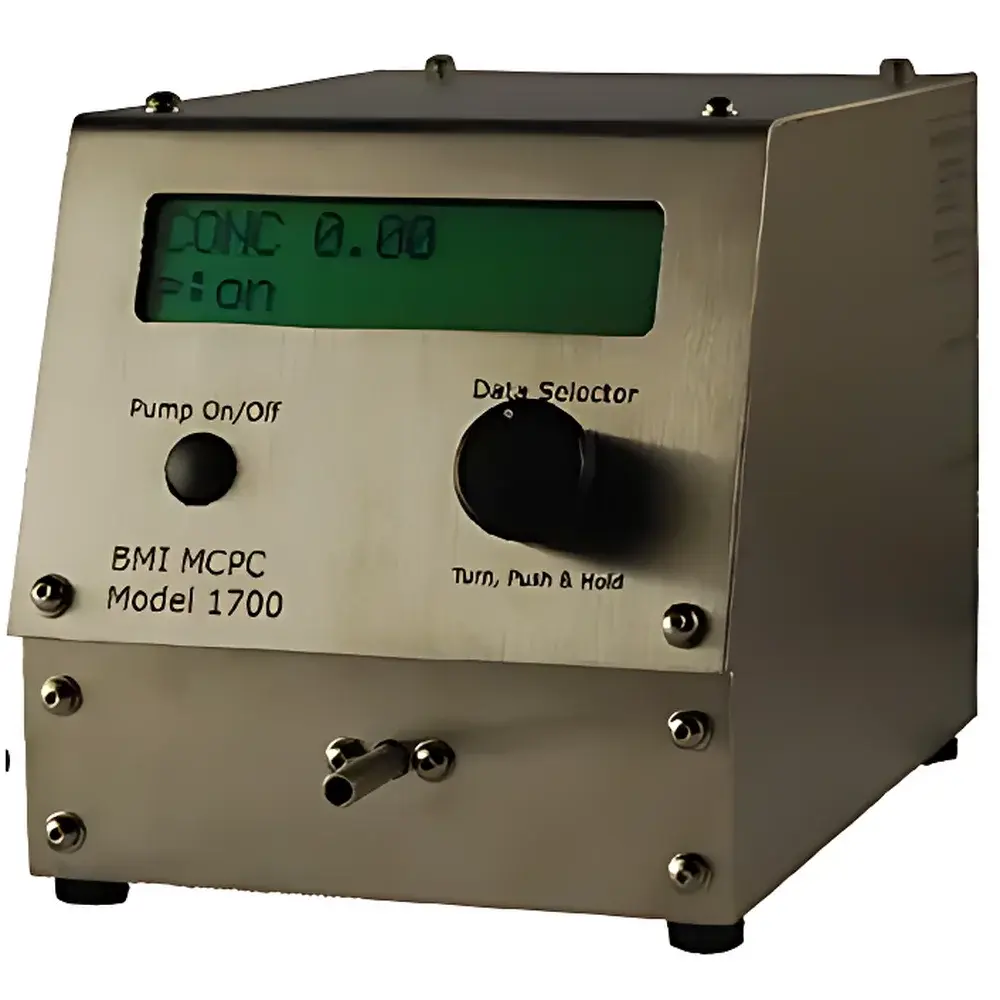
BMI MCPC Mixed-Mode Condensation Particle Counter
| Brand | BMI/Brechtel Manufacturing Inc. |
|---|---|
| Origin | USA |
| Model | MCPC |
| Particle Size Range | 5–3000 nm |
| Response Time | 180 ms |
| Minimum Detectable Size | 5 nm |
| Saturation Temperature | 45°C |
| Condenser Temperature | 20°C |
| Optical Block Temperature | 30°C |
| Minimum Detectable Concentration | 0.001 particles/cm³ |
| Maximum Concentration (before coincidence error >5%) | ~60,000 particles/cm³ |
| Coincidence Error at 100,000 particles/cm³ | 35% |
| Aerosol Flow Rate | 0.36 L/min |
| Sheath Air Flow Rate | 0.36 L/min |
| Total Exhaust Flow | 2 L/min |
| Working Fluid | Reagent-Grade n-Butanol |
| Butanol Consumption | 1.5 mL/h (≈250 mL/week) |
| Fluid Reservoir Capacity | 250 mL |
| Output Signal | Digital pulse, 0–5 V TTL-compatible |
| Warm-up Time | 5 min (at 20°C ambient) |
| Dimensions | 20.32 × 14.61 × 13.46 cm |
| Weight | 2.95 kg |
| Accuracy | ±3% (3σ, validated against NIST-traceable CPC standards) |
| Tilt Tolerance | Stable up to 12° inclination |
| Compliance | Designed for GLP-compliant field deployment |
| compatible with ASTM D8196-22 (CPC performance verification), ISO 27891 | 2021 (aerosol instrumentation calibration), and USP <788> particulate matter testing workflows |
Overview
The BMI MCPC Mixed-Mode Condensation Particle Counter is a high-performance, laboratory-grade aerosol detection instrument engineered for ultrafast, quantitative measurement of nanoparticle number concentrations in real time. Operating on the principle of mixed-mode condensational growth—combining turbulent mixing with saturated n-butanol vapor—the MCPC achieves rapid, controlled particle activation and optical detection. Unlike conventional single-stage condensation particle counters (CPCs), the MCPC integrates optimized thermal gradients across its saturator (45°C), condenser (20°C), and optical block (30°C) to maximize nucleation efficiency while minimizing re-evaporation and wall losses. Its 180 ms system response time enables sub-second temporal resolution in dynamic aerosol environments—critical for scanning mobility particle sizers (SMPS), hygroscopic tandem differential mobility analyzers (HTDMA), and unmanned aerial vehicle (UAV)-based atmospheric profiling. Validated to ±3% (3σ) against NIST-traceable reference standards, the MCPC meets metrological requirements for regulatory monitoring, climate research, and inhalation toxicology studies.
Key Features
- Sub-200 ms total system response time—enabling 4× higher time resolution in size distribution scans versus conventional CPCs
- Detection threshold of 5 nm—supporting nucleation-mode aerosol characterization relevant to new particle formation (NPF) studies
- Compact, ruggedized design (20.3 × 14.6 × 13.5 cm; 2.95 kg) with 12° tilt tolerance—field-deployable on ground stations, mobile labs, and Arctic UAV platforms
- Low butanol consumption (1.5 mL/h) and integrated 250 mL reservoir—minimizing maintenance frequency and enabling unattended operation for >7 days
- Leak-tight fluidic architecture with dual-stage filtration and pressure-balanced flow control—ensuring stable supersaturation and reproducible counting efficiency
- TTL-compatible digital pulse output (0–5 V)—directly interfaced with data acquisition systems, SMPS controllers, and LabVIEW-based DAQ frameworks
Sample Compatibility & Compliance
The MCPC accepts ambient air, filtered dilution streams, and conditioned aerosol outputs from DMA, HTDMA, or volatility tandem DMA systems without modification. It maintains counting stability across relative humidity ranges of 10–90% RH and ambient temperatures from 5–35°C. The instrument complies with ASTM D8196-22 for CPC performance verification, aligns with ISO 27891:2021 calibration traceability requirements, and supports audit-ready operation under GLP and GMP frameworks. Its ±3% accuracy (3σ) has been verified using monodisperse PSL and NaCl nanoparticles calibrated via NIST SRM 1963 and ISO 14644-3 reference protocols. All firmware and hardware configurations are documented per FDA 21 CFR Part 11 requirements for electronic records and signatures when deployed in pharmaceutical cleanroom monitoring applications.
Software & Data Management
The MCPC operates as a standalone sensor with analog/digital output—no proprietary software required. Pulse train data is acquired via standard counter/timer modules (e.g., National Instruments USB-6363) or integrated into existing aerosol data pipelines using open-source Python libraries (e.g., aerosolpy, smirf). For synchronized operation with SMPS or HTDMA systems, BMI provides ASCII protocol documentation supporting RS-232 and TTL trigger handshaking. Raw count rates are timestamped with microsecond precision, enabling post-hoc alignment with mobility voltage ramps or humidity step changes. Audit logs—including temperature setpoints, flow validation timestamps, and butanol level alerts—are stored in non-volatile memory and exportable as CSV for regulatory review.
Applications
- Real-time nucleation-mode aerosol monitoring in atmospheric chemistry field campaigns (e.g., DOE ARM, NOAA AOS)
- High-temporal-resolution scanning mobility particle sizing (SMPS) with enhanced inversion stability below 10 nm
- Hygroscopic growth factor measurement in HTDMA systems requiring fast-response CPC back-end detection
- Ultrafine particle exposure assessment in occupational hygiene and indoor air quality studies
- Validation of aerosol generation systems in pharmaceutical inhaler development (per USP and ISO 23409)
- Arctic and high-altitude UAV-based aerosol profiling—leveraging low power draw (12 V DC, <15 W) and mechanical robustness
FAQ
What particle size range does the MCPC cover, and how is the 5 nm lower limit achieved?
The MCPC measures particles from 5 nm to 3000 nm. The 5 nm detection threshold results from precise control of butanol supersaturation via thermal gradient optimization and turbulent mixing dynamics—not from optical scattering enhancement. This enables reliable detection of freshly nucleated clusters under atmospheric conditions.
How is coincidence error managed at high concentrations?
Coincidence correction is applied algorithmically using Poisson-based deconvolution of pulse train statistics. At 100,000 particles/cm³, measured error is 35%; the recommended upper operational limit for <5% uncertainty is ~60,000 particles/cm³.
Can the MCPC operate continuously for extended periods without maintenance?
Yes—its 250 mL butanol reservoir supports >7 days of continuous operation at nominal flow. Integrated level sensing and low-flow alarm outputs allow integration into automated refill or shutdown protocols.
Is the MCPC compatible with ISO 21501-4 or EU GMP Annex 1 requirements?
While not certified as a Class 5 cleanroom monitor per ISO 21501-4, the MCPC’s ±3% accuracy, temperature-stabilized optics, and audit-trail-capable firmware support qualification under EU GMP Annex 1 for environmental monitoring when used within a validated SMPS or aerosol generation system.
Does BMI provide calibration services traceable to national standards?
Yes—BMI offers annual factory recalibration traceable to NIST SRM 1963 and ISO 14644-3 reference aerosols, including full uncertainty budget reporting compliant with ISO/IEC 17025.
Related Products







