
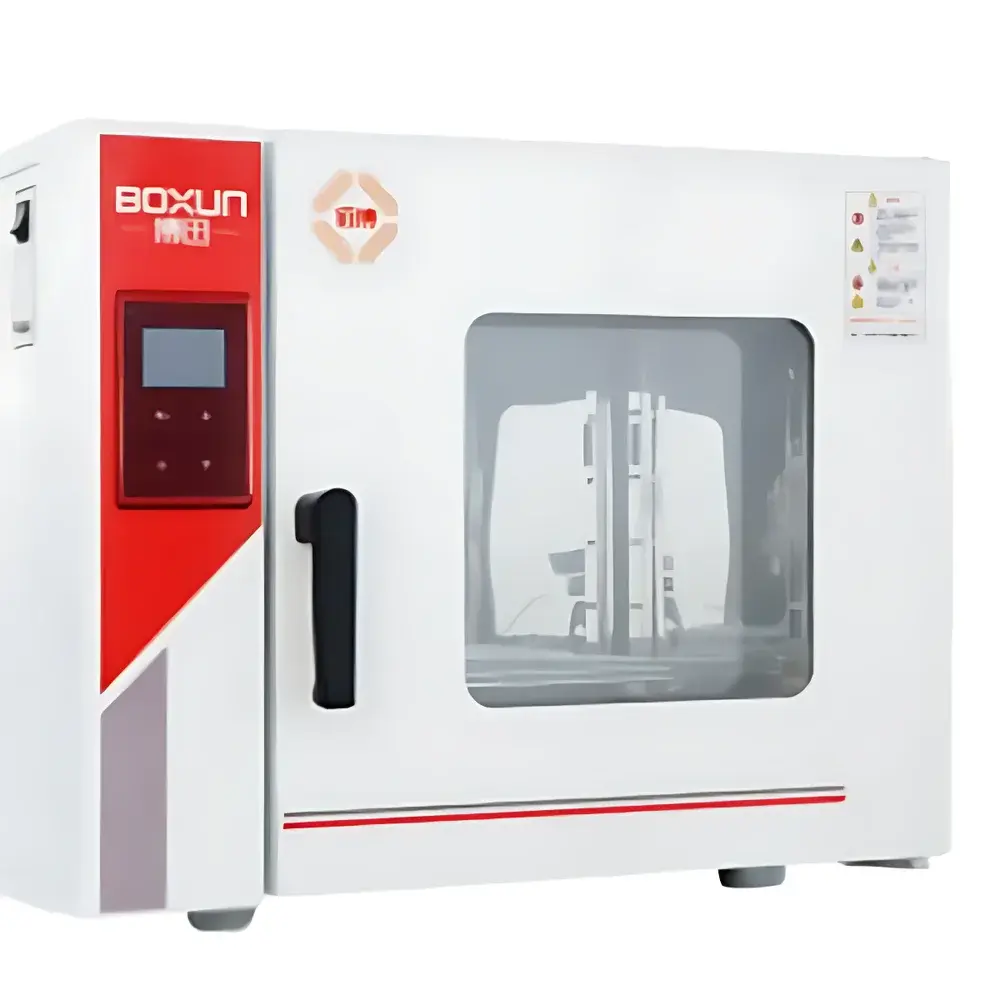
Boxun BGZ Series Forced-Air Drying Oven (Model BGZ-30 to BGZ-420)
| Brand | Boxun |
|---|---|
| Origin | Shanghai, China |
| Model | BGZ-30 |
| Temperature Range | RT+5°C to 250°C |
| Temperature Uniformity | ±2% |
| Temperature Fluctuation | ±1°C at 105°C |
| Control Resolution | 0.1°C |
| Internal Chamber Dimensions (L×W×H) | 350×330×350 mm |
| External Dimensions (L×W×H) | 640×555×505 mm |
| Heating Method | Forced-air convection with adjustable fan speed (6-step) |
| Insulation | High-efficiency mineral fiber |
| Inner Chamber Material | Mirror-finish stainless steel (AISI 304) |
| Power Supply | AC 220V±10%, 50Hz±2% (BGZ-30–BGZ-240) |
| Input Power | 950 W (BGZ-30) to 3100 W (BGZ-420) |
| Timer Range | 0–9999 min/h (selectable) |
| Programmable Control | 10 segments × 100 cycles |
| Communication Interface | RS-485 |
| Compliance | GB/T 30435–2013 |
Overview
The Boxun BGZ Series Forced-Air Drying Oven is an engineered solution for precise, repeatable thermal processing in laboratory and industrial quality control environments. Designed according to GB/T 30435–2013, this series employs a robust forced-convection architecture—featuring a high-efficiency PMMA II microprocessor-based controller, a sealed chamber with double-layer insulated walls, and a preheated air inlet system—to ensure rapid heating, stable setpoint maintenance, and uniform temperature distribution across the working volume. Unlike natural convection ovens, the BGZ series utilizes a shielded centrifugal blower and six-stage adjustable airflow to actively circulate heated air, minimizing thermal stratification and enabling consistent drying, sterilization, and heat-treatment outcomes—even with heterogeneous or powder-based samples. Its operational range (RT+5°C to 250°C), combined with ±1°C temperature fluctuation (measured at 105°C) and ±2% spatial uniformity, meets routine requirements for ASTM D1654 (coating drying), ISO 5725 (precision testing), and USP (sterile processing validation).
Key Features
- Mirror-finish AISI 304 stainless steel interior chamber—corrosion-resistant, non-porous, and compliant with GLP cleaning protocols;
- Preheated air mixing chamber upstream of the working space—reduces thermal lag and improves ramp rate (>4°C/min at 180°C);
- Six-step programmable fan speed control—suppresses dust dispersion during drying of particulate or powdered specimens;
- Rotary dual-latch door mechanism with high-compression silicone gasket—ensures leak-tight sealing and minimizes ambient air infiltration;
- PMMA II touchscreen interface with color LCD—supports real-time parameter display, multi-segment programming (10 segments × 100 cycles), countdown timer, and delay-start scheduling;
- RS-485 serial interface—enables integration with LIMS or SCADA systems for audit-trail-capable data logging (compatible with FDA 21 CFR Part 11–compliant software);
- Auto-recovery function—resumes prior operating conditions after power interruption, preserving process integrity and eliminating manual reconfiguration;
- Chamfered internal corners and slide-out shelves—facilitate complete cavity access and residue-free cleaning per ISO 14644 cleanroom maintenance standards.
Sample Compatibility & Compliance
The BGZ series accommodates a broad spectrum of sample types—including glassware, metal components, polymer films, pharmaceutical excipients, soil aggregates, and microbiological media plates—without compromising thermal fidelity. Its stainless steel construction and absence of organic insulation binders prevent outgassing contamination, making it suitable for applications requiring low-volatility environments (e.g., residual solvent removal per ICH Q5C). The oven complies with national standard GB/T 30435–2013 for electrically heated drying ovens and supports traceable calibration per ISO/IEC 17025 requirements. Optional validation packages include IQ/OQ documentation templates aligned with GMP Annex 15 and EU GMP Chapter 3 expectations for thermal equipment qualification.
Software & Data Management
Equipped with RS-485 connectivity, the BGZ oven interfaces seamlessly with third-party data acquisition platforms (e.g., LabVIEW, WinCC, or custom Python-based monitoring suites). The controller logs timestamped temperature profiles, alarm events, and runtime statistics—retaining up to 30 days of local history. When paired with validated PC software, full electronic records—including user identity, parameter changes, and deviation alerts—are generated with immutable audit trails satisfying 21 CFR Part 11 Subpart B requirements. All firmware updates are digitally signed and version-controlled, ensuring long-term compliance continuity during regulatory inspections.
Applications
- Moisture content determination (ASTM D2231, ISO 712);
- Thermal stability testing of active pharmaceutical ingredients (APIs) and excipients;
- Drying of filter papers, crucibles, and volumetric glassware prior to gravimetric analysis;
- Heat treatment of calibration standards and reference materials;
- Accelerated aging studies for packaging materials (ISO 11607);
- Pre-sterilization conditioning of surgical instruments and labware;
- Post-curing of composite resins and ceramic precursors;
- Residual solvent evaporation in analytical sample preparation workflows.
FAQ
What is the maximum operating temperature of the BGZ series?
The BGZ ovens are rated for continuous operation up to 250°C, with thermal cut-off protection activated at 270°C.
Does the BGZ series support GLP-compliant data archiving?
Yes—when used with validated external software, the RS-485 interface enables secure, time-stamped data export with user authentication and change tracking per GLP principles.
Can the fan speed be adjusted independently of temperature setpoint?
Yes—the six-stage airflow control operates independently, allowing optimization for sensitive powders, fragile coatings, or high-mass loads without altering thermal parameters.
Is the inner chamber accessible for cleaning verification?
Absolutely—the removable shelves, chamfered corners, and smooth stainless surface permit visual inspection, swab sampling, and ATP bioluminescence testing per cleaning validation SOPs.
How is temperature uniformity verified during installation qualification (IQ)?
Uniformity is assessed using a minimum of nine calibrated PT100 sensors placed across the working volume per ISO 14644-3, with results documented in the IQ report against the ±2% specification.



