
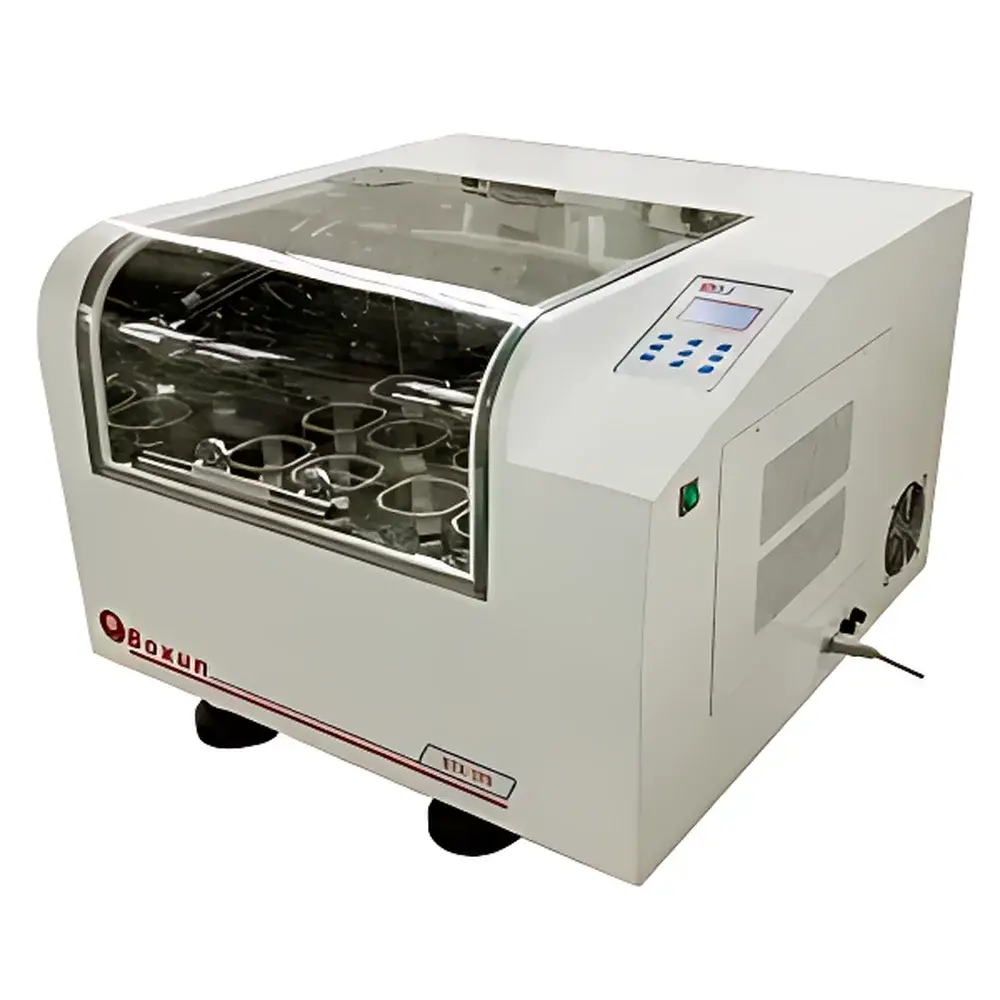
Boxun BSD-TX345 Benchtop Orbital Shaker
| Brand | Boxun |
|---|---|
| Origin | Shanghai, China |
| Manufacturer Type | Direct Manufacturer |
| Product Category | Domestic |
| Model | BSD-TX345 |
| Price Range | USD 1,400–2,800 |
| Instrument Type | Full-Temperature Orbital Shaker |
| Timer Range | 0–999 h |
| Oscillation Frequency | 30–250 rpm (up to 600 rpm at amplitude <5 mm) |
| Orbit Diameter | Φ0–40 mm (infinitely adjustable) |
| Temperature Control Range | RT+6°C to 60°C |
| Temperature Uniformity | ±1°C at 37°C |
| Temperature Accuracy | ±0.1°C |
| Chamber Volume | 45 L |
| Platform Dimensions | 400 × 370 mm |
| Platform Quantity | 1 |
| Power Consumption | 700 W |
| Input Voltage | AC 220 V, 50/60 Hz |
| Display | Backlit LCD with PID microprocessor control |
| Drive System | Single-axis orbital drive |
| Motor Type | Brushless DC motor |
| Safety Features | Over-temperature audiovisual alarm, power-failure recovery, parameter lock, acceleration ramp control |
Overview
The Boxun BSD-TX345 Benchtop Orbital Shaker is an integrated full-temperature orbital incubator shaker engineered for precision cell culture, microbial growth, enzyme assays, and biochemical solubilization applications in academic research labs, QC microbiology units, and bioprocess development facilities. It operates on the principle of controlled orbital motion—generating uniform, low-shear agitation via a single-axis rotating drive mechanism—to ensure consistent oxygen transfer and suspension homogeneity across diverse sample formats. Unlike reciprocating or vortex shakers, the BSD-TX345’s orbital trajectory (adjustable from Φ0 to Φ40 mm) enables scalable aeration without excessive foam formation or shear-induced cell lysis. Its temperature-controlled chamber (RT+6°C to 60°C), combined with high-stability PID regulation (±0.1°C setpoint accuracy, ±1°C uniformity at 37°C), supports simultaneous thermal and mechanical conditioning—critical for aerobic fermentation, protein expression in E. coli, and mammalian suspension culture.
Key Features
- Infinitely adjustable orbit diameter (Φ0–40 mm) enables precise tuning of mixing intensity and dissolved oxygen (DO) transfer rates for sensitive biological systems.
- Wide oscillation frequency range: 30–250 rpm standard; extends to 600 rpm when amplitude is reduced below 5 mm—supporting both gentle suspension and vigorous aeration protocols.
- Brushless DC motor delivers constant torque and speed stability across voltage fluctuations (AC 220 V, 50/60 Hz), eliminating brush wear and requiring zero routine maintenance.
- Microprocessor-based PID controller with environmental scanning logic continuously monitors chamber conditions and dynamically adjusts heating output to maintain thermal fidelity.
- Backlit LCD display shows real-time values for temperature, speed, orbit diameter, remaining time, and system status—alongside user-defined setpoints.
- Programmable timer (0–999 hours) with auto-restart and power-failure recovery ensures uninterrupted long-duration experiments (e.g., overnight bacterial growth curves or multi-day induction protocols).
- Parameter lock function prevents accidental modification of operational settings during active runs—essential for GLP-compliant workflows and shared-lab environments.
- Controlled acceleration ramp minimizes mechanical shock during startup, protecting fragile cultures, agarose gels, or fragile assay plates placed directly on the platform.
Sample Compatibility & Compliance
The BSD-TX345 accommodates standard laboratory vessels including Erlenmeyer flasks (250 mL × 8 standard load), test tubes, deep-well plates, and custom containers up to 1 L capacity (max 4 × 1000 mL). Its 400 × 370 mm stainless-steel platform supports universal clamping accessories (sold separately) for secure mounting of flask holders, tube racks, or microplate adapters. The unit complies with IEC 61010-1:2010 safety standards for laboratory electrical equipment and meets electromagnetic compatibility (EMC) requirements per EN 61326-1. While not certified for ISO 13485 or FDA 21 CFR Part 11 out-of-the-box, its parameter logging capability (via optional RS-232/USB interface) supports audit-ready data capture when integrated into validated SOPs under GMP/GLP frameworks.
Software & Data Management
The BSD-TX345 operates autonomously via its embedded microcontroller and does not require external software for basic operation. However, optional communication modules enable serial (RS-232) or USB connectivity for remote monitoring and data export to CSV or Excel-compatible formats. Logged parameters include timestamped temperature, speed, orbit setting, elapsed time, and alarm events—facilitating traceability in regulated environments. Firmware supports user-defined profile storage (up to 10 programs), enabling rapid recall of validated methods such as “E. coli BL21(DE3) induction at 37°C, 200 rpm, Φ25 mm” without manual reconfiguration.
Applications
- Microbial cultivation (bacteria, yeast, fungi) under controlled temperature and aeration conditions.
- Recombinant protein expression in liquid culture media with tunable DO levels.
- Suspension-based mammalian cell expansion prior to transfection or bioreactor inoculation.
- Enzyme kinetics studies requiring homogeneous mixing and stable thermal environment.
- Antibiotic susceptibility testing (AST) and minimum inhibitory concentration (MIC) assays.
- Extraction optimization for metabolites, nucleic acids, or intracellular proteins.
- Standardization of sample preparation for downstream HPLC, ELISA, or NGS library construction.
FAQ
What is the maximum flask size supported on the BSD-TX345 platform?
The platform accommodates up to four 1000 mL Erlenmeyer flasks simultaneously, or twenty-three 50 mL tubes—subject to balanced loading and secure clamping.
Does the shaker support external data logging or network integration?
Yes—optional RS-232 or USB interface modules enable real-time parameter streaming and event-triggered data export for LIMS or ELN integration.
Is the temperature calibration traceable to national standards?
Factory calibration is performed using NIST-traceable reference thermometers; users may perform field verification and adjustment via the service menu using a calibrated probe.
Can the unit operate continuously for more than 24 hours?
Yes—the 999-hour timer and power-failure recovery function support unattended multi-day operation without manual intervention.
What safety protections are built into the temperature control system?
Independent over-temperature cutoff circuitry triggers audible/visual alarms and cuts heater power if chamber temperature exceeds setpoint by >5°C—preventing sample degradation or thermal runaway.





