
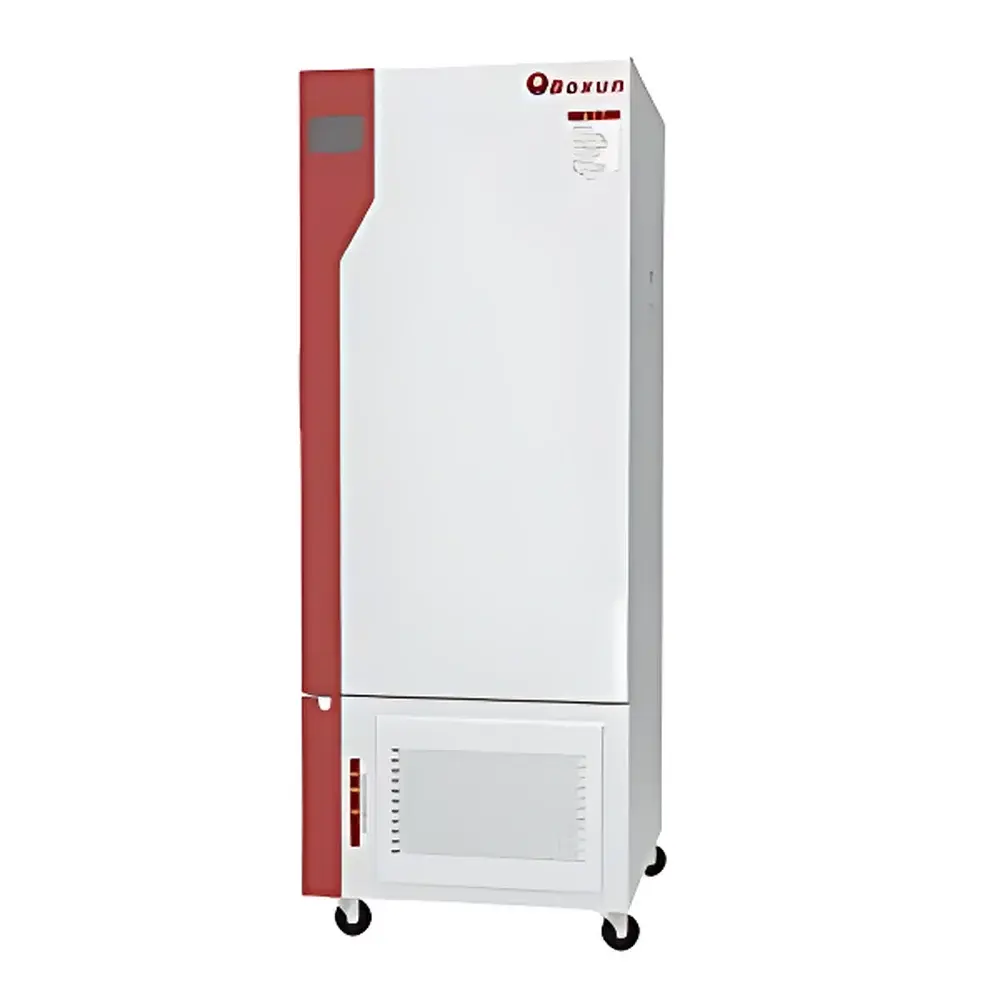
Boxun BXY-250 Drug Stability Testing Chamber
| Brand | Boxun |
|---|---|
| Origin | Shanghai, China |
| Manufacturer Type | Direct Manufacturer |
| Country of Origin | China |
| Model | BXY-250 |
| Price Range | USD 2,800 – 7,000 |
| Temperature Control Range | 0–70 °C |
| Temperature Resolution | 0.1 °C |
| Temperature Uniformity (at 25 °C) | ±1 °C |
| Temperature Fluctuation (at 25 °C) | ±0.5 °C |
| Humidity Control Range | 25–95 %RH |
| Humidity Fluctuation | ±3 %RH |
| Input Power | 1750 W |
| Programmable Stages | 30 segments × 99 cycles |
| Segment Duration Range | 1–9999 hours per segment |
| Internal Chamber Dimensions (L×W×H) | 510×450×1090 mm |
| External Dimensions (L×W×H) | 650×740×1726 mm |
| Standard Shelves | 4 pcs (max. 7 pcs) |
| Data Storage Capacity | 250,000 records |
| Real-time Data View | Last 1600 entries |
| Interface | USB + RS485 |
| Standard Accessories | Mechanical door lock, embedded thermal printer |
| Optional Accessories | GPRS SMS alarm module, FDA-compliant monitoring software, GMP-compliant monitoring software, wireless temperature/humidity data loggers (with calibration certificates), IQ/OQ/PQ validation documentation |
Overview
The Boxun BXY-250 Drug Stability Testing Chamber is an ICH-compliant environmental simulation system engineered for long-term and accelerated stability studies of pharmaceutical products in accordance with ICH Q1A(R2), Q5C, and Q5D guidelines. It provides precise, reproducible control of temperature (0–70 °C), relative humidity (25–95 %RH), and optional light exposure—critical parameters defined in regulatory protocols for assessing chemical degradation, physical changes, and shelf-life prediction of active pharmaceutical ingredients (APIs), finished dosage forms, and biologics. Designed specifically for GLP- and GMP-aligned laboratories, the chamber integrates a dual-loop fuzzy PID control architecture with variable-frequency refrigeration, C.H. heat-recycling technology, and high-accuracy imported humidity sensors to minimize thermal lag and ensure rapid recovery (<15 min) following door openings—essential for maintaining protocol integrity during routine sampling.
Key Features
- 4.3-inch TFT LCD touchscreen interface with 16-bit true-color display and intuitive touch navigation
- 30-segment × 99-cycle programmable controller running on Windows CE OS with high-frequency CPU and expanded memory for complex multi-condition protocols
- Imported energy-efficient compressor, high-static-pressure centrifugal fan, and capacitive humidity sensor (±1.5 %RH accuracy) for stable climatic performance
- Real-time logging of temperature and humidity data (250,000-point internal memory); last 1600 entries viewable directly on screen
- USB and RS485 communication interfaces supporting data export, remote monitoring, and integration with LIMS or SCADA systems
- Embedded thermal printer for immediate hard-copy output of chamber status, alarms, and parameter logs
- Comprehensive safety suite: over-temperature cut-off, door-open alarm, low-water level alert, sensor fault detection, and password-protected screen lock
- Optimized thermal architecture featuring C.H. (Cycle Heat) recirculation system to reduce heating energy consumption by up to 22% versus conventional designs
Sample Compatibility & Compliance
The BXY-250 accommodates standard pharmaceutical packaging formats—including blister packs, vials, syringes, bottles, and sachets—on up to seven adjustable stainless-steel shelves (4 supplied). Its interior chamber (510 × 450 × 1090 mm) supports ICH Zone IVb (30 °C/75 %RH) and Zone III (30 °C/65 %RH) testing conditions without condensation or stratification. All operational parameters comply with ISO 14644-1 Class 8 cleanroom-compatible airflow design principles. The system meets mechanical and electrical safety requirements per IEC 61010-1 and is suitable for installation in qualified environments under FDA 21 CFR Part 11 (when paired with FDA Edition monitoring software), EU Annex 11, and WHO TRS 986 Annex 6. Optional 3Q (IQ/OQ/PQ) validation documentation packages are available to support GMP audits and regulatory submissions.
Software & Data Management
Data integrity is ensured through time-stamped, tamper-evident event logging—including power-on/off, parameter modifications, alarm triggers, and door access events—all exportable via USB in CSV or PDF format. The FDA Edition and GMP Edition monitoring software provide role-based user access control, electronic signatures, audit trails, and automatic report generation compliant with ALCOA+ principles. Wireless temperature/humidity data loggers (optional) feature NIST-traceable calibration certificates at three points (0 °C, 60 °C, 121 °C) or three RH/Temp combinations (15 °C/40 %RH, 20 °C/60 %RH, 30 °C/80 %RH), enabling full traceability for equipment qualification and ongoing performance verification.
Applications
- ICH Q1A(R2) accelerated stability testing (40 °C/75 %RH, 30 °C/65 %RH)
- Long-term storage condition assessment (25 °C/60 %RH, 30 °C/65 %RH)
- Intermediate condition studies (30 °C/65 %RH)
- Photostability testing per ICH Q5B (when equipped with UV/visible light modules)
- Excipient compatibility screening and formulation development support
- Stability-indicating method validation under stressed conditions
- Biological product real-time and accelerated stability programs (e.g., monoclonal antibodies, vaccines)
FAQ
Does the BXY-250 meet ICH Q1 requirements for stability testing?
Yes—the chamber delivers the temperature and humidity tolerances specified in ICH Q1A(R2) and Q5C, including ±0.5 °C temperature fluctuation and ±3 %RH humidity fluctuation at setpoints.
Can the system be integrated into a centralized laboratory monitoring network?
Yes—via RS485 Modbus RTU protocol or optional FDA/GMP software with Ethernet connectivity, enabling centralized oversight across multiple chambers.
Is 3Q validation support included with purchase?
No—3Q documentation (IQ/OQ/PQ) is available as a separately commissioned service, aligned with ASTM E2500 and EU GMP Annex 15.
What calibration options are available for traceability?
NIST-traceable wireless loggers with certified calibration points (temperature only or combined temp/RH) can be supplied with full metrology reports.
How does the C.H. heat-recycling system improve energy efficiency?
By capturing and reusing residual heat from the refrigeration cycle during heating phases, the C.H. system reduces compressor cycling frequency and lowers average power draw by approximately 22%.




