
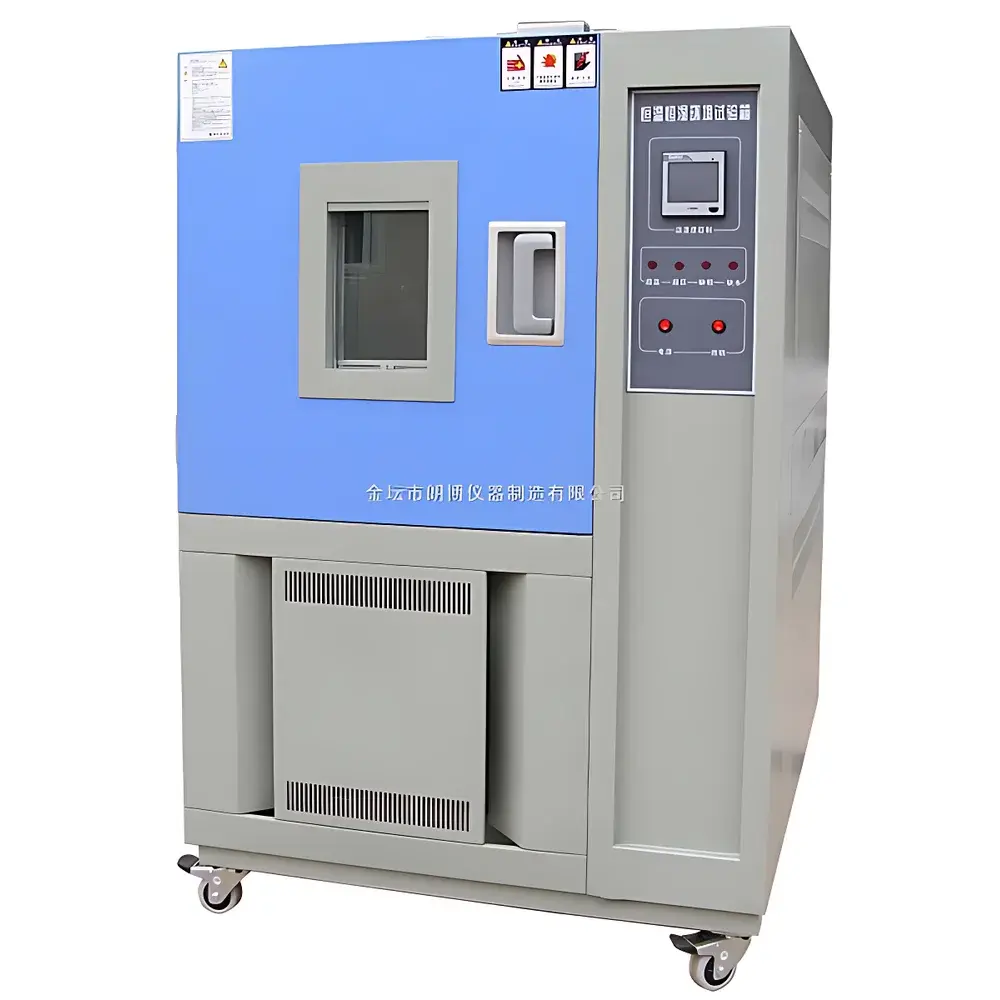
Langbo HUS-100 Rust Preventive Oil Humidity-Temperature Test Chamber
| Brand | Langbo |
|---|---|
| Model | HUS-100 |
| Temperature Range | RT+10°C to 65°C |
| Temperature Uniformity | ±2°C |
| Temperature Fluctuation | ±0.5°C |
| Temperature Deviation | ±2°C |
| Humidity Range | ≥95% RH |
| Humidity Uniformity | +2% / −3% RH |
| Humidity Fluctuation | ±2% RH |
| Air Exchange Rate | 3× chamber volume per hour (adjustable) |
| Specimen Rack Rotation Speed | 1 rpm per 3 min (±10%, adjustable) |
| Chamber Water Depth | 200 mm |
| Power Supply | AC 380 V ±10%, 50 Hz, 3-phase 5-wire |
| Rated Power | 4.5 kW |
| Internal Dimensions (W×D×H) | 450×450×500 mm |
| Compliance | GB/T 23619–2009 |
Overview
The Langbo HUS-100 Rust Preventive Oil Humidity-Temperature Test Chamber is a precision-engineered environmental test system designed specifically for evaluating the corrosion-inhibiting performance of rust preventive oils under controlled high-humidity, elevated-temperature conditions. It operates on the principle of accelerated wet-heat aging—maintaining a stable thermal and hygrometric environment that replicates aggressive atmospheric storage or transport conditions. Per GB/T 23619–2009 (“Test Method for Rust Preventive Oils under Humid Heat Conditions”), the chamber sustains a nominal test condition of 49 °C ±2 °C and ≥95% relative humidity (RH), with rigorous control over air exchange, specimen rotation, and condensate management. Its robust stainless-steel inner chamber, double-wall insulation, and integrated water-heating humidification system ensure long-term stability and repeatability across extended exposure cycles—critical for QC laboratories validating oil formulations, batch release testing, or comparative performance benchmarking against industry benchmarks.
Key Features
- Intelligent PID + SSR temperature & humidity control system with high-resolution digital display, touch-sensitive interface, and auto-tuning capability for minimized operator intervention and enhanced setpoint stability.
- Specimen rotation rack engineered to comply precisely with GB/T 23619–2009: rotates at 1 revolution per 3 minutes (±10%, field-adjustable), with dedicated oil-collection tray beneath to prevent cross-contamination and enable quantitative residue analysis.
- Forced-air ventilation subsystem delivering ≥3× internal chamber volume per hour, incorporating particulate filtration (HEPA-grade pre-filter), calibrated rotameter flow control, and non-corrosive ducting to ensure consistent oxygen supply and vapor homogeneity.
- Water-heated humidification system with 200 mm deep reservoir, eliminating steam-spray inconsistencies and ensuring uniform RH distribution without localized condensation on specimens or sensors.
- Triple-layer thermal insulation (foam + aluminum foil + air gap) and seamless welded SUS304 interior minimize thermal leakage and reduce energy consumption while maintaining ±0.5 °C temperature fluctuation and ≤±2 °C spatial uniformity.
- Comprehensive safety architecture including over-temperature cut-off, dry-run protection for heater elements, real-time fault logging, and audible/visual alarm signaling during operational anomalies.
Sample Compatibility & Compliance
The HUS-100 accommodates standardized ferrous test panels (e.g., ASTM D665A/D665B, ISO 7384, or GB/T 23619–2009-specified steel coupons) mounted on the rotating rack. Panel spacing, orientation, and exposure geometry conform to national and international rust evaluation protocols. The chamber’s design supports full traceability in regulated environments: all control parameters—including temperature, humidity, airflow rate, rotation timing, and runtime—are digitally recorded and exportable in CSV format. While not inherently 21 CFR Part 11 compliant, its data logging architecture permits integration with validated LIMS or ELN platforms supporting GLP/GMP workflows. Calibration certificates for integrated Pt100 sensors and humidity transducers are available upon request, aligned with ISO/IEC 17025-accredited metrology practices.
Software & Data Management
The embedded microcontroller features a non-volatile memory buffer retaining up to 30 days of continuous 1-minute interval logs (temperature, RH, runtime). Data export is supported via USB port (no proprietary software required); raw files contain timestamped values with sensor ID and unit metadata. Optional RS485 Modbus RTU interface enables remote monitoring and centralized control within existing facility SCADA or MES systems. All setpoints, alarm thresholds, and runtime schedules are password-protected and support multi-level user access (operator, supervisor, administrator). Audit trail functionality records user login/logout events and parameter modifications—essential for internal quality audits and regulatory readiness.
Applications
- Accelerated corrosion resistance validation of solvent-based, emulsifiable, and greasy rust preventive compounds per GB/T 23619–2009 and equivalent regional standards.
- Batch-to-batch consistency testing for OEM lubricant suppliers supplying automotive, aerospace, or heavy machinery manufacturers.
- Formulation R&D for volatile corrosion inhibitors (VCI) packaging efficacy under sustained humid heat stress.
- Failure analysis of field-reported rust incidents by replicating suspected storage microclimates in controlled laboratory conditions.
- Supporting ISO 9001:2015 clause 8.5.1 (control of production and service provision) through documented environmental conditioning evidence.
FAQ
What standards does the HUS-100 directly support?
It is explicitly engineered to meet the operational requirements of GB/T 23619–2009; its air exchange rate, rotation speed, temperature/humidity tolerances, and specimen mounting geometry align with this standard.
Can the chamber operate continuously for 999 hours without interruption?
Yes—the timer supports up to 999 hours of uninterrupted operation with automatic shutdown and alarm activation upon completion or fault detection.
Is the humidity control based on steam generation or water evaporation?
Humidity is generated exclusively via heated water reservoir evaporation, avoiding mineral deposition, sensor drift, or droplet contamination associated with ultrasonic or steam-based systems.
Does the unit include calibration documentation?
Factory calibration reports for temperature and humidity sensors are provided; third-party ISO/IEC 17025 calibration services can be arranged separately.
What maintenance intervals are recommended?
Monthly inspection of water reservoir cleanliness and filter replacement; quarterly verification of rotation speed accuracy and annual thermohygrometer recalibration are advised per manufacturer guidelines.



