
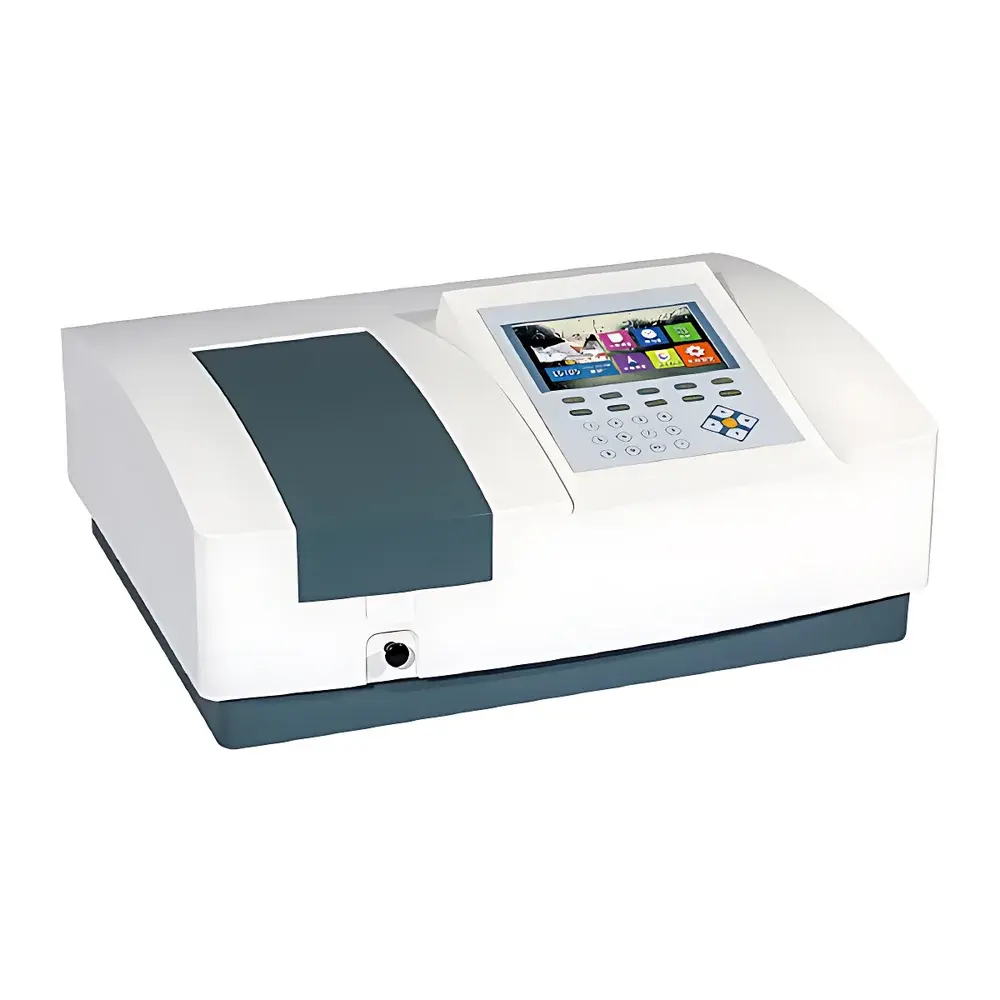
Yoke N5000 UV-Vis Spectrophotometer
| Brand | Yoke |
|---|---|
| Origin | Shanghai, China |
| Manufacturer Type | Direct Manufacturer |
| Model | N5000 |
| Optical System | Pseudo-Double-Beam (Ratio Monitoring) |
| Detector | Photodiode Array (PDA) |
| Wavelength Range | 190–1100 nm |
| Wavelength Accuracy | ±0.1 nm @ 656.1 nm (D₂ line), ±0.3 nm across full range |
| Spectral Bandwidth | 1.8 nm |
| Stray Light | ≤0.03% T |
| Wavelength Repeatability | ≤0.1 nm |
| Baseline Flatness | ±0.001 A |
| Photometric Accuracy | ±0.002 A (0–0.5 A), ±0.004 A (0.5–1.0 A), ±0.2% T (0–100% T) |
| Stability | ±0.0005 A/h @ 500 nm |
| Light Sources | Imported Deuterium & Tungsten Lamps |
| Display | 7-inch TFT Color LCD |
| Data Interface | USB & RS-232 |
| Power Supply | AC 110/220 V, 50/60 Hz |
| Dimensions (L×W×H) | 545 × 468 × 245 mm |
| Weight | ~16 kg |
Overview
The Yoke N5000 UV-Vis Spectrophotometer is a high-performance, pseudo-double-beam scanning spectrophotometer engineered for precision quantitative and qualitative analysis in routine laboratory environments. Based on the principle of absorption spectroscopy, it measures the intensity of light transmitted through or reflected from a sample as a function of wavelength across the ultraviolet and visible spectrum (190–1100 nm). Its ratio-monitoring optical architecture—often referred to as a “pseudo-double-beam” configuration—compensates for fluctuations in source intensity by continuously comparing sample and reference beam intensities using a single photodiode array (PDA) detector. This design delivers enhanced baseline stability and reduced drift compared to single-beam systems, without the mechanical complexity and cost of true dual-beam optics. The instrument meets key performance criteria outlined in pharmacopoeial standards—including USP , EP 2.2.25, and ChP IV—particularly with respect to spectral bandwidth (1.8 nm), stray light (<0.03% T), and wavelength accuracy (±0.1 nm at the deuterium emission line).
Key Features
- Pseudo-double-beam optical path with real-time reference beam monitoring for improved photometric stability and minimized baseline drift.
- High-resolution 7-inch TFT color LCD touchscreen interface with intuitive graphical navigation and digital membrane keypad input.
- Embedded ARM7 processor coupled with high-precision analog-to-digital conversion circuitry ensures rapid spectral acquisition, low-noise signal processing, and reliable data integrity.
- Optimized optical bench featuring reinforced baseplate and imported optical mounting components to maintain long-term alignment and mechanical robustness.
- Integrated dual-lamp system (imported deuterium lamp for UV region, tungsten-halogen lamp for visible/NIR) with automatic lamp switching and lifetime monitoring.
- Comprehensive connectivity suite including USB host port (supports direct data export to USB flash drives), RS-232 serial interface for legacy instrument integration, and optional PC control via dedicated software.
Sample Compatibility & Compliance
The N5000 accommodates standard 10-mm rectangular quartz or glass cuvettes, as well as optional accessories such as micro-volume holders, fiber-optic probes, and solid-sample reflectance attachments. It supports absorbance (A), transmittance (T), concentration (C), and kinetic (E) measurement modes. Instrument validation protocols align with GLP and GMP requirements: wavelength accuracy and photometric linearity are traceable to NIST-certified standards; stray light and spectral bandwidth comply with ISO 9001–certified manufacturing controls. While not pre-certified for FDA 21 CFR Part 11, the system’s audit-ready data logging—via timestamped, user-ID-tagged spectra stored in CSV or proprietary binary formats—facilitates implementation of electronic signature workflows when deployed within validated IT infrastructure.
Software & Data Management
The N5000 operates with embedded firmware supporting standalone operation, while optional PC-based software enables advanced spectral processing—including peak identification, derivative analysis, multi-component quantitation, and spectral subtraction. All acquired spectra are timestamped and tagged with operator ID, method name, and instrument serial number. Internal memory stores up to 2,000 full-spectrum scans; external storage via USB expands capacity indefinitely. Export formats include ASCII (.csv), JCAMP-DX (.jdx), and PNG for reporting. Data files retain metadata required for regulatory review, and software update logs are retained for change-control documentation per ISO/IEC 17025 Section 5.9.
Applications
This spectrophotometer serves core analytical functions across pharmaceutical QC labs (e.g., assay of active pharmaceutical ingredients per USP monographs), environmental testing (nitrate, phosphate, COD analysis), food & beverage quality control (colorimetric assays, preservative quantification), academic teaching laboratories (Beer–Lambert law verification, enzyme kinetics), and materials science (thin-film transmittance, nanoparticle plasmon resonance characterization). Its 1.8 nm spectral bandwidth satisfies pharmacopoeial resolution requirements for identity testing, while low stray light enables accurate measurements of highly absorbing samples near 0% T.
FAQ
What does “pseudo-double-beam” mean in this context?
It refers to an optical design where a single beam is split into sample and reference paths using a rotating mirror or beam splitter, with both intensities measured sequentially by the same PDA detector—enabling real-time ratio correction without requiring two independent detectors.
Is the N5000 compliant with pharmacopoeial wavelength accuracy requirements?
Yes: its ±0.1 nm accuracy at 656.1 nm (D₂ line) and ±0.3 nm over 190–1100 nm meets USP and EP 2.2.25 specifications for wavelength calibration verification.
Can the instrument be integrated into a LIMS environment?
Yes—via RS-232 or USB virtual COM port, enabling automated data transfer using standard SCPI or custom ASCII command sets; integration requires middleware configuration per lab-specific LIMS architecture.
What maintenance is required for long-term photometric stability?
Annual verification of lamp output, wavelength calibration, and stray light performance is recommended; deuterium lamp replacement is typically required every 1,000–1,500 operating hours.
Does the system support GLP-compliant audit trails?
Raw data files include embedded timestamps, operator IDs, and method parameters; full audit trail functionality (e.g., user action logging, edit history) requires deployment with validated third-party software or custom IT validation.
Related Products






