
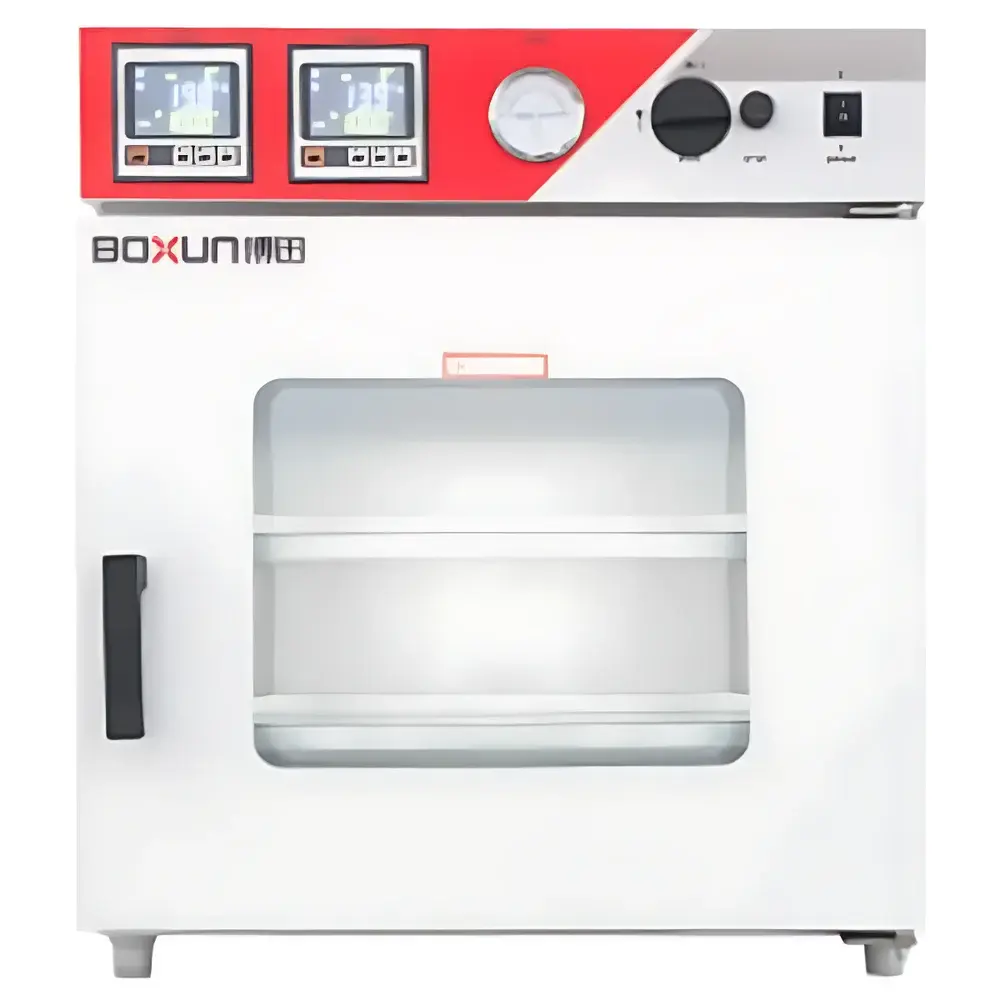
BOXUN BZF-50 Vacuum Drying Oven
| Brand | BOXUN |
|---|---|
| Origin | Shanghai, China |
| Model | BZF-50 |
| Capacity | 50 L |
| Temperature Range | Ambient +5°C to 250°C |
| Temperature Uniformity | ±0.5°C |
| Temperature Resolution | 0.1°C |
| Vacuum Level | ≤133 Pa |
| Interior Dimensions (W×D×H) | 415×370×345 mm |
| Exterior Dimensions (W×D×H) | 575×550×675 mm |
| Interior Material | SUS304 Stainless Steel |
| Heating Method | Forced-air Circulation with Heated Chamber Walls |
| Power Supply | 220 V ±10%, 50/60 Hz |
| Input Power | 900 W |
| Operating Ambient Temperature | 5–40°C |
| Door | Double-layer Tempered Glass with Adjustable Silicone Gasket |
| Control Interface | LCD Display with Microcontroller-based PID Controller |
| Communication | RS485 Port with PC Connectivity and Data Logging Software |
| Safety Features | Over-temperature Alarm, Auto-recovery After Power Interruption, Parameter Memory Retention |
Overview
The BOXUN BZF-50 Vacuum Drying Oven is an engineered solution for precise, low-thermal-stress dehydration of heat-sensitive, oxidation-prone, or compositionally complex samples. Unlike conventional convection ovens, it operates under controlled negative pressure—typically down to ≤133 Pa—to lower the boiling point of solvents and moisture, enabling drying at significantly reduced temperatures while preserving structural integrity and chemical stability. This principle is critical in applications where thermal degradation, decomposition, or unintended oxidation must be avoided—such as lyophilization pre-treatment, active pharmaceutical ingredient (API) stabilization, polymer solvent removal, or preparation of electron microscopy specimens. The unit’s forced-air circulation heating system ensures uniform thermal distribution across the stainless-steel chamber, minimizing axial and radial temperature gradients and supporting reproducible process outcomes compliant with GLP and ISO 17025 laboratory practice requirements.
Key Features
- Chamber constructed from mirror-finish SUS304 stainless steel with seamless, radius-cornered interior for full cleanability and corrosion resistance—essential for repeated sterilization cycles and residue-free operation.
- Double-layer tempered glass door with adjustable silicone gasket provides real-time visual monitoring while maintaining high vacuum integrity; door tension is user-tunable to accommodate gasket compression aging over time.
- Microprocessor-based PID temperature controller with LCD interface delivers setpoint accuracy of ±0.5°C and resolution of 0.1°C; includes programmable timer (0–9999 min), over-temperature cut-off, and automatic parameter retention during power failure.
- RS485 serial interface enables integration into centralized lab data management systems; supplied software supports real-time parameter logging, alarm event timestamping, and export of CSV-formatted datasets for audit-ready documentation.
- Ergonomic, streamlined chassis fabricated from cold-rolled steel with eco-friendly metallic coating—designed for durability, electromagnetic compatibility (EMC), and alignment with modern laboratory aesthetic standards.
Sample Compatibility & Compliance
The BZF-50 accommodates a broad spectrum of sample formats including Petri dishes, weighing boats, glass vials, aluminum pans, and custom trays up to 415 mm wide. Its 50 L usable volume (415 × 370 × 345 mm) supports batch processing of biological tissues, ceramic precursors, catalyst powders, botanical extracts, and pharmaceutical granules without crowding-induced vapor diffusion limitations. The system meets baseline mechanical and electrical safety requirements per IEC 61010-1 and is compatible with common vacuum pump configurations (e.g., dual-stage rotary vane or diaphragm pumps). While not certified to UL or CE for standalone medical device use, its operational parameters align with ASTM E145-22 (Standard Specification for Gravity-Convection and Forced-Ventilation Ovens) and support method validation under USP and ISO 5600-2 for analytical sample preparation workflows.
Software & Data Management
The included PC software communicates via standard Modbus RTU protocol over RS485, enabling remote configuration of temperature ramps, hold times, vacuum sequencing (when paired with optional vacuum controller), and alarm thresholds. All operational events—including power loss recovery, setpoint changes, alarm triggers, and door opening—are time-stamped with millisecond precision and stored locally on the controller’s non-volatile memory. Data exports comply with 21 CFR Part 11 readiness when deployed with validated user access controls and electronic signature modules (available as optional add-ons). Audit trails are exportable in tamper-evident formats suitable for internal QA review or external regulatory inspection.
Applications
- Pharmaceutical R&D: Residual solvent removal from lyophilized formulations without amorphous phase collapse.
- Materials Science: Dehydration of metal-organic frameworks (MOFs) and perovskite precursors prior to calcination.
- Environmental Testing: Gravimetric moisture analysis of soil, sludge, or airborne particulate filters per EPA Method 505.
- Food & Agriculture: Low-temperature drying of enzyme-rich plant extracts and probiotic cultures.
- Electronics Manufacturing: Outgassing of encapsulated components prior to hermetic sealing.
FAQ
What vacuum level can the BZF-50 achieve without an external pump?
The unit does not include an integrated vacuum pump; it requires connection to an external pump (recommended ultimate vacuum ≤10 Pa) to reach its specified operating range of ≤133 Pa.
Is the temperature sensor calibrated traceable to NIST?
The built-in PT100 sensor is factory-calibrated; NIST-traceable calibration certificates are available upon request as a value-added service.
Can the BZF-50 be used for sterilization?
It is not designed or validated for microbiological sterilization; it supports dry-heat decontamination of glassware at ≥160°C per ISO 17665, but does not replace autoclave validation protocols.
Does the oven support ramp-and-soak temperature programming?
Yes—the microcontroller supports multi-segment temperature profiles with independent ramp rates and dwell times, configurable via the LCD interface or PC software.
What maintenance is required for long-term vacuum integrity?
Annual inspection of the silicone door gasket for compression set and periodic cleaning of the chamber seal groove with isopropyl alcohol are recommended; vacuum gauge calibration should be verified every 12 months.



