
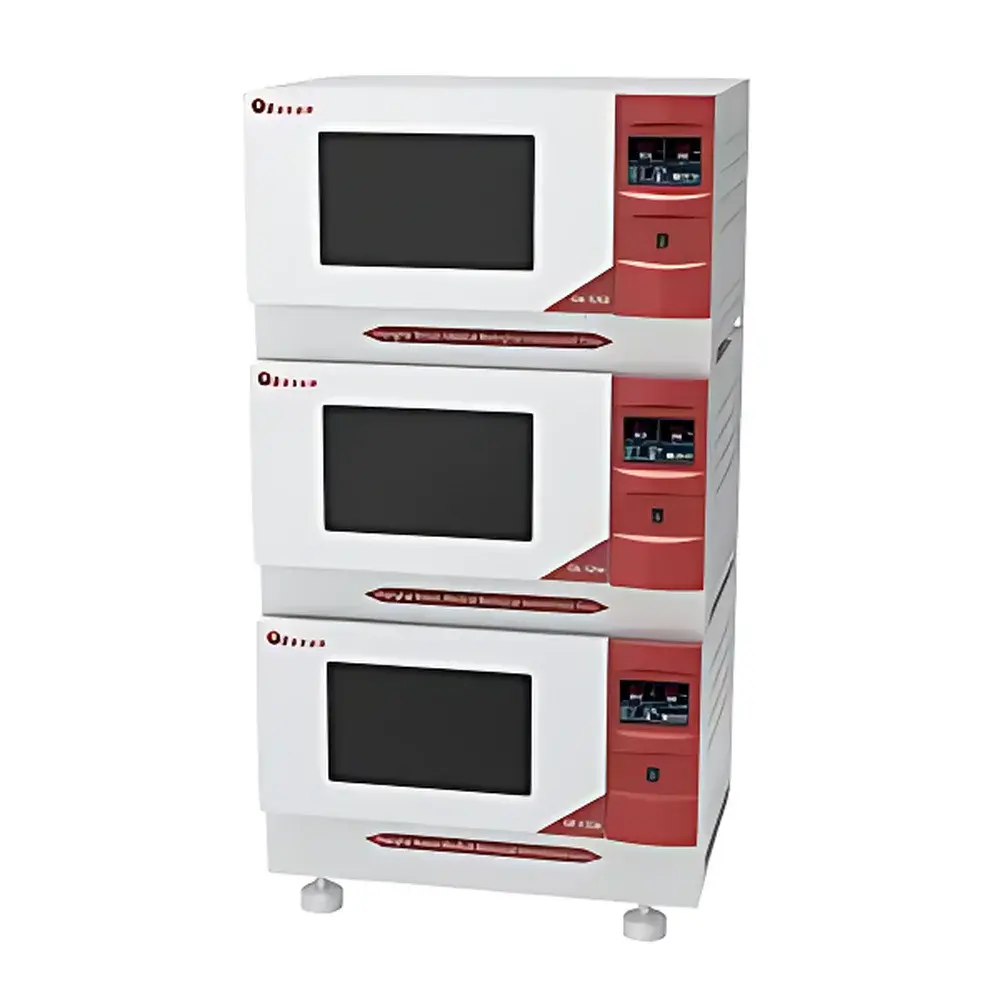
BOXUN DF(X)-125S(X) Stackable Incubated Shaker
| Brand | BOXUN |
|---|---|
| Origin | Shanghai, China |
| Manufacturer Type | Direct Manufacturer |
| Product Category | Domestic |
| Model | DF(X)-125S(X) |
| Instrument Type | Temperature-Controlled Orbital/Reciprocating Shaker |
| Timer Range | 0–1000 hours |
| Oscillation Speed | Reciprocating: 30–250 rpm ±1 rpm |
| Orbital | 30–300 rpm ±1 rpm |
| Oscillation Amplitude | Reciprocating: 35 mm |
| Orbital | Ø26 mm |
| Temperature Range | 4–60 °C |
| Temperature Uniformity (at 37 °C) | ±1.0 °C |
| Temperature Stability | ±0.2 °C |
| Control Resolution | 0.1 °C |
| Shelf Quantity | 1 per module (stackable up to 3 layers) |
| Power Input | AC 220 V, 50 Hz |
| Single-Layer Power Consumption | 1300 W |
| Chamber Volume | 125 L |
| Dimensions (2-layer) | 990 × 770 × 1275 mm |
| (3-layer) | 990 × 770 × 1855 mm |
Overview
The BOXUN DF(X)-125S(X) Stackable Incubated Shaker is an engineered solution for laboratories requiring high-density, multi-condition cultivation and mixing in constrained spatial environments. Designed around a modular stackable architecture, it enables vertical integration of up to three independently controlled incubation-shaking units—each operating with precise temperature regulation and programmable oscillation parameters. The system employs a dual-mode drive mechanism supporting both reciprocating (linear back-and-forth) and orbital (circular) motion, grounded in well-established fluid dynamics principles for optimal suspension homogeneity in microbial, mammalian, and enzymatic cultures. Its core thermal management utilizes PID-controlled forced-air circulation with high-efficiency heat exchange and real-time feedback from multiple platinum resistance thermometers (PT100), ensuring compliance with ISO 13485 environmental control requirements for bioprocess development and stability testing.
Key Features
- Modular stacking capability: Up to three layers can be assembled vertically, with bottom two layers featuring downward-opening doors and the top layer equipped with upward-opening auto-lift doors—optimized for ergonomic access and containment integrity.
- Independent per-layer control: Each unit maintains separate setpoints for temperature (4–60 °C), oscillation mode (reciprocating/orbital), speed (30–300 rpm), amplitude (35 mm or Ø26 mm), and timer (0–1000 h), enabling parallel experiments under divergent physiological conditions.
- Brushless DC motor drive: Delivers consistent torque across the full speed range, eliminates carbon brush wear, and ensures stable low-speed operation (<50 rpm) critical for sensitive cell suspensions and fragile tissue aggregates.
- Touchscreen HMI with data visualization: 7-inch capacitive display supports real-time plotting of temperature and speed profiles, historical data recall, password-protected parameter locking, and screen lock functionality to prevent accidental modification during long-duration runs.
- Enhanced safety and reliability: Integrated over-temperature alarm with audible/visual alert; power-fail recovery logic that resumes pre-interruption settings upon grid restoration; soft-start acceleration control to minimize mechanical shock to culture vessels.
- Ergonomic chamber design: Rounded internal corners with polymer trim facilitate cleaning and reduce microbial retention; slide-out platform secured by eccentric cam clamping allows rapid flask holder replacement without full tray removal.
Sample Compatibility & Compliance
The DF(X)-125S(X) accommodates standard laboratory glassware and disposable bioreactors—including 100 mL to 2000 mL Erlenmeyer flasks, baffled flasks, and multi-well plates—via configurable clamp systems. Its temperature uniformity (±1.0 °C at 37 °C) and stability (±0.2 °C) meet ASTM E2237-22 criteria for incubator performance validation. When configured with optional FDA-compliant monitoring software, the system supports 21 CFR Part 11 audit trails, electronic signatures, and change control logs—making it suitable for GLP and GMP-regulated environments including QC microbiology, vaccine process development, and stability-indicating assay preparation. Optional wireless temperature recorders (calibrated at 0 °C, 60 °C, and 121 °C) provide traceable validation data compliant with ISO/IEC 17025 requirements.
Software & Data Management
Standard firmware includes on-device data logging (up to 30 days of timestamped temperature/speed records), USB export, and password-protected configuration backup. Optional PC-based monitoring software offers remote supervision via RS-485 or Ethernet, real-time graphing, automated report generation (PDF/CSV), and configurable alarm notifications—including SMS alerts via integrated GPRS module. The FDA Edition adds role-based user access levels, immutable audit trails, and electronic signature workflows aligned with FDA guidance on computerized system validation (CSV). All software modules are validated per IQ/OQ protocols and support installation qualification documentation packages upon request.
Applications
This shaker serves as a primary platform for aerobic microbial cultivation (E. coli, yeast, Bacillus spp.), suspension cell line expansion (CHO, HEK293), enzyme kinetics assays, hybridization reactions, and biochemical oxygen demand (BOD) testing. It is routinely deployed in pharmaceutical R&D labs for media optimization studies, in academic molecular biology departments for plasmid amplification and protein expression screening, and in environmental testing facilities for wastewater biodegradability assessments. Its compact footprint and multi-zone flexibility make it especially valuable in core facilities, teaching laboratories, and contract development organizations where floor space efficiency and experimental throughput are prioritized.
FAQ
Can the DF(X)-125S(X) operate with different shaking modes simultaneously across stacked layers?
Yes—each layer functions as an autonomous unit with independent selection of reciprocating or orbital motion, speed, amplitude, temperature, and timing.
Is the system compatible with sterile workflow requirements?
The sealed chamber design, smooth non-porous interior surfaces, and autoclavable flask clamps support ISO 5 cleanroom integration when used with appropriate gowning and air handling protocols.
What validation documentation is available for regulated environments?
Factory-installed IQ/OQ protocols, calibration certificates for PT100 sensors, and optional third-party 21 CFR Part 11 compliance verification reports are provided upon order confirmation.
Does the shaker support external data acquisition via analog or digital interfaces?
Standard RS-485 communication is included; optional Ethernet/IP or Modbus TCP gateways enable integration into LabVantage, STARLIMS, or custom SCADA systems.
How is temperature uniformity verified across the working volume?
Uniformity is confirmed per ISO 13485 Annex C using nine-point mapping with NIST-traceable thermocouples at nominal setpoints (25 °C, 37 °C, 55 °C), with results documented in the Performance Qualification report.
Related Products




