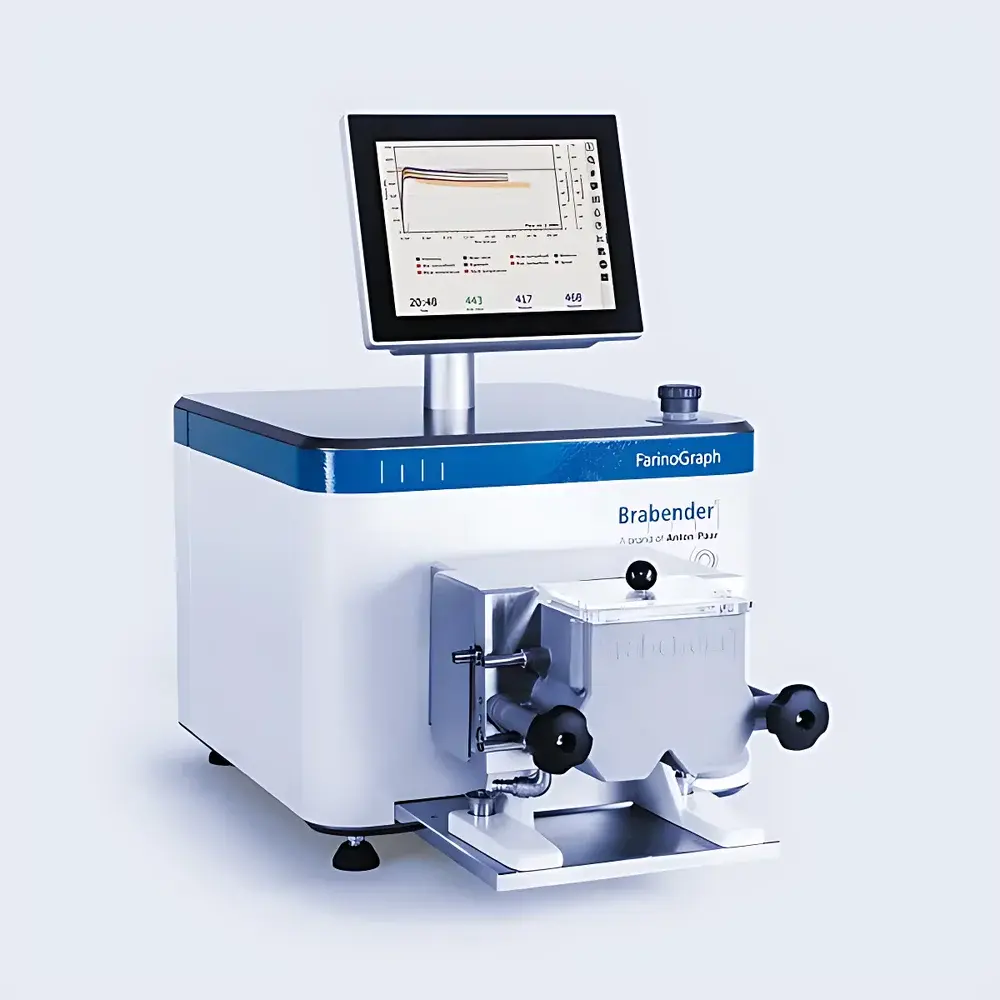
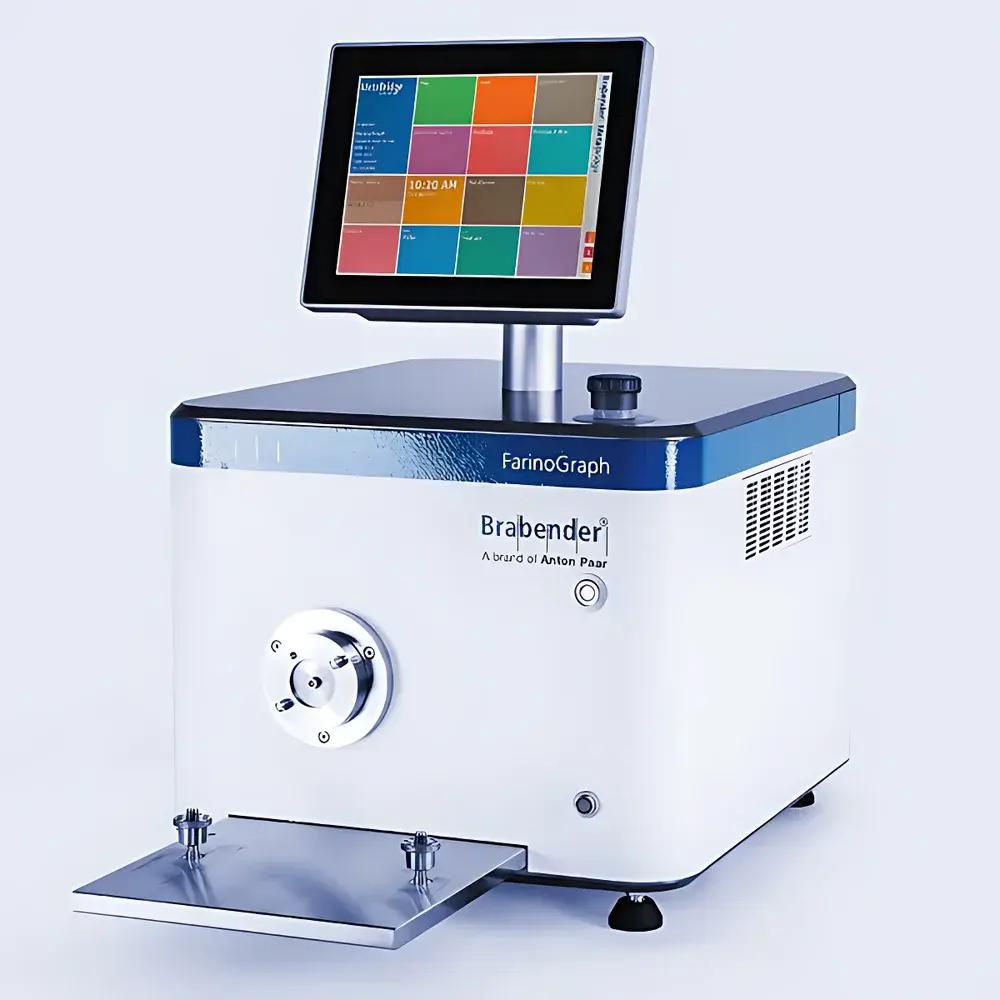
Brabender FarinoGraph E-300 Advanced Flour and Dough Rheometer
| Brand | Anton Paar |
|---|---|
| Origin | Germany |
| Model | FarinoGraph E-300 |
| Compliance | ISO 5530-1, ISO 5530-2, AACCI 54-22.01, ICC 114/1, GB/T 14614, DIN EN ISO 5530-1 |
| Torque Range | Up to 28 N·m |
| Measurement Duration | 0–200 min |
| Power Supply | 230 V (184–264 V) / 50–60 Hz, 1 kW or 115 V (88–126 V) / 50–60 Hz, 1 kW |
| Dimensions (W×H×D) | 430 × 630 × 740 mm |
| Weight (without mixer) | 56 kg |
| Weight (with S300 mixer) | 74 kg |
| Interfaces | 4× USB, 1× HDMI, 2× Ethernet |
| Software | MetaBridge v3.x with AI-assisted curve interpretation and audit-trail-enabled data management |
Overview
The Brabender FarinoGraph E-300 Advanced Flour and Dough Rheometer is a precision-engineered instrument for the standardized determination of wheat flour hydration behavior and dough rheological properties under controlled mixing conditions. Based on the fundamental principle of torque measurement during constant-speed mixing of flour and water, the FarinoGraph generates a time-dependent consistency curve—commonly referred to as the farinogram—that quantifies key functional parameters including water absorption, dough development time, stability, softening degree, and viscosity profile. This methodology aligns with the Couette-type mixing geometry defined in ISO 5530-1 and ISO 5530-2, ensuring metrological traceability and inter-laboratory comparability across global milling, baking, and ingredient R&D facilities. Designed and manufactured in Germany, the E-300 model integrates enhanced thermal management, motorized mixer head positioning, and real-time torque calibration to deliver high reproducibility (<1.5% RSD for repeated WA measurements) and long-term operational robustness.
Key Features
- High-fidelity torque sensing system with dynamic range up to 28 N·m and resolution better than 0.02 N·m, enabling accurate characterization of both low-protein flours and high-strength gluten-rich formulations.
- Modular mixer architecture supporting interchangeable bowls and impellers—including S300 (300 g), S50 (50 g), and specialized attachments such as FarinoAdd-S300 for gluten-free systems—to accommodate diverse sample volumes and compositional requirements.
- Integrated temperature-controlled environment (±0.5 °C) for consistent hydration kinetics, critical when evaluating enzyme activity, hydrocolloid interactions, or thermal sensitivity of dough systems.
- Motor-driven vertical adjustment of mixing head ensures precise, repeatable immersion depth and eliminates operator-induced variability during setup.
- Comprehensive compliance with over 30 international standards—including AACCI, ICC, ISO, DIN, BS, NF, GOST, and GB/T—facilitating regulatory reporting and method validation under GLP and GMP frameworks.
- Dual-voltage power supply (115 V / 230 V) with wide-frequency tolerance (45–66 Hz) ensures stable operation in global laboratory environments without external voltage regulation.
Sample Compatibility & Compliance
The FarinoGraph E-300 accommodates a broad spectrum of cereal-based and alternative substrates: refined wheat flour, whole grain blends, rye, spelt, oat, rice, buckwheat, and formulated gluten-free matrices (e.g., tapioca/corn/potato starch blends). It supports testing of fortified flours containing emulsifiers (DATEM, SSL), enzymatic additives (amylases, xylanases, transglutaminase), hydrocolloids (guar gum, CMC, HPMC), and pre-fermented sourdough starters. All measurements adhere strictly to ISO 5530-1 (principle and general requirements) and ISO 5530-2 (specific test conditions), while also satisfying AACCI Method 54-22.01 (flour quality), ICC Standard 114/1 (water absorption), and GB/T 14614 (Chinese national standard for flour consistency). The system is fully compatible with FDA 21 CFR Part 11-compliant workflows when used with MetaBridge’s electronic signature and audit trail modules.
Software & Data Management
MetaBridge v3.x serves as the unified control and analysis platform for the FarinoGraph E-300. Its intuitive interface guides users through method selection, parameter definition, and real-time curve visualization. Advanced features include AI-assisted farinogram interpretation—automatically detecting peak torque, onset of development, and decay inflection points—with configurable acceptance criteria per parameter. Raw torque-time datasets are stored in vendor-neutral CSV and XML formats; all user actions, calibration events, and result modifications are logged with timestamped, user-identified audit trails. Export options support direct integration into LIMS platforms via secure FTP or REST API, and reports comply with ISO/IEC 17025 documentation requirements. Optional 21 CFR Part 11 modules provide role-based access control, electronic signatures, and immutable record retention.
Applications
- Flour mill quality assurance: Routine monitoring of water absorption (WA), dough development time (DDT), and stability (S) to ensure batch-to-batch consistency and contractual compliance.
- Bakery R&D: Evaluation of additive efficacy—e.g., how fungal α-amylase modifies softening degree (DSICC) or how oxidants extend dough stability under extended mixing protocols.
- Gluten-free product development: Quantification of hydration capacity and structural breakdown kinetics in non-gluten matrices using FarinoAdd-S300 accessories and customized mixing profiles.
- Malt and brewing support: Correlation of farinographic softening with malt modification indices (e.g., Kolbach index), particularly when coupled with mashing trials and wort filtration studies.
- Ingredient supplier qualification: Verification of functional performance claims for enzymes, emulsifiers, and hydrocolloids under standardized dough-forming conditions.
- Academic and regulatory laboratories: Generation of reference data for method validation, proficiency testing schemes, and interlaboratory comparison studies aligned with ISO/IEC 17043.
FAQ
What is the difference between the FarinoGraph E-300 and earlier FarinoGraph models?
The E-300 introduces motorized head positioning, improved thermal stabilization, enhanced torque sensor linearity, and native support for MetaBridge software with AI-driven curve analysis—features not available in legacy FarinoGraph E-200 or manual variants.
Can the FarinoGraph E-300 be used for gluten-free flour testing?
Yes—when equipped with the FarinoAdd-S300 attachment and configured with low-shear mixing profiles, it delivers reproducible hydration and breakdown metrics for starch-based and protein-fortified gluten-free systems.
Is MetaBridge software validated for regulated environments?
MetaBridge v3.x includes optional 21 CFR Part 11 compliance packages, supporting electronic signatures, audit trails, and role-based security—validated for use in FDA-inspected food manufacturing and contract research organizations.
Does the instrument require annual recalibration?
While no mandatory annual recalibration is stipulated by ISO 5530, Brabender recommends biannual torque verification using certified reference loads and quarterly system performance checks using standard flour reference materials (e.g., ICC RM 105).
How does the FarinoGraph compare to the Mixolab for dough rheology?
The FarinoGraph focuses exclusively on isothermal, constant-speed mixing to assess fundamental hydration and gluten network formation; the Mixolab adds variable-temperature capability and dual-function (mixing + heating/cooling) to simulate thermal transitions during baking—making them complementary rather than interchangeable tools.