
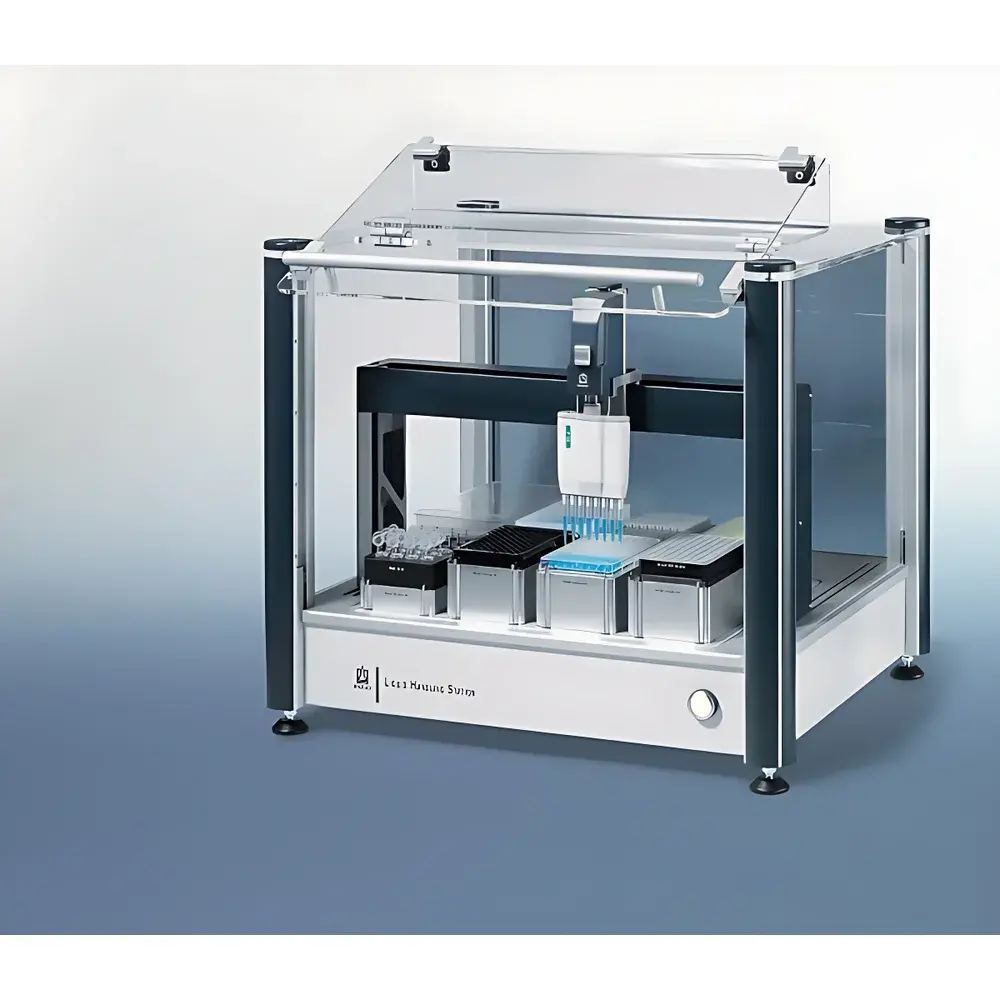
BRAND LHS Liquid Handling Workstation
| Brand | BRAND® |
|---|---|
| Origin | Germany |
| Model | LHS |
| Plate Positions | 8 |
| Pipetting Accuracy (A) | ±1–8% |
| Precision (CV) | ≤0.3–5.0% |
| Pipetting Range | 1–1000 µL (single-channel) |
| Sample Throughput | up to 300 samples per run |
| Dimensions (W×D×H, closed) | 485 × 595 × 530 mm |
| Weight | ~25 kg |
| Operating Temperature | +15 °C to +35 °C |
| Power Supply | 100–240 V, 50/60 Hz |
| Safety Compliance | IEC 61010-1, IP20, Class I Protection |
| EMC Compliance | DIN EN 61326-1 |
| Acoustic Noise Level | ≤46 dB(A) |
| Software Interface | USB |
| Max Power Consumption | 150 W |
Overview
The BRAND LHS Liquid Handling Workstation is a benchtop semi-automated pipetting system engineered for precision, reliability, and operational simplicity in mid-throughput laboratory environments. Designed and manufactured in Germany, the LHS integrates BRAND’s 45+ years of expertise in piston-driven air-displacement pipetting technology with rigorous adherence to ISO 8655 calibration standards. Unlike fully robotic platforms, the LHS operates on a fixed 8-position deck architecture—optimized for reproducible liquid transfers across diverse vessel formats without requiring complex integration or dedicated infrastructure. Its core principle relies on calibrated air-piston displacement, ensuring consistent volume delivery across defined ranges (1–1000 µL for single-channel; 1–50 µL and 20–300 µL for 8-channel), with accuracy (A) and coefficient of variation (CV) values validated per DIN EN ISO 8655 under controlled ambient conditions (20 °C, deionized water). The system is purpose-built for laboratories seeking traceable, audit-ready liquid handling performance without the overhead of high-end automation—making it particularly suitable for QC/QA labs, academic core facilities, and diagnostic development units operating under GLP-aligned workflows.
Key Features
- Modular 8-position deck layout: Supports simultaneous placement of source plates, destination plates, tip racks, and waste containers—including ANSI/SLAS-compliant 96-well and 384-well microplates, tube strips, and individual tubes.
- Dual pipetting modules: Interchangeable single-channel (SC) and 8-channel (MC) pipetting heads—each pre-calibrated and certified to ISO 8655, with independent volume range configurations optimized for low-volume precision or parallel throughput.
- Intuitive method programming: Graphical user interface (GUI) enables rapid protocol creation—no coding or scripting required. Drag-and-drop workflow builder supports serial dilutions, plate replication, reformatting (e.g., 96-to-384), and multi-step transfer sequences.
- Compact footprint & ergonomic design: Occupies only 0.29 m² (485 × 595 mm) with a maximum height of 690 mm when fully extended—ideal for space-constrained fume hoods or shared lab benches.
- Traceability-ready operation: Built-in logging captures timestamped execution records, tip usage, error events, and environmental parameters (ambient temperature)—supporting internal documentation requirements aligned with ISO/IEC 17025 and FDA 21 CFR Part 11 principles.
- Regulatory-compliant construction: Meets IEC 61010-1 for electrical safety, IP20 for ingress protection, and DIN EN 61326-1 for electromagnetic compatibility—certified for use in clinical, pharmaceutical, and research settings governed by GxP frameworks.
Sample Compatibility & Compliance
The LHS accommodates standard laboratory consumables conforming to ANSI/SLAS dimensional specifications, including polypropylene and polystyrene microplates (96- and 384-well), PCR plates, tube racks (1.5 mL, 2.0 mL), and universal tip boxes. All pipetting operations are validated using deionized water at 20 °C per DIN EN ISO 8655, with accuracy and precision data provided for discrete volume points across each channel’s operational range. While not classified as a medical device or IVD instrument, the LHS supports workflows referenced in ASTM E2875 (standard guide for validation of automated liquid handlers) and USP (general chapter on analytical instrumentation). Its mechanical stability and thermal mass minimize drift during extended runs, contributing to inter-day reproducibility essential for assay development and routine QC testing.
Software & Data Management
The workstation ships with BRAND’s proprietary LHS Control Software—a Windows-based application supporting method creation, execution scheduling, and result export in CSV and PDF formats. Each method file stores complete configuration metadata: pipette head type, tip geometry, aspiration/dispense speeds, touch-off settings, and delay times. Audit trail functionality logs all user actions, including login/logout timestamps, method modifications, and run completions—with optional password-protected administrator access levels. Raw log files are stored locally on internal flash memory and can be exported via USB port for long-term archival. Although the system does not feature network connectivity or LIMS integration out-of-the-box, its structured output format allows straightforward ingestion into third-party laboratory information management systems through batch import protocols.
Applications
- Preparation of “assay-ready” plates for ELISA, cell-based assays, and enzymatic activity screening
- qPCR and RT-qPCR reaction setup—including master mix distribution, template dilution series, and triplicate plating
- Serial dilution workflows with variable step factors (e.g., 1:2, 1:3, 1:10) across multi-well formats
- Plate replication (96→96, 384→384) and reformatting (96→384, 384→96) with cross-contamination mitigation logic
- Cell culture support tasks: media exchange, passaging reagent dispensing, and viability dye addition
- Downstream sample preparation for HPLC, LC-MS, and NGS library quantification steps
FAQ
Is the LHS compatible with non-BRAND tips?
Yes—the system accepts universal-fit pipette tips meeting ISO 8655 dimensional tolerances; however, optimal accuracy and leak-free performance are guaranteed only with BRAND OptiTip® or Dispensette®-compatible tips.
Does the LHS support calibration verification according to ISO 8655?
Yes—users may perform volumetric verification using gravimetric methods per ISO 8655-6, and calibration certificates for factory-tested pipetting modules are supplied with each unit.
Can multiple users share method libraries securely?
Yes—method files are stored in a centralized folder structure with Windows-level permissions; administrator-defined user groups control edit vs. execute privileges.
What maintenance is required to sustain performance?
Routine cleaning of the pipetting head and deck surface is recommended after each use; annual preventive maintenance (PM) by an authorized BRAND service technician ensures continued compliance with published accuracy specifications.
Is the LHS suitable for regulated environments such as clinical diagnostics?
While the LHS itself is not CE-IVD or FDA-cleared, its design, documentation, and traceability features enable implementation within laboratory-developed test (LDT) workflows compliant with CLIA and CAP requirements—subject to site-specific validation per SOP.



