
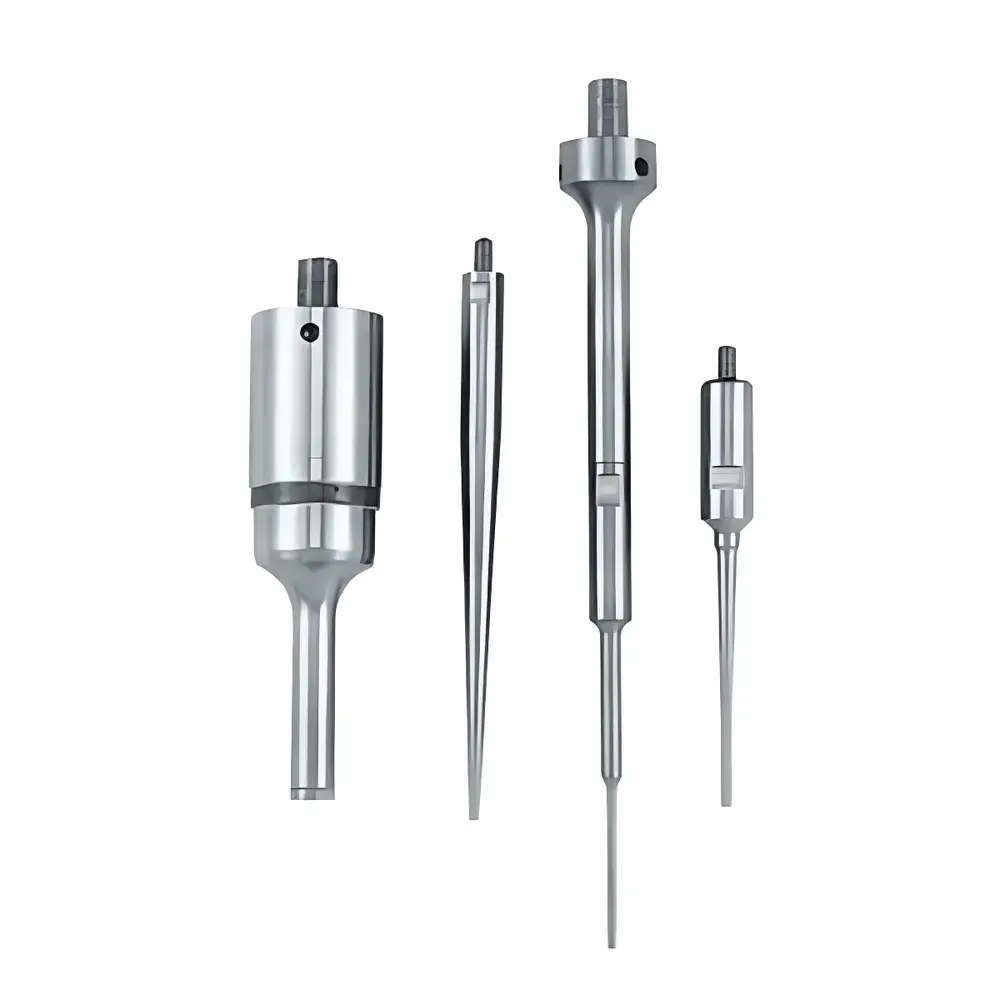
Branson S-250 Ultrasonic Cell Disruptor with Transducer Horns and Sound Enclosure
| Brand | Branson |
|---|---|
| Origin | USA |
| Model | S-250 |
| Instrument Type | Ultrasonic Cell Disruptor |
| Temperature Range | 5°C–50°C |
| Operating Frequency | 40 kHz |
| Ultrasonic Power Output | 200 W |
| Sample Volume Capacity | 200 µL–1000 mL |
| Sample Throughput | Single-sample processing |
| Horn Material | Ti-7Al-4Mo alloy |
| Sound Enclosure Noise Reduction | 20–25 dB(A) |
Overview
The Branson S-250 Ultrasonic Cell Disruptor is an engineered benchtop system designed for controlled, reproducible lysis of biological cells, tissues, and subcellular structures via high-intensity ultrasonic cavitation. Operating at a fixed frequency of 40 kHz, the system delivers 200 W of acoustic power to generate transient microcavitation events in liquid media—producing localized shear forces, shockwaves, and thermal transients sufficient to disrupt membranes, solubilize inclusion bodies, fragment chromatin, and disperse aggregated nanoparticles. Unlike pulsed or variable-frequency platforms, the S-250 employs a resonant piezoelectric transducer coupled to interchangeable titanium alloy horns (Ti-7Al-4Mo), ensuring mechanical stability, corrosion resistance, and minimal harmonic distortion across extended duty cycles. The system is intended for use in regulated life science laboratories where consistency, traceability, and operator safety are critical—particularly in applications requiring adherence to GLP, ISO 13485, or USP guidelines for cell disruption validation.
Key Features
- Robust Ti-7Al-4Mo horn construction—superior fatigue resistance and acoustic transmission efficiency compared to standard Ti-6Al-4V alloys, minimizing microfracture risk during high-amplitude operation.
- Modular horn architecture supporting five functional configurations: stepped, high-gain, exponential, cup-horn (standard & high-intensity), flow-through, sealed-atmosphere, and continuous-flow chamber—enabling method-specific optimization without hardware replacement.
- Integrated digital amplitude control (0–100% full scale) with real-time power monitoring and automatic impedance compensation to maintain consistent energy delivery despite sample viscosity or temperature shifts.
- Sound-attenuating enclosure rated for 20–25 dB(A) noise reduction—meeting OSHA PEL thresholds for prolonged operator exposure and enabling compliance with institutional hearing conservation programs.
- Programmable temperature management interface compatible with external recirculating chillers (e.g., Thermo Fisher Polyscience units) to maintain sample integrity within 5°C–50°C operational range during extended sonication protocols.
Sample Compatibility & Compliance
The S-250 accommodates heterogeneous biological matrices—including bacterial pellets, mammalian cell suspensions, plant tissue homogenates, viral lysates, and nanoparticle colloids—across volumes from 200 µL (microtip horns) to 1 L (continuous-flow chamber). Cup horns enable non-contact processing of up to 16 samples simultaneously in sealed tubes, satisfying containment requirements for BSL-2/BSL-3 agents, radioisotope-labeled reagents, or cytotoxic compounds. All horn geometries comply with ASTM F2697-22 (Standard Practice for Ultrasonic Processing of Biological Samples) and support IQ/OQ documentation per FDA 21 CFR Part 11 when paired with Branson’s optional data-logging software. System validation packages include horn calibration certificates traceable to NIST standards and acoustic output verification reports.
Software & Data Management
While the base S-250 operates via front-panel controls, optional Branson Insight™ Software (v4.2+) enables protocol-driven operation with audit-trail logging, electronic signatures, and export of time-stamped amplitude, power, temperature, and duration metadata in CSV/Excel format. Data files conform to ALCOA+ principles (Attributable, Legible, Contemporaneous, Original, Accurate, Complete, Consistent, Enduring, Available) and support integration into LIMS environments via OPC UA or RESTful API endpoints. Firmware updates preserve backward compatibility with legacy S-250/S-450 transducer modules and ensure alignment with current IEC 62304 medical device software lifecycle requirements.
Applications
- Chromatin shearing for ChIP-seq and ATAC-seq library preparation under controlled thermal conditions.
- Preparation of antigenic lysates for monoclonal antibody development with minimized protein denaturation.
- Dispersion of metal oxide nanomaterials (e.g., TiO₂, Fe₃O₄) in aqueous or organic solvents for drug delivery formulation.
- Emulsification of lipid-based nanocarriers (liposomes, solid lipid nanoparticles) with narrow polydispersity index (PDI <0.2).
- Continuous-flow disruption of E. coli cultures at 38 L/h for recombinant protein harvest in cGMP bioprocessing workflows.
- Deagglomeration of ceramic pigments and pharmaceutical excipients prior to tablet compression analysis.
FAQ
What is the recommended maintenance interval for Ti-7Al-4Mo horns?
Horns should be inspected visually before each use for pitting or cracking; ultrasonic performance testing is advised every 200 hours of cumulative operation or quarterly—whichever occurs first.
Can the S-250 be validated for GMP-compliant production?
Yes—when configured with Insight™ Software, calibrated horns, and documented IQ/OQ protocols, the system meets Annex 11 and EU GMP Chapter 4 requirements for ancillary equipment used in sterile manufacturing.
Is the sound enclosure compatible with third-party chillers?
The enclosure features rear-panel cutouts and cable grommets designed for seamless integration with standard recirculating chillers (e.g., Huber, Julabo, LAUDA) without compromising acoustic isolation.
How does the high-intensity cup horn differ acoustically from the standard version?
The conical radiating surface focuses acoustic energy into a smaller focal zone, increasing spatial peak intensity by ~2.3× compared to flat-surface cup horns—enabling efficient disruption of viscous or particulate-laden samples in 50 mL conical tubes.
Does Branson provide horn calibration services traceable to national standards?
Yes—Branson’s Metrology Lab issues NIST-traceable calibration certificates for all horn types, including amplitude linearity verification across 0–100% setpoints and resonance frequency confirmation at 40.0 ± 0.2 kHz.




