
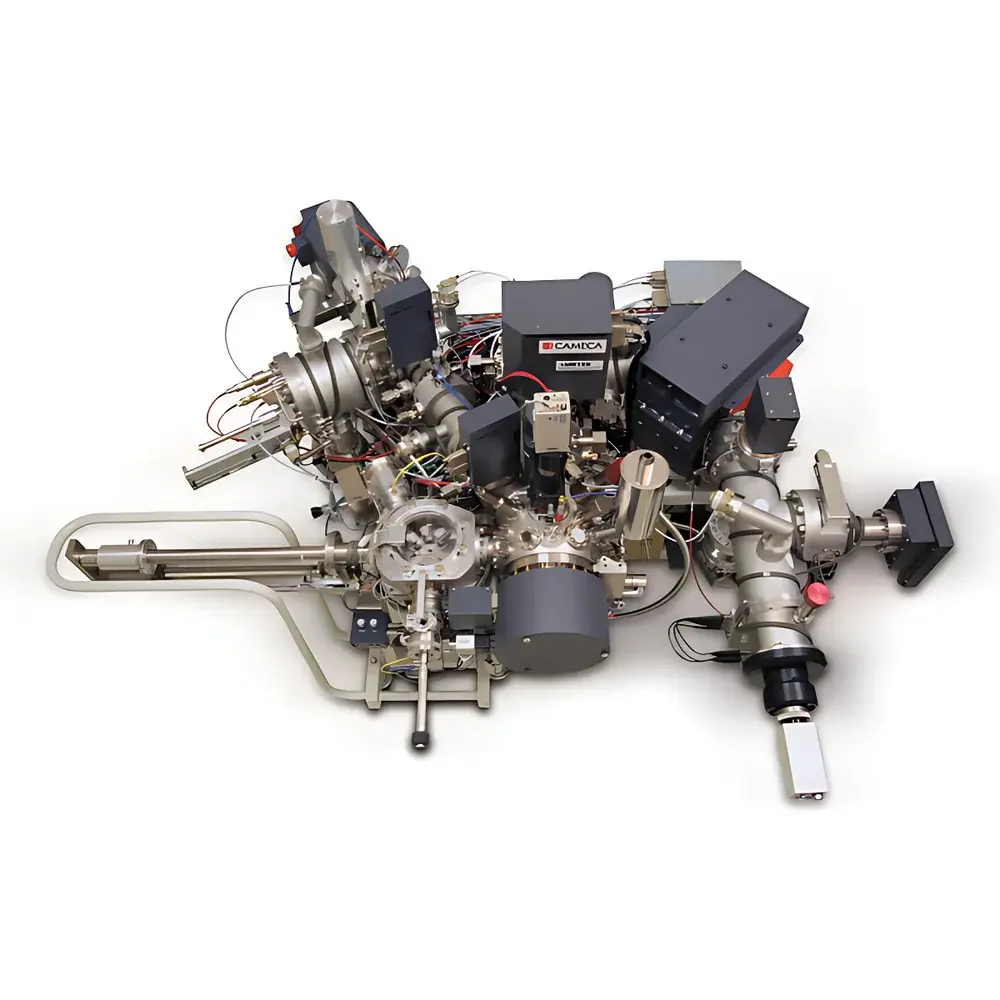
CAMECA IMS 7f-Auto Secondary Ion Mass Spectrometer
| Brand | Cameca |
|---|---|
| Origin | France |
| Model | IMS 7f-Auto |
| Instrument Type | Magnetic Sector Mass Spectrometer |
| Primary Ion Beam Energy Range | 1–15 keV |
| Mass Range | 1–360 Da |
| Mass Resolution (M/ΔM) | >20,000 |
| Ion Sources | O₂⁺ and Cs⁺ reactive primary ion sources |
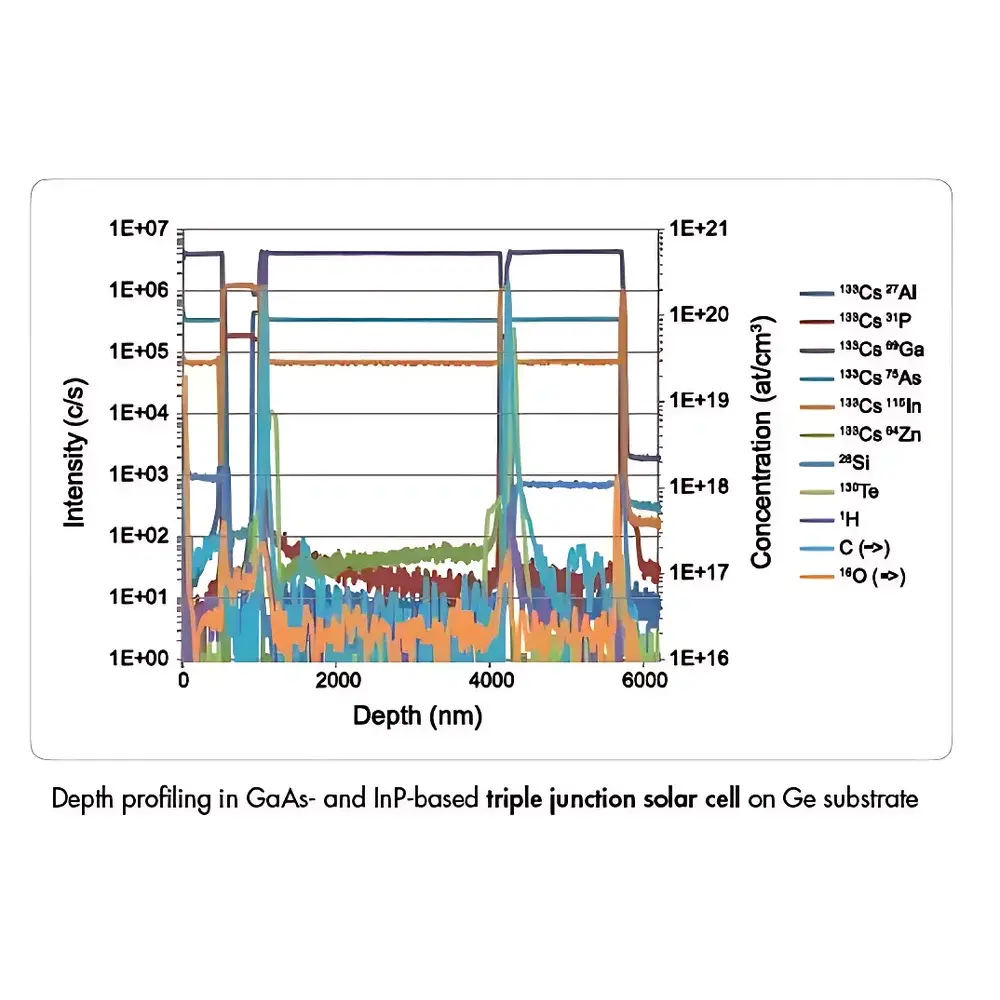
| Depth Profiling Capability | High depth resolution & high dynamic range (>10⁶) |
| Automation | Fully motorized sample storage chamber with auto-load/unload, coaxial primary ion gun, remote operation support |
| Detection Limit | Sub-ppq (parts-per-quadrillion) for selected elements in matrix-matched standards |
| Reproducibility | RSD < 0.5% for repeated analyses under standardized conditions |
Overview
The CAMECA IMS 7f-Auto is a high-performance magnetic sector secondary ion mass spectrometer (SIMS) engineered for quantitative elemental and isotopic depth profiling with exceptional sensitivity, mass resolution, and analytical reproducibility. Operating on the principle of sputter-induced ionization—where a focused primary ion beam (O₂⁺ or Cs⁺) bombards a solid sample surface to generate secondary ions subsequently analyzed by double-focusing magnetic sector mass separation—the IMS 7f-Auto delivers sub-monolayer detection limits and isotopic precision required for advanced materials R&D, semiconductor process control, and geochemical reference analysis. Its design integrates decades of CAMECA’s expertise in ultra-high-vacuum instrumentation, beam optics, and multi-collector detection architecture, making it suitable for laboratories requiring trace-level quantification across conductive and insulating matrices—including Si wafers, III–V compound semiconductors (e.g., GaAs, InP), II–VI thin films (e.g., CdTe, ZnO), oxide glasses, metallic alloys, and ceramic substrates.
Key Features
- Magnetic sector mass analyzer delivering mass resolution >20,000 (M/ΔM, 10% valley definition), enabling baseline separation of isobaric interferences (e.g., ²⁸Si⁺ vs. ¹⁴N₂⁺, ⁵⁶Fe⁺ vs. ⁴⁰Ca¹⁶O⁺).
- Dual reactive primary ion sources (O₂⁺ and Cs⁺) optimized for enhanced positive- and negative-ion yields, respectively—critical for achieving low detection limits (<10¹⁴ atoms/cm³ for many elements in Si or SiO₂ matrices).
- Coaxial primary ion column with motorized alignment and real-time beam current monitoring, reducing operator dependency during beam tuning and improving long-term beam stability (drift <0.5% over 8 h).
- High-transmission ion optics coupled with energy filtering and multi-collection detection, supporting simultaneous acquisition of multiple isotopes with <0.01% relative mass bias stability.
- Fully automated sample handling system: motorized storage chamber accommodating up to 24 samples, integrated robotic transfer arm, and vacuum-integrated load-lock—enabling unattended overnight and multi-day analysis sequences.
- Direct ion imaging capability with lateral resolution down to ~100 nm (under optimal conditions), supporting correlation between compositional mapping and structural features observed via SEM or TEM.
Sample Compatibility & Compliance
The IMS 7f-Auto accommodates flat, polished solid samples up to 25 mm in diameter and 5 mm thick, including electrically conductive (metals, doped Si), semi-conductive (GaAs, SiC), and insulating materials (glass, Al₂O₃, HfO₂). Charge compensation is achieved via low-energy electron flood gun and/or surface potential stabilization using adjustable bias electrodes. The instrument complies with ISO/IEC 17025 requirements for testing laboratories, supports audit-ready data logging aligned with FDA 21 CFR Part 11 (electronic records and signatures), and facilitates GLP/GMP-compliant workflows through configurable user access levels, electronic signature enforcement, and full audit trail generation for all acquisition parameters and calibration events.
Software & Data Management
CAMECA’s proprietary MultiMode software provides unified control of beam tuning, stage navigation, acquisition sequencing, and real-time data visualization. It supports script-driven batch analysis (Python API integration available), automated standardization against certified reference materials (e.g., NIST SRMs, USGS glasses), and matrix-matched quantification using relative sensitivity factors (RSFs). Raw data are stored in vendor-neutral .ims format compliant with ASTM E1398-22 (Standard Practice for SIMS Data Exchange), enabling interoperability with third-party processing tools (e.g., IGOR Pro, MATLAB-based quantification suites). All metadata—including vacuum status, beam current history, aperture settings, and detector gain—are embedded and exportable for traceability.
Applications
- Semiconductor industry: dopant profiling (B, P, As, Sb) in FinFETs and nanowire devices; interface contamination analysis at Si/SiO₂ and high-k/metal gate stacks.
- Photovoltaics: depth-resolved quantification of Na, K, Li segregation in CIGS and perovskite absorber layers; diffusion kinetics studies under thermal stress.
- Geosciences: in situ U–Pb, Sm–Nd, and Lu–Hf isotopic dating of zircon, apatite, and monazite with spatial resolution ≤5 µm.
- Advanced packaging: Cu–Sn intermetallic growth kinetics at solder joint interfaces; oxygen ingress mapping in 3D TSV dielectric liners.
- Nuclear materials: actinide isotope ratio measurements (²³⁵U/²³⁸U, ²⁴⁰Pu/²³⁹Pu) in irradiated fuel particles with minimal peak tailing.
FAQ
What vacuum level does the IMS 7f-Auto maintain during analysis?
The instrument operates at a base pressure of ≤5 × 10⁻¹⁰ mbar in the analysis chamber, achieved via cryogenic pumping and ion-getter technology—essential for minimizing background from residual hydrocarbons and water during ultra-trace analysis.
Can the IMS 7f-Auto perform isotopic ratio measurements with external precision?
Yes—using multi-collection mode with Faraday cups and discrete-dynode electron multipliers, it achieves external precision of ≤0.05% RSD (2σ) for major isotope ratios (e.g., ²⁰⁸Pb/²⁰⁶Pb) over 10–20 replicate analyses on homogeneous standards.
Is matrix-matched calibration mandatory for quantitative SIMS?
While relative sensitivity factors (RSFs) derived from matrix-matched standards yield highest accuracy, the IMS 7f-Auto supports empirical RSF libraries and iterative correction models for cases where certified standards are unavailable—subject to documented uncertainty propagation.
How is data integrity ensured during unattended operation?
Each analysis run generates a cryptographic hash of raw data files and logs all parameter changes in a tamper-evident SQLite database; deviations from pre-defined tolerances trigger automatic pause-and-alert protocols.
Does the system support in-vacuum sample cleaning prior to analysis?
Yes—low-energy Ar⁺ sputtering (0.1–1 keV) is available for in-situ surface cleaning without breaking vacuum, minimizing oxidation or contamination risks during transfer.





