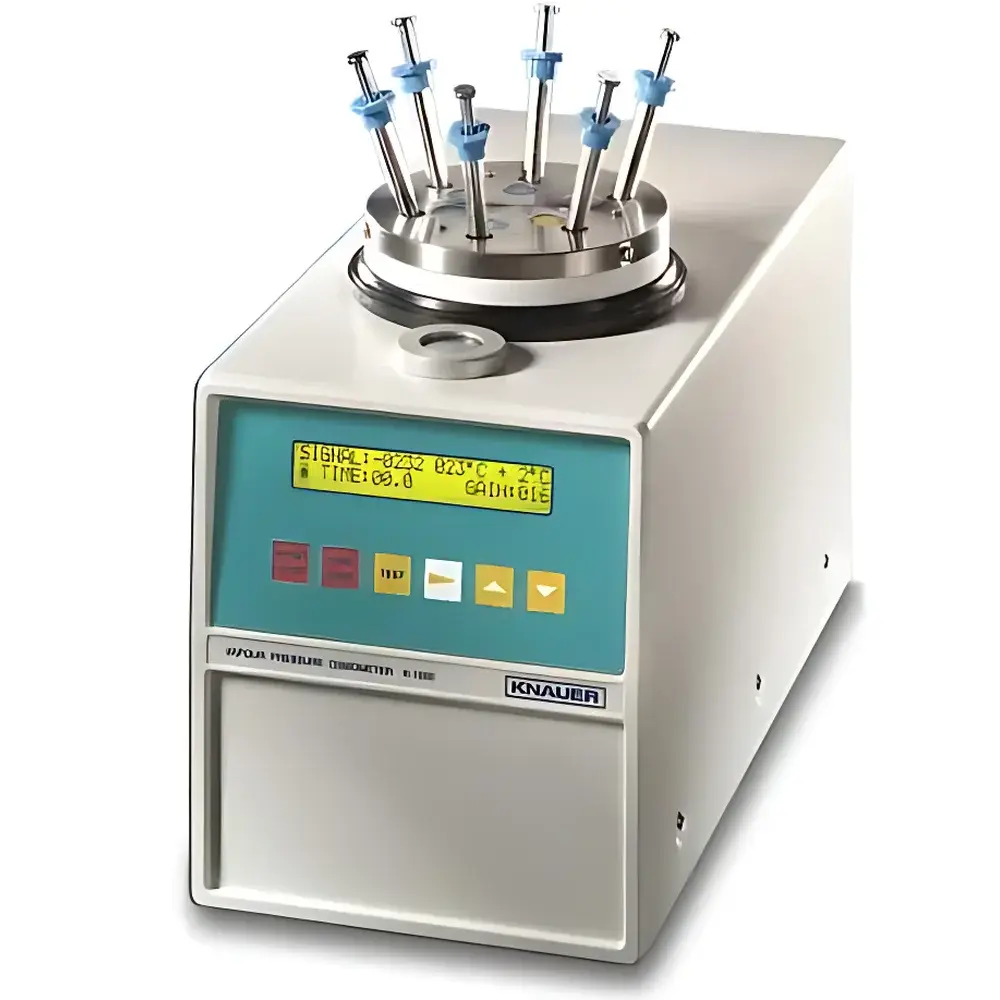
KNAUER K-7000 Vapor Pressure Osmometer (Molecular Weight Determination System)
| Origin | Germany |
|---|---|
| Manufacturer Type | Authorized Distributor |
| Origin Category | Imported |
| Model | K-7000 |
| Pricing | Available Upon Request |
Overview
The KNAUER K-7000 Vapor Pressure Osmometer is a precision analytical instrument engineered for the determination of number-average molecular weight (Mn) and total osmolality in non-volatile solutes across aqueous and organic solvent systems. Its operational principle is grounded in Raoult’s Law: the vapor pressure depression of a solvent induced by dissolved solute particles is directly proportional to the molal concentration of solute. The K-7000 implements this thermodynamic relationship via dual thermistor-based detection—two matched thermistors serve as arms of a Wheatstone bridge within a temperature-controlled measurement cell. One thermistor is exposed to pure solvent, the other to sample solution. As solvent vapor condenses preferentially onto the cooler solution droplet (due to its lower vapor pressure), a measurable temperature differential (ΔT) develops. This ΔT is linearly correlated with solute molality; given known concentration, Mn is calculated per the osmotic equation: Mn = k·c / ΔT, where k is the instrument-specific calibration constant. Designed for reproducibility in regulated environments, the K-7000 supports method validation under GLP and GMP frameworks, with full traceability of thermal equilibration, injection timing, and signal stabilization.
Key Features
- Single universal thermistor probe covering the full operating temperature range (20–130 °C), compatible with water, methanol, chloroform, toluene, and other common organic solvents
- High-resolution ΔT detection (0–6 °C range) with electronic gain adjustment (1–256) to optimize signal-to-noise ratio for low-concentration samples
- Integrated microprocessor control enabling autonomous operation: all parameters—including cell temperature, measurement duration, and data acquisition intervals—are programmable via front-panel interface or software
- Internal memory stores up to 100 complete measurement records with timestamps, temperature logs, and raw ΔT traces; data reviewable on built-in LCD display
- RS232 serial interface compliant with standard laboratory PC configurations for real-time data streaming and remote instrument control
- Modular design supporting optional thermal printer (A3701-PR) for GLP-compliant hard-copy output of calibration reports and sample analyses
Sample Compatibility & Compliance
The K-7000 accommodates a broad spectrum of sample matrices, including physiological fluids (serum, urine, cerebrospinal fluid), polymer solutions (polyethylene glycols, polystyrenes, dendrimers), pharmaceutical excipients, and small-molecule APIs. Molecular weight determination is validated for Mn ranges of 40–40,000 g/mol in organic solvents and up to 10,000 g/mol in aqueous media. Sensitivity reaches 3.3 × 10⁻⁵ mol/kg (in toluene) and 1.7 × 10⁻⁴ mol/kg (in water), permitting accurate analysis of dilute biological and synthetic formulations. Instrument compliance aligns with ISO 8502 (osmometry standards), ASTM D1498 (vapor pressure osmometry of polymers), and USP (osmolality measurements). Data integrity meets FDA 21 CFR Part 11 requirements when used with EuroOsmo7000 v3.2+ featuring audit trail, electronic signatures, and user-access controls.
Software & Data Management
EuroOsmo7000 is the dedicated Windows-based application for instrument control, calibration, and quantitative analysis. It provides automated calibration routines using certified NaCl standards (e.g., Y1241 series: 300–2000 mOsmol/kg), dynamic baseline correction, and multi-point Mn regression fitting. All measurement parameters—including solvent selection, temperature ramp profiles, injection volume (1000 µL), and integration window—are configurable and saved with each assay. Raw ΔT vs. time curves are exportable in CSV and ASCII formats; graphical overlays support comparative analysis across batches or formulations. Software-generated reports include instrument ID, operator ID, calibration certificate reference, and uncertainty estimates derived from replicate standard deviations—fully auditable for regulatory submissions.
Applications
- Quality control of parenteral drug products and lyophilized formulations for osmolality compliance
- Determination of Mn and polydispersity index (PDI) estimation in synthetic polymers without column calibration
- Osmolality profiling of dialysate, IV fluids, and ocular preparations per pharmacopeial monographs
- Stability assessment of protein therapeutics under thermal or chemical stress (aggregation-induced shifts in Mn)
- Characterization of surfactant micelles and nanoparticle dispersions in non-aqueous media
- Academic research in physical chemistry, colloid science, and biomacromolecular thermodynamics
FAQ
What solvents are compatible with the K-7000?
Water, methanol, ethanol, chloroform, tetrahydrofuran, toluene, benzene, and dimethylformamide are routinely supported. Solvent volatility and boiling point must remain below the maximum cell temperature (130 °C).
Is the K-7000 suitable for measuring proteins or peptides?
Yes—provided the analyte is non-volatile and remains stable at the selected measurement temperature. Typical applications include insulin, albumin, and monoclonal antibody fragments in buffered aqueous solutions.
How is calibration performed?
Calibration uses certified NaCl standards (e.g., Y1241 series) or benzoic acid (Y1026) across three or more concentrations. EuroOsmo7000 calculates the instrument constant k and applies it to subsequent unknowns.
Can the K-7000 be integrated into a LIMS environment?
Yes—via RS232 serial output or optional USB-to-serial adapter, raw data streams can be parsed by LIMS middleware using configurable delimiter protocols and timestamped metadata fields.
What maintenance is required for long-term accuracy?
Annual verification of thermistor linearity and cell temperature uniformity is recommended. Cleaning of the thermistor surfaces with high-purity solvent after each solvent change prevents residue buildup and thermal lag.