
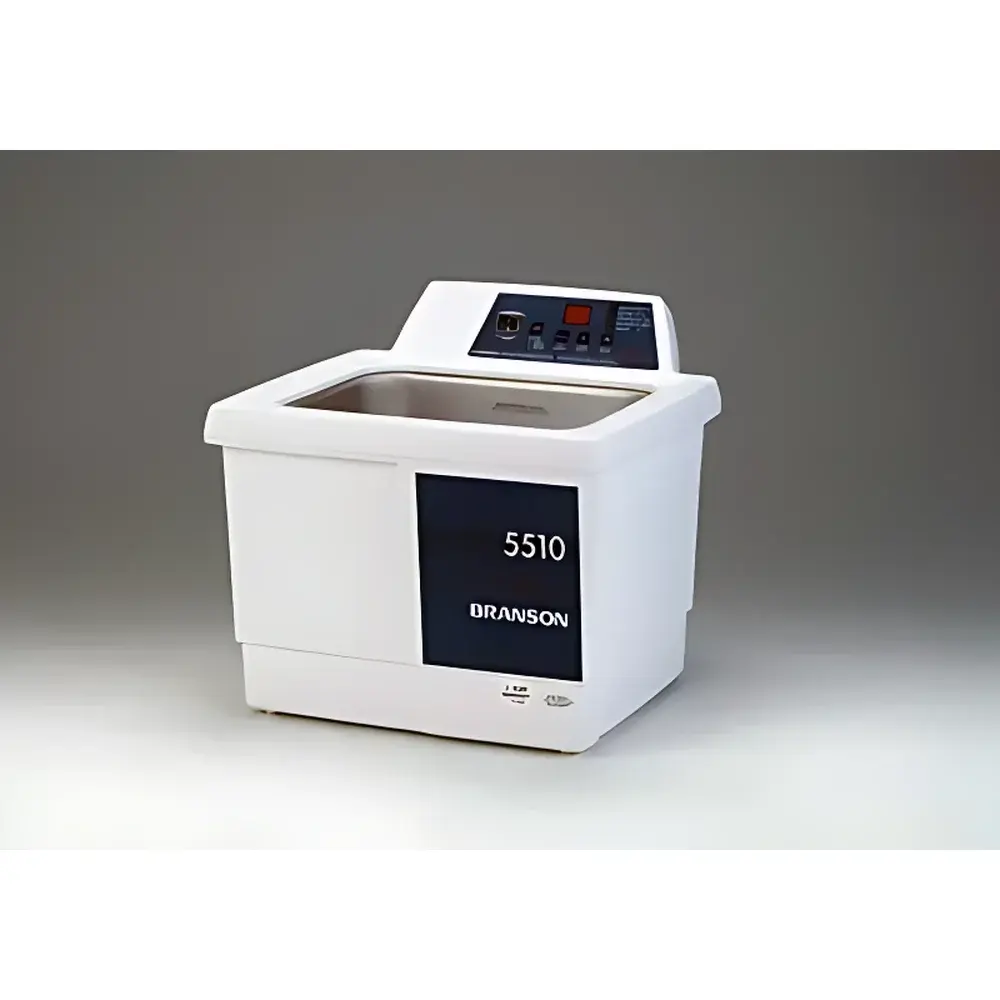
Branson B1510E-MT Ultrasonic Cleaner
| Brand | Branson |
|---|---|
| Origin | USA |
| Model | B1510E-MT |
| Tank Capacity | 1.9 L |
| Internal Dimensions | 152 × 139 × 101 mm |
| Ultrasonic Frequency | 40 kHz |
| Heating Range | 0–70 °C |
| Timer Range | 1–99 min |
| Heater Power | 63 W |
| Total Power | 143 W |
| Input Voltage | 220 V, 50/60 Hz |
| Construction Material | Polypropylene (PP) Housing |
| Transducer Type | Langevin-type metal/ceramic stack |
| Mounting | Adhesive-bonded transducers |
| Control Interface | Digital display with real-time temperature readout |
| Lid Function | Hinged noise-reduction lid with integrated drip tray and drain valve |
| Compliance | Designed for laboratory-grade cleaning per ASTM D2258 and ISO 13485-aligned manufacturing practices |
Overview
The Branson B1510E-MT Ultrasonic Cleaner is a precision-engineered benchtop instrument designed for consistent, reproducible cleaning of delicate laboratory components—including glassware, pipette tips, microplates, surgical instruments, and precision optics. It operates on the principle of high-frequency acoustic cavitation: at 40 kHz, ultrasonic energy generates controlled microbubbles in the cleaning solution that collapse asymmetrically near surfaces, producing localized shear forces sufficient to dislodge particulate contaminants, organic residues, and biofilm without mechanical abrasion. This physical cleaning mechanism avoids solvent-intensive or thermal degradation pathways, making it suitable for pre-analytical sample preparation in QC/QA labs, clinical diagnostics, pharmaceutical R&D, and academic research environments where residue-free surfaces are critical for downstream assays.
Key Features
- Digital microprocessor control with dual-display interface showing real-time bath temperature and setpoint—enabling precise thermal regulation within ±1.5 °C across the 0–70 °C range.
- Robust polypropylene (PP) tank and housing engineered for chemical resistance against common aqueous detergents, mild acids, and alkaline solutions—validated per ASTM D543 for immersion resistance.
- Langevin-type transducer assembly integrating ceramic piezoelectric elements bonded to titanium alloy front mass—optimized for high electromechanical coupling efficiency and long-term stability under continuous operation.
- Adhesive-bonded transducer mounting system eliminates mechanical fasteners, reducing vibration-induced fatigue and ensuring uniform energy transfer across the entire tank bottom surface.
- Vertical PCB orientation with conformal coating minimizes condensation ingress risk—a critical design consideration for humid lab environments and extended heating cycles.
- Hinged acoustic lid doubles as a functional drip tray; integrated drain valve enables rapid, spill-free solution exchange—reducing cross-contamination risk between cleaning batches.
- Sweep-frequency modulation (±1 kHz around 40 kHz center) prevents standing wave formation and ensures homogeneous cavitation distribution regardless of load geometry or solution level.
- Programmable timer supports 1–99 minute intervals with automatic shutdown—supporting GLP-compliant documentation when paired with external logging systems.
Sample Compatibility & Compliance
The B1510E-MT accommodates standard laboratory vessels up to 139 mm in width and 101 mm in depth, including beakers, vials, cuvettes, and small instrument parts. Its 1.9 L capacity and defined optimal fill line ensure consistent acoustic field intensity per ASTM F1210-22 guidelines for ultrasonic cleaner performance verification. The unit complies with IEC 61000-6-3 (EMC emissions) and IEC 61000-6-2 (immunity), and its construction meets UL 61010-1 requirements for electrical safety in laboratory equipment. While not certified for sterile processing per ISO 17664, it is routinely deployed in ISO 13485-regulated facilities for non-sterile pre-cleaning prior to autoclaving or ethylene oxide treatment.
Software & Data Management
This model operates via embedded firmware with no proprietary software dependency. All parameters—including time, temperature, and power state—are retained through power cycling. For audit-trail requirements in regulated environments (e.g., FDA 21 CFR Part 11), integration with external data loggers or LIMS platforms is supported via analog output (0–5 V) for temperature monitoring. Optional RS-232 interface kits enable remote command execution and event logging—facilitating traceability in GMP-aligned workflows where calibration records, usage logs, and maintenance history must be retained for ≥2 years.
Applications
- Cleaning of HPLC and GC sample vials prior to autosampler injection to prevent carryover and column fouling.
- Removal of polishing compounds and oils from optical lenses and metrology standards in calibration laboratories.
- Preparation of stainless-steel surgical tools for sterilization validation studies (per AAMI ST79).
- Decontamination of reusable microfluidic chips and MEMS devices prior to surface characterization (XPS, AFM).
- Routine maintenance of electron microscopy grids and TEM specimen holders to eliminate hydrocarbon contamination.
- Supporting USP and compounding workflows by cleaning laminar flow hood accessories and environmental sampling swabs.
FAQ
Is the B1510E-MT suitable for use with flammable solvents?
No. This unit is rated for aqueous and water-miscible detergent solutions only. Flammable or low-flashpoint solvents require explosion-proof ultrasonic systems compliant with NEC Class I, Division 1 specifications.
What is the recommended cleaning solution concentration for general labware?
For routine glassware and metal parts, a 1–2% w/v neutral pH detergent (e.g., Alconox® Liquinox®) is optimal. Avoid phosphate-based formulations in aluminum fixtures to prevent pitting corrosion.
How often should the transducer bond integrity be verified?
Visual inspection of adhesive margins every 6 months is advised. Performance drift—such as reduced cleaning efficacy at nominal settings or audible frequency instability—warrants professional service evaluation.
Can the unit maintain temperature stability during extended ultrasonic cycles?
Yes. The 63 W heater and insulated PP housing provide stable thermal equilibrium within ±1.5 °C over 99-minute cycles, provided ambient lab temperature remains between 15–30 °C and ventilation clearance exceeds 10 cm on all sides.
Does Branson provide IQ/OQ documentation support for this model?
Standard factory test reports are included. Customized Installation Qualification (IQ) and Operational Qualification (OQ) protocols—aligned with EU Annex 15 and ASTM E2500—can be supplied upon request for regulated facility deployment.



