
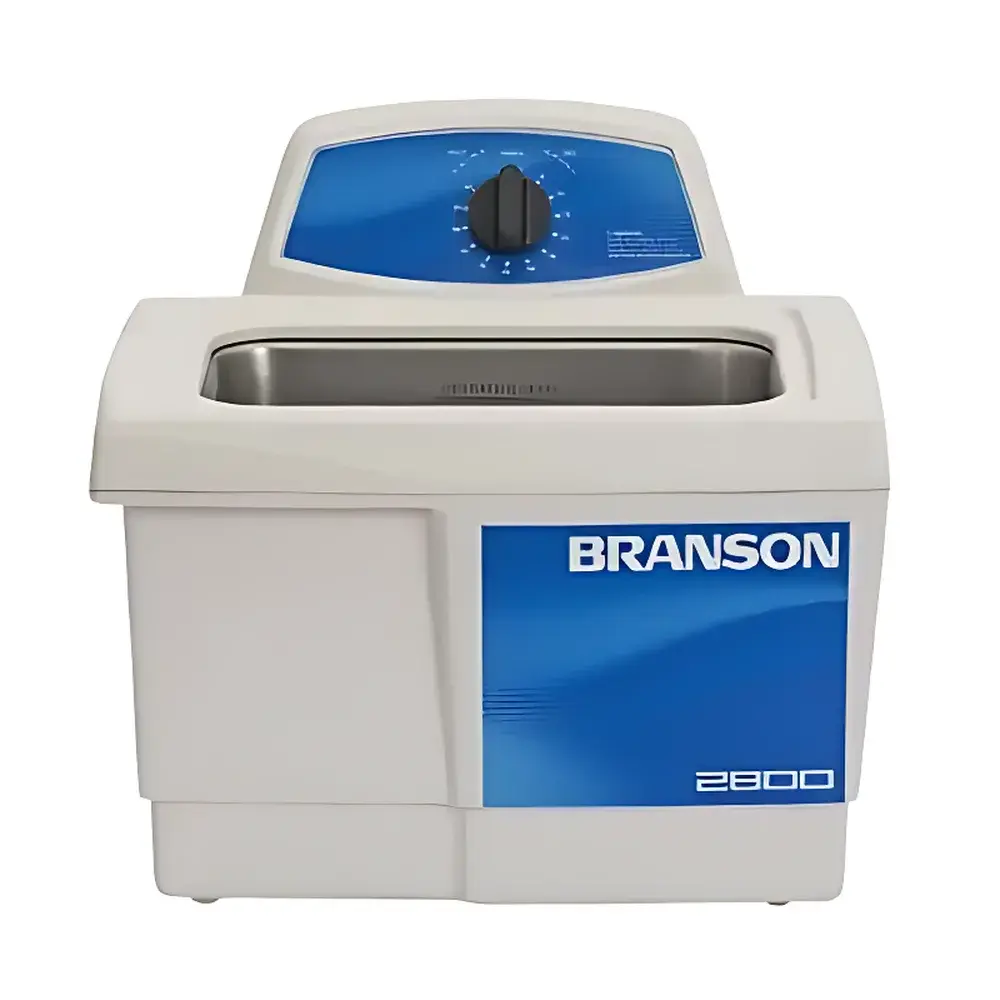

Branson M2800-C Benchtop Ultrasonic Cleaner
| Brand | Branson |
|---|---|
| Origin | USA |
| Model | M2800-C |
| Capacity | 2.8 L |
| Ultrasonic Frequency | 40 kHz |
| Ultrasonic Power Output | 110 W (adjustable) |
| Temperature Range | 20–69 °C (adjustable) |
| Timer Range | 1–99 min (digital) |
| Sound-Dampening Lid | Yes |
| Drain Valve | Manual |
| Construction | Polypropylene (PP) exterior housing, 304 stainless steel tank |
| Certifications | CE, UL, CSA, FCC, TÜV |
Overview
The Branson M2800-C is a precision-engineered benchtop ultrasonic cleaner designed for reproducible, high-efficiency cleaning of delicate laboratory components—including glassware, pipette tips, filtration membranes, microfluidic devices, and precision instrumentation parts. It operates on the principle of cavitation-induced acoustic energy transfer: at a fixed frequency of 40 kHz, piezoelectric transducers generate high-frequency pressure waves in the cleaning liquid, producing transient microbubbles that collapse violently near surfaces—mechanically dislodging particulate contaminants, organic residues, and biofilms without abrasion or thermal degradation. Unlike basic cleaners with fixed power delivery, the M2800-C employs real-time power tracking and professional sweep-frequency modulation to maintain consistent acoustic energy output across varying load conditions, fluid levels, and temperature gradients—ensuring process repeatability essential for QC labs, analytical sample preparation, and regulated environments.
Key Features
- Intelligent power tracking circuitry dynamically adjusts output to compensate for changes in tank loading, solution composition, or temperature—preserving stable cavitation intensity over time.
- Sweep-frequency operation (±1 kHz around 40 kHz center) eliminates standing wave nodes and ensures uniform energy distribution throughout the 2.8 L tank volume—critical for consistent cleaning of multi-part racks or irregularly shaped samples.
- Langevin-type transducer assembly combining metal mass and ceramic piezoelectric elements delivers enhanced durability, thermal stability, and long-term acoustic efficiency (>10,000 hours MTBF under standard operating conditions).
- Vertically mounted internal PCB architecture minimizes moisture ingress risk and improves thermal dissipation—supporting continuous operation in humid lab environments.
- Ergonomic control panel positioned above the tank prevents liquid spillage into electronics; intuitive digital interface enables precise setting of time (1–99 min), temperature (20–69 °C), and power level (10–100% of 110 W).
- Integrated sound-dampening lid doubles as a drip tray and incorporates a manual drain valve for rapid, controlled solution removal—reducing cross-contamination risk between cleaning cycles.
- Tank constructed from medical-grade 304 stainless steel; outer housing fabricated from chemically resistant polypropylene (PP)—validated for compatibility with aqueous detergents, mild alkaline solutions, and low-concentration ethanol-based rinses.
Sample Compatibility & Compliance
The M2800-C accommodates standard laboratory vessels up to 230 mm (L) × 140 mm (W) × 100 mm (D), supporting common formats such as beakers (up to 1000 mL), Petri dishes, cuvettes, syringe filters, and chromatography vials. Its non-aggressive, solvent-free cleaning mechanism preserves surface integrity of optics, coated sensors, and MEMS devices. All units are fully compliant with electromagnetic compatibility (EMC) and electrical safety requirements per IEC/EN 61000-6-3, IEC/EN 61000-6-4, UL 61010-1, CSA C22.2 No. 61010-1, and FCC Part 15 Subpart B. Independent third-party certification by TÜV Rheinland confirms conformity with EN 61000-6-2 (immunity) and EN 61000-6-4 (emissions), satisfying audit requirements for ISO/IEC 17025-accredited laboratories and GLP-compliant workflows.
Software & Data Management
While the M2800-C operates via standalone digital controls (no PC connectivity), its parameter settings—time, temperature, and power—are retained in non-volatile memory after power cycling. The timer supports both discrete cycle mode (1–99 min) and continuous operation, enabling unattended batch processing. For traceability in regulated applications, users may document operational parameters manually or integrate the unit into broader lab equipment logs. Optional Branson Cleaning Validation Kits (sold separately) support protocol development aligned with ASTM F2491 and ISO 13408-1 standards for cleaning validation in pharmaceutical manufacturing environments.
Applications
- Routine decontamination of HPLC/GC autosampler vials, columns, and injector components prior to analysis.
- Removal of residual proteins, lipids, and nucleic acids from electrophoresis combs, gel trays, and blotting apparatus.
- Cleaning of optical components (lenses, prisms, photomultiplier housings) without scratching or coating damage.
- Preparation of electron microscopy grids and TEM sample holders requiring particle-free surfaces.
- De-gassing and homogenization of viscous solvents or nanoparticle suspensions prior to filtration or dispensing.
- Supporting USP and compliance in sterile compounding facilities through validated cleaning of reusable components.
FAQ
Does the M2800-C support external data logging or RS-232/USB connectivity?
No—the M2800-C is a stand-alone analog/digital instrument without communication ports. Parameter history must be recorded manually or via external environmental monitoring systems.
What cleaning solutions are compatible with the 304 stainless steel tank?
Aqueous alkaline detergents (pH 9–11), neutral enzymatic cleaners, and diluted isopropanol/water mixtures (≤30% v/v) are recommended. Avoid hydrochloric acid, hypochlorite solutions, and undiluted organic solvents.
Is the unit suitable for cleaning aluminum or soft-metal parts?
Yes—when used with appropriate low-foaming, non-corrosive detergents and limited exposure times (<10 min), the M2800-C safely cleans aluminum, brass, and titanium alloys without pitting or etching.
How often should the transducer bonding integrity be verified?
Branson recommends annual visual inspection of transducer mounting surfaces and acoustic coupling integrity during routine maintenance. No scheduled recalibration is required unless physical damage or performance drift is observed.
Can the unit operate continuously for extended periods?
Yes—the M2800-C is rated for uninterrupted operation up to 8 hours per cycle. Thermal protection circuitry automatically disables ultrasonics if internal temperatures exceed safe thresholds.



