
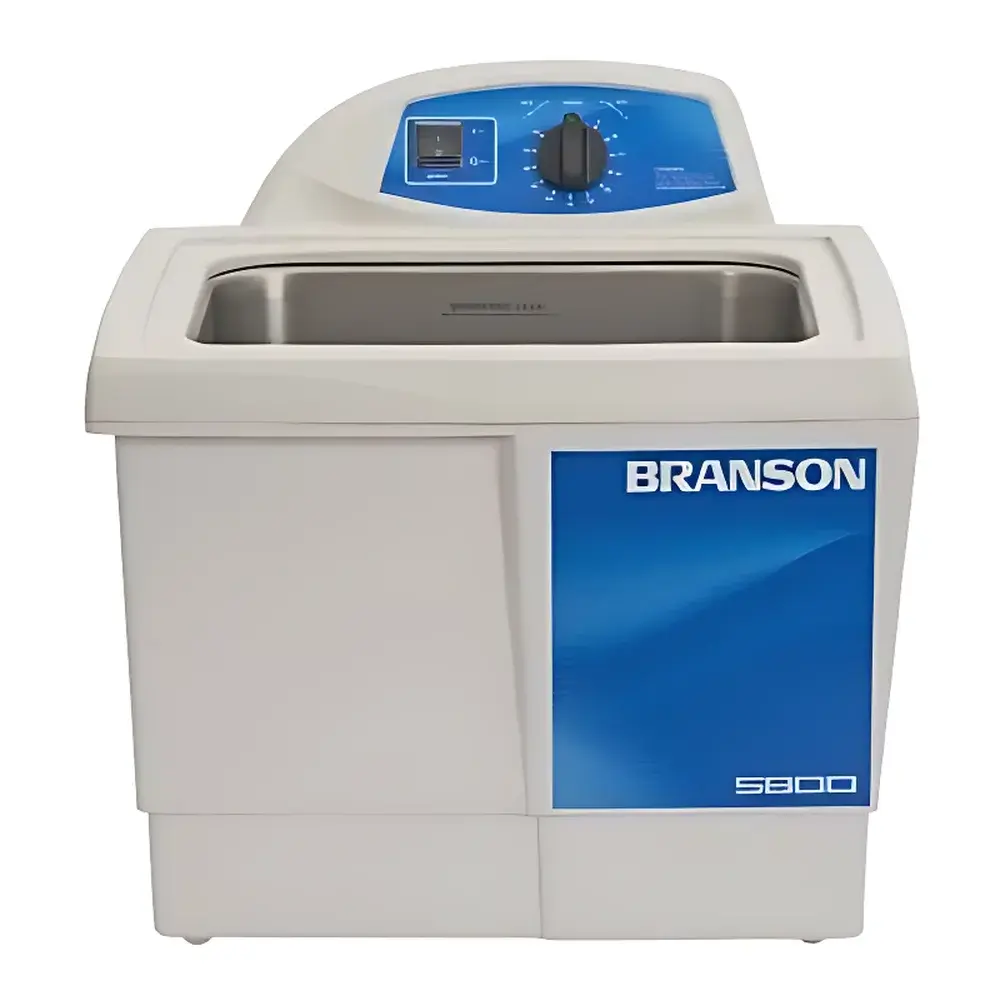
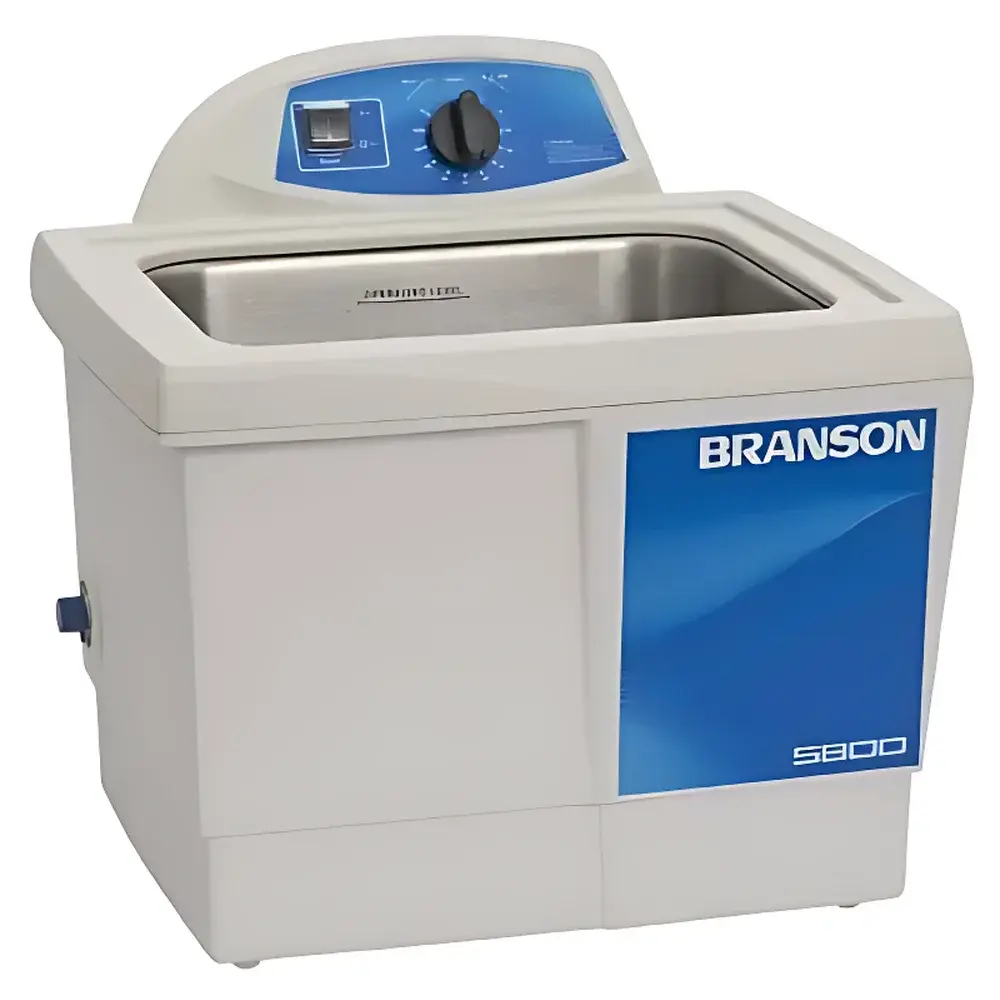
Branson M5800H-C Benchtop Ultrasonic Cleaner
| Brand | Branson |
|---|---|
| Origin | USA |
| Model | M5800H-C |
| Frequency | 40 kHz |
| Internal Tank Capacity | 9.5 L |
| Internal Dimensions (L×W×D) | 290 × 240 × 150 mm |
| External Dimensions (L×W×D) | 397 × 401 × 378 mm |
| Weight | 6.4 kg |
| Timer Range | 0–60 min or continuous mode |
| Maximum Heating Temperature | 69 °C |
| Heating Power | 285 W |
| Ultrasonic Power Output | 180 W |
| Drain Port | Yes |
| Tank Material | Polypropylene (PP) |
| Safety Certifications | CE, UL, CSA, FCC, TÜV |
Overview
The Branson M5800H-C is a precision-engineered benchtop ultrasonic cleaner designed for consistent, repeatable cleaning performance in analytical laboratories, quality control environments, and research facilities. It operates on the principle of high-frequency acoustic cavitation—generating controlled micro-bubbles in liquid media that collapse with localized energy release, effectively dislodging particulate contaminants, organic residues, and biofilms from delicate instrumentation, glassware, surgical tools, and electronic components. Engineered for reliability and regulatory compliance, the M5800H-C integrates Branson’s proprietary sweep-frequency technology and automatic power tracking to maintain stable ultrasonic energy delivery across varying load conditions, fluid levels, and temperature gradients—ensuring reproducibility critical for GLP- and GMP-aligned workflows.
Key Features
- Automatic power tracking circuitry maintains constant ultrasonic output regardless of transducer loading, bath temperature fluctuations, or changes in solution composition—enabling method transfer across users and protocols.
- Sweep-frequency operation (centered at 40 kHz) eliminates standing wave patterns and ensures uniform cavitation distribution throughout the tank volume, significantly improving cleaning homogeneity compared to fixed-frequency systems.
- Langevin-type piezoelectric transducers—fabricated with metal-ceramic composite elements—deliver enhanced mechanical Q-factor and long-term stability under continuous duty cycles.
- Chemically resistant polypropylene (PP) tank construction provides excellent resistance to mild acids, alkaline solutions, and common solvents used in laboratory cleaning protocols (e.g., dilute HNO₃, NaOH, isopropanol).
- Vertical PCB orientation and elevated control panel design minimize moisture ingress risk and improve long-term reliability in humid lab environments.
- Integrated heating system (up to 69 °C) supports temperature-assisted cleaning for viscous or waxy residues; heating power is independently regulated (285 W) to prevent thermal overshoot.
- Mechanical timer with 0–60 minute range or continuous mode offers flexibility for both routine and extended cleaning applications; no software dependency required.
- Dual-function lid serves as both acoustic dampener and drip tray; integrated drain valve enables rapid, spill-free fluid disposal without tilting or manual siphoning.
- Optimized fill line indicator ensures operation at the manufacturer-specified liquid level—critical for maximizing acoustic coupling efficiency and minimizing transducer stress.
Sample Compatibility & Compliance
The M5800H-C accommodates a broad range of sample types including stainless steel, aluminum, borosilicate glass, quartz, ceramic substrates, and plastic components rated for ultrasonic exposure. Its PP tank and sealed electronics architecture meet stringent requirements for use with aqueous, semi-aqueous, and low-volatility solvent-based cleaning solutions. All units are certified to international safety and electromagnetic compatibility standards: UL 61010-1 (North America), CSA C22.2 No. 61010-1, EN 61000-6-3/6-4 (EMC), EN 61010-1 (safety), and carry full TÜV SÜD certification—reflecting validation against worst-case electrical insulation, thermal runaway, and mechanical stress testing protocols. These certifications support audit readiness for FDA-regulated environments operating under 21 CFR Part 11-compliant data management frameworks.
Software & Data Management
The M5800H-C operates via an embedded hardware controller with no external software dependency—eliminating cybersecurity vulnerabilities and reducing validation burden in regulated labs. While it does not feature digital logging or network connectivity, its mechanical timer and fixed-temperature setpoint provide fully traceable, operator-independent parameter execution. For laboratories requiring documented cleaning parameters, integration with external environmental monitoring systems (e.g., calibrated thermocouple loggers, timed video capture) is routinely implemented during IQ/OQ/PQ qualification. The unit’s robust analog architecture ensures uninterrupted operation in facilities where IT infrastructure limitations or cybersecurity policies restrict connected instrumentation.
Applications
This system is routinely deployed in pharmaceutical QC labs for pre-analysis cleaning of HPLC vials, pipette tips, and dissolution apparatus parts; in semiconductor R&D for wafer and mask substrate decontamination; in clinical microbiology for sterilization-prep of reusable culture plates and inoculation loops; and in materials science for removal of polishing compounds from metallographic specimens. Its 9.5 L capacity and 290 × 240 × 150 mm tank geometry accommodate standard 1-L beakers, multi-well plates, and small instrument assemblies without requiring custom fixtures.
FAQ
What is the recommended cleaning solution for the M5800H-C?
Aqueous alkaline or neutral pH detergents (e.g., Branson EC, Alconox Liquinox) are preferred for general labware. Avoid chlorinated solvents or strong oxidizers unless verified compatible with PP and transducer housing.
Can this unit be used with flammable solvents?
No. The M5800H-C is not explosion-proof and lacks intrinsically safe design features required for volatile organic solvents.
Is the heating function programmable or only on/off?
Heating is manually activated via a dedicated toggle switch and maintains setpoint temperature passively; no digital PID control or ramping is available.
Does the unit include degassing functionality?
Sweep-frequency operation inherently reduces dissolved gas nucleation sites, supporting passive degassing during initial fill—no dedicated vacuum or pulse-mode degas cycle is provided.
How often should the tank be descaled or maintained?
In hard water areas, periodic descaling with 5% citric acid solution (at 50 °C, 15 min) is recommended every 2–4 weeks depending on usage frequency and water quality.



