
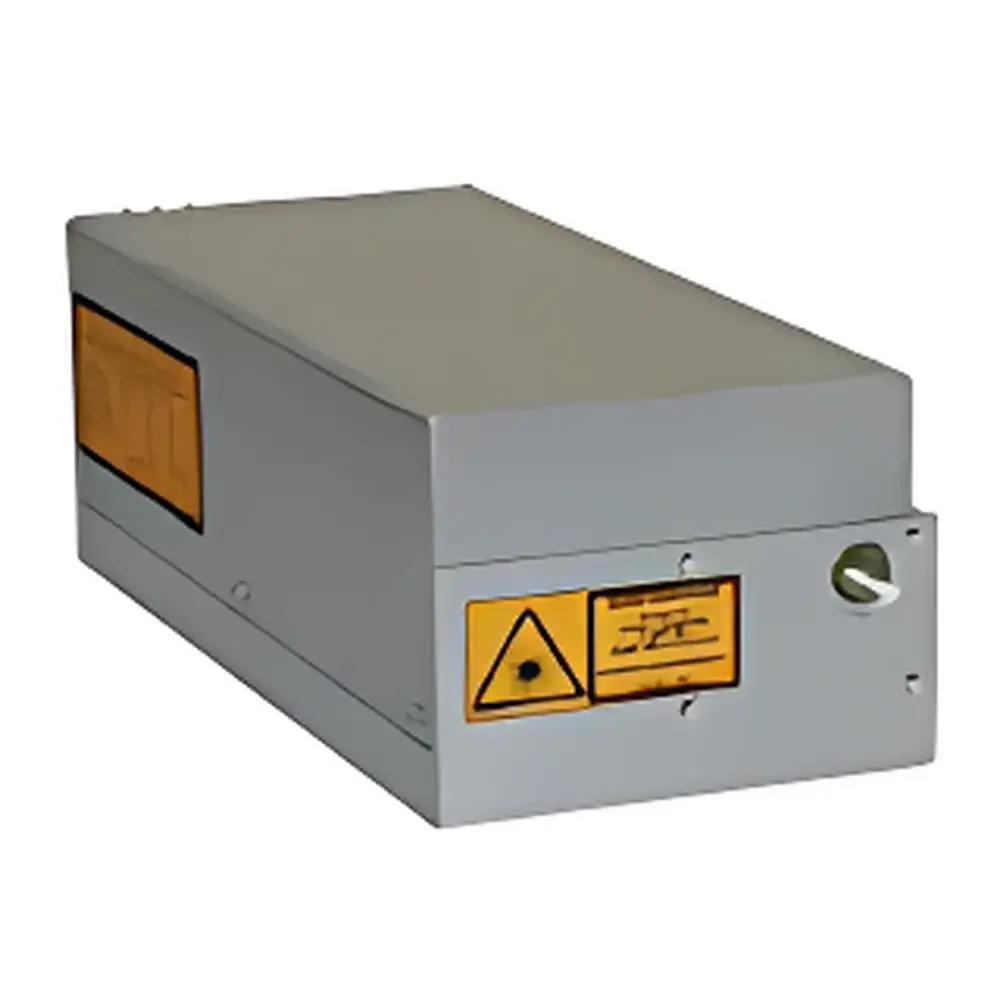
Bright Solutions NewOpto Picosecond Laser System
| Brand | Bright Solutions |
|---|---|
| Origin | USA |
| Manufacturer Type | Authorized Distributor |
| Origin Category | Imported |
| Model | NewOpto |
| Wavelengths | 266 nm, 355 nm, 532 nm, 1064 nm, 1572 nm |
| Pulse Energy | 300 nJ – 1 mJ |
| Pulse Width | 350 ps – 750 ps |
| Repetition Rate | Single Shot to 100 kHz |
| Beam Quality (M²) | ≤1.1 – ≤1.5 |
| Optional Modules | External Driver, Thermoelectric or Water Cooling Units |
| Configurable Options | Wavelength Selection, Extended Repetition Rate Ranges, Beam Expanding/Collimating Optics |
Overview
The Bright Solutions NewOpto Picosecond Laser System is a high-stability, diode-pumped solid-state (DPSS) laser platform engineered for precision time-resolved applications requiring sub-nanosecond temporal resolution. Operating on the principle of passive Q-switching in Nd:YAG, Nd:YVO₄, or optical parametric oscillator (OPO)-based architectures, the system delivers transform-limited Gaussian pulses with controlled temporal profiles and excellent spatial coherence. Its picosecond pulse duration—ranging from 350 ps to 750 ps—enables efficient nonlinear optical processes such as second-harmonic generation (SHG), optical parametric amplification (OPA), and time-of-flight (ToF) measurements while minimizing thermal load on sensitive targets. Designed for integration into OEM instruments and laboratory-grade setups, the NewOpto series supports multi-wavelength operation across deep UV (266 nm), near-UV (355 nm), visible (532 nm), NIR (1064 nm), and short-wave infrared (1572 nm) spectral bands—making it suitable for both fundamental photonics research and industrial process development.
Key Features
- Multi-wavelength output: Standard wavelengths include 266 nm, 355 nm, 532 nm, 1064 nm, and 1572 nm—each optimized for specific absorption and nonlinear interaction characteristics.
- Adjustable pulse energy: Configurable from 300 nJ up to 1 mJ per pulse, enabling scalability across low-fluence spectroscopy and high-energy ablation applications.
- Precise temporal control: Pulse widths tightly maintained between 350 ps and 750 ps, with jitter < 1% RMS, ensuring reproducibility in pump-probe experiments and LIDAR signal processing.
- Flexible repetition rate: Operation from single-shot triggering to continuous burst modes at up to 100 kHz, compatible with gated detection systems and high-throughput manufacturing interfaces.
- Diffraction-limited beam quality: M² ≤ 1.1–1.5 across all wavelengths, supporting tight focusing for micromachining, ophthalmic procedures, and confocal microscopy integration.
- Modular architecture: Optional external driver units, thermoelectric coolers (TEC), or water-cooling kits allow deployment in environments with strict thermal management requirements.
Sample Compatibility & Compliance
The NewOpto Picosecond Laser System is compatible with a broad range of optical materials—including fused silica, CaF₂, BK7, sapphire, and semiconductor wafers—without inducing significant thermal distortion during repetitive irradiation. Its pulse parameters comply with ISO 11551 (laser beam power/energy measurement) and IEC 60825-1:2014 (laser product safety classification). For medical device integration, the 532 nm and 1064 nm variants meet ANSI Z136.1 safety standards for Class IV laser systems. When configured with TTL or RS-232 trigger inputs and analog modulation capability, the system supports GLP-compliant data acquisition workflows and can be validated under FDA 21 CFR Part 11 when paired with compliant software platforms.
Software & Data Management
The laser system integrates seamlessly with third-party control environments via USB, RS-232, or digital I/O interfaces. Bright Solutions provides a vendor-neutral SDK supporting LabVIEW™, MATLAB®, Python (PySerial), and C++ APIs for full parameter scripting—including real-time adjustment of repetition rate, pulse energy scaling, and interlock status monitoring. All operational logs—including shot count, temperature telemetry, and fault event timestamps—are stored locally with UTC-synchronized metadata. Audit trails generated during calibration or maintenance cycles adhere to ISO/IEC 17025 traceability requirements when used in accredited testing laboratories.
Applications
- LIDAR and time-of-flight ranging: High peak power and narrow pulse width enable centimeter-level distance resolution in atmospheric sensing and autonomous vehicle navigation subsystems.
- Short-wave infrared (SWIR) imaging: 1572 nm emission serves as an eye-safe illumination source for active SWIR cameras used in defense surveillance and agricultural monitoring.
- Microfabrication and semiconductor processing: Sub-10 µm feature ablation with minimal heat-affected zones in silicon, GaAs, and thin-film PV materials.
- Ophthalmology and dermatology: Selective photothermolysis in corneal surgery (e.g., fs/ps LASIK pre-treatment) and pigment-specific lesion removal with reduced epidermal injury risk.
- Time-resolved fluorescence and transient absorption spectroscopy: Synchronization with streak cameras or TCSPC modules for nanosecond-to-picosecond kinetic analysis.
- Solar cell texturing and selective emitter formation: High-repetition-rate 1064 nm pulses enable rapid surface structuring of PERC and TOPCon cell architectures.
FAQ
Is this laser system FDA-cleared for medical use?
No—this is a Class IV industrial/research laser system. Medical use requires additional regulatory clearance by end-device manufacturers under FDA 510(k) or De Novo pathways.
Can the repetition rate be externally triggered?
Yes—TTL-compatible sync input allows precise external triggering with jitter < 5 ns, supporting pump-probe delay stages and synchronized detector gating.
What cooling options are available?
Standard air-cooled operation is supported up to 50 kHz; optional TEC modules extend stability to 100 kHz, while water-cooling enables continuous duty cycle operation above 80 kHz.
Are custom wavelengths beyond the listed five available?
Yes—OPO-based configurations support tunable output from 410 nm to 4 µm upon request; lead times and minimum order quantities apply.
Does the system include beam delivery optics?
Basic collimation is integrated; optional beam expanders, Galilean telescopes, and fiber coupling adapters are available as configurable accessories.




