
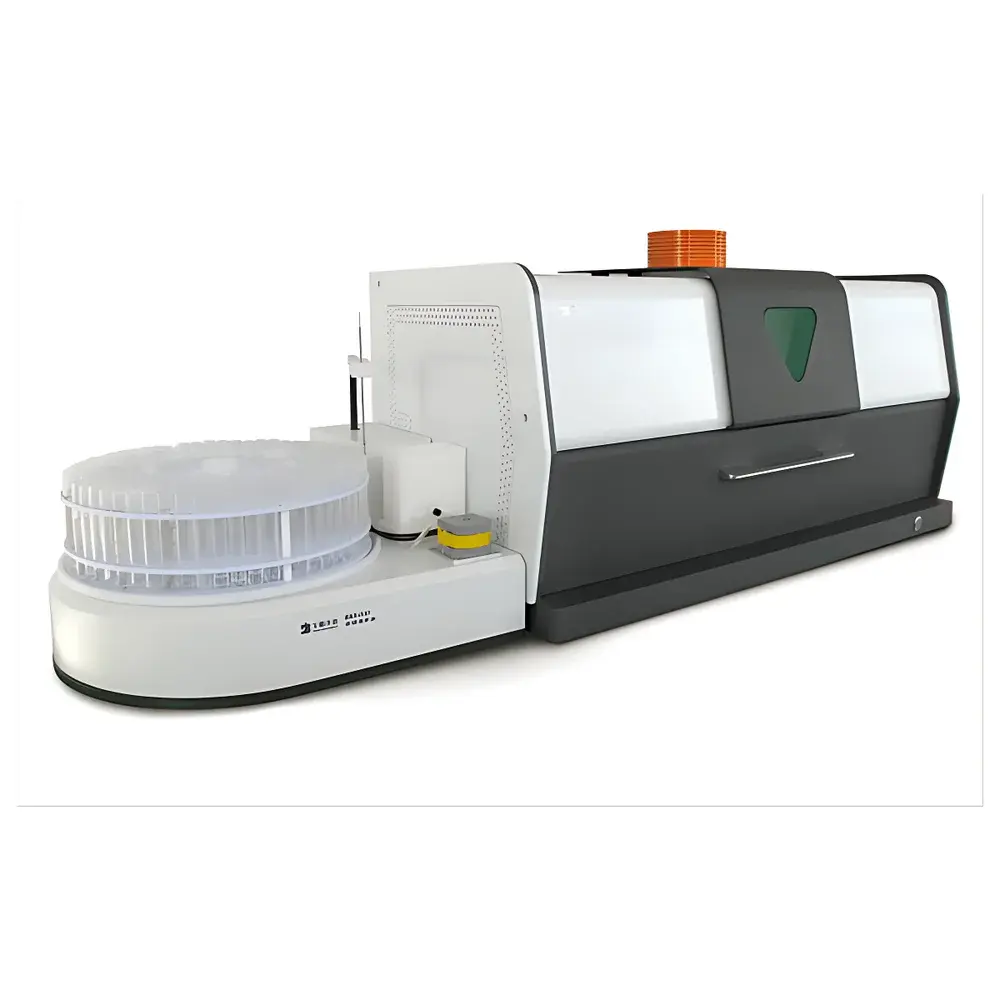
Brookfield BAF-3000 Atomic Fluorescence Spectrometer
| Brand | Brookfield |
|---|---|
| Origin | Beijing, China |
| Manufacturer Type | Direct Manufacturer |
| Model | BAF-3000 |
| Detection Elements | As, Hg, Se, Sb, Bi, Pb, Te, Ge, Cd, Sn, Zn, Au |
| Channel Configuration | Triple-channel simultaneous detection |
| Speciation Capability | As, Hg, Se, Sb (post-upgrade) |
| Optical Design | Optimized low-background fluorescence path with 30% sensitivity enhancement vs. conventional configurations |
| Mercury Lamp System | Auto-ignition and real-time drift compensation |
| Light Source Alignment | Motorized auto-focusing |
Overview
The Brookfield BAF-3000 Atomic Fluorescence Spectrometer is a triple-channel hydride generation atomic fluorescence (HG-AFS) instrument engineered for trace elemental quantification in complex matrices. It operates on the principle of atomic fluorescence spectroscopy, where analyte elements—after chemical reduction to volatile hydride or cold vapor forms—are atomized in a quartz cell and excited by a high-intensity hollow cathode lamp (HCL). The resulting element-specific fluorescence emission is measured at right angles to the excitation beam, minimizing scattered light interference and enabling sub-picogram-level detection limits. Designed for routine compliance testing and research-grade analysis, the BAF-3000 delivers high reproducibility and long-term signal stability across environmental, food safety, clinical, and geochemical laboratories.
Key Features
- Triple-channel simultaneous detection: Independent optical paths and detectors allow concurrent quantification of As, Hg, Se, Sb, Bi, Pb, Te, Ge, Cd, Sn, Zn, and Au—reducing analysis time by up to 67% compared to sequential single-channel systems.
- Optimized low-background optical architecture: A re-engineered excitation/emission geometry with precision-aligned parabolic mirrors and spectral filtering reduces stray light and increases net fluorescence signal intensity by approximately 30%, directly improving method detection limits (MDLs) and measurement precision.
- Mercury lamp auto-ignition and real-time drift correction: Integrated high-voltage pulse circuitry enables reliable cold-vapor mercury lamp ignition without external starters. A continuous photometric monitoring system tracks lamp output intensity and applies dynamic baseline correction during acquisition, ensuring consistent calibration integrity over multi-hour runs.
- Motorized auto-focusing light source alignment: Each hollow cathode lamp is mounted on a motorized XYZ stage that automatically positions the optimal focal spot onto the quartz atomizer. This eliminates manual lamp alignment procedures and ensures repeatable optical coupling across lamp replacements and maintenance cycles.
- Modular hydride generation system: Chemically resistant PTFE reaction coils, programmable peristaltic pump control, and gas–liquid separator design support robust hydride formation for As, Se, Sb, Bi, Te, and Sn, as well as cold-vapor generation for Hg and Cd.
Sample Compatibility & Compliance
The BAF-3000 accommodates liquid samples ranging from 0.5 mL to 10 mL volume, including acid-digested environmental waters (e.g., EPA Method 1631E), microwave-digested food and biological tissues, and diluted pharmaceutical extracts. Sample introduction is compatible with standard 16-mm borosilicate glass vials and automated autosampler trays. The instrument meets functional requirements for ISO/IEC 17025-accredited laboratories and supports documentation workflows aligned with GLP and GMP principles. Its software architecture includes audit-trail functionality compliant with FDA 21 CFR Part 11 for electronic records and signatures, facilitating regulatory submissions in food safety (e.g., GB 5009.11–2023, USP ) and environmental monitoring (e.g., ISO 11969, ASTM D5673).
Software & Data Management
The BAF-3000 is operated via Brookfield AFS Control Suite v4.2—a Windows-based application supporting method development, sequence scheduling, real-time signal visualization, and multi-point calibration (linear, quadratic, and weighted least-squares). Raw fluorescence intensity data are stored in vendor-neutral CSV and XML formats, with embedded metadata including lamp ID, integration time, carrier gas flow, and digestion batch identifiers. The software provides built-in uncertainty propagation calculations per ISO/IEC Guide 98-3 (GUM), supports QC charting (X-bar/R, Levey-Jennings), and exports reports conforming to LIMS-compatible templates. All user actions—including parameter changes, calibration updates, and result approvals—are timestamped and logged with operator ID for full traceability.
Applications
The BAF-3000 is routinely deployed in national reference laboratories for regulatory surveillance of arsenic in rice and infant formula (per Codex Alimentarius STAN 193–1995), mercury in fish tissue (EPA 1631), selenium in dietary supplements (USP ), and antimony in drinking water (WHO Guidelines for Drinking-water Quality, 4th ed.). It supports speciation-ready configurations for As(III)/As(V), methylmercury/total Hg, and Se(IV)/Se(VI) when coupled with HPLC–AFS interfaces. Additional validated use cases include lead screening in cosmetics (EU Cosmetics Regulation EC No. 1223/2009), gold quantification in geological leachates (ASTM D5173), and cadmium determination in textile dyes (OEKO-TEX Standard 100).
FAQ
What sample preparation protocols are recommended for solid matrices such as soil or plant tissue?
Acid digestion using closed-vessel microwave systems with HNO₃–H₂O₂–HF mixtures is required prior to analysis. Certified reference materials (e.g., NIST SRM 2710a, GBW 07605) must be processed in parallel to validate recovery and matrix effect correction.
Does the BAF-3000 support hyphenated techniques such as HPLC–AFS?
Yes—the instrument features TTL-triggered acquisition mode and analog voltage output for seamless synchronization with commercial HPLC systems, enabling validated speciation workflows per ISO/IEC 17025 method validation guidelines.
Is method transfer possible from older single-channel AFS instruments?
Method parameters—including carrier gas flow, reaction coil temperature, and integration time—can be ported directly; however, calibration curves require re-establishment due to enhanced sensitivity and reduced background noise.
What maintenance intervals are specified for the quartz atomizer and reaction manifold?
Quartz atomizers should be inspected after every 200 injections and replaced if etching or carbon deposition is observed; PTFE reaction coils are rated for ≥1,000 analyses under standard operating conditions and should be replaced quarterly in high-throughput labs.
Can the system be integrated into a centralized laboratory information management system (LIMS)?
Yes—via ODBC-compliant database export and HL7-compatible result transmission modules included in the optional Enterprise Integration Package.





