
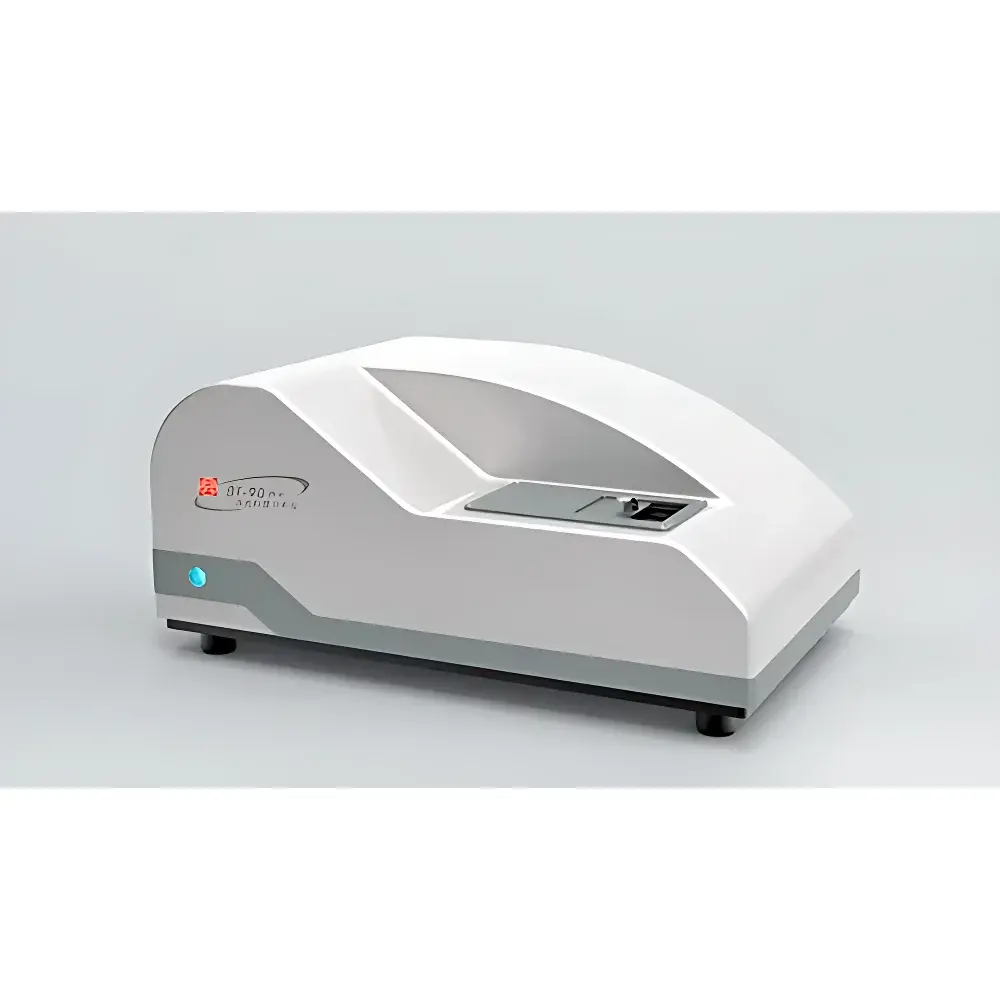
Brookfield BT90 Advanced Dynamic Light Scattering Nanoparticle Size Analyzer
| Origin | Beijing, China |
|---|---|
| Manufacturer Type | Authorized Distributor |
| Origin Category | Domestic (PRC) |
| Model | BT90 |
| Price Range | USD 21,000–28,000 (FOB) |
| Dispersion Method | Wet Dispersion |
| Measurement Range | 1–9500 nm |
| Repeatability | <1% RSD |
| Measurement Time | 10–15 seconds |
| Laser Source | 20 mW, 635 nm Solid-State Diode Laser |
| Scattering Angle | 90° |
| Detector | High-Sensitivity PMT |
| Correlator | 200 Physical Channels, 1–5 µs Dynamic Sampling & Delay Time |
| Sample Cell Volume | 0.5 mL & 8 mL |
| Temperature Control Range | 15–90 °C |
| Temperature Stability | ±0.5 °C |
| Analysis Modes | NNSL, Multi-Peak, CONTIN |
| Dimensions | 45 × 305 × 210 mm |
| Weight | 15 kg |
Overview
The Brookfield BT90 Advanced Dynamic Light Scattering (DLS) Nanoparticle Size Analyzer is an engineered solution for high-precision hydrodynamic diameter measurement of colloidal nanoparticles and macromolecules in liquid suspension. Based on the fundamental principles of Brownian motion and photon correlation spectroscopy, the BT90 detects temporal fluctuations in scattered laser intensity arising from thermally driven particle diffusion. These intensity autocorrelations are quantitatively analyzed using digital signal processing to extract the diffusion coefficient, which—via the Stokes–Einstein equation—is directly converted into particle size distribution (PSD) without calibration standards. Designed for routine laboratory use in regulated and research environments, the system delivers sub-nanometer resolution across a broad dynamic range (1–9500 nm), making it suitable for characterizing proteins, polymer colloids, lipid nanoparticles, metal oxides, and pharmaceutical nanocarriers under physiologically or industrially relevant conditions.
Key Features
- High-stability 20 mW, 635 nm solid-state diode laser with low noise and long operational lifetime
- 90° fixed-angle detection geometry optimized for sensitivity and minimal multiple scattering artifacts in dilute to moderately concentrated dispersions
- Thermally regulated sample chamber with programmable temperature control (15–90 °C) and precision stability of ±0.5 °C—critical for temperature-dependent aggregation studies and viscosity-corrected sizing
- Dual-volume quartz cuvette support (0.5 mL micro-cell and 8 mL standard cell) enabling flexible sample volume management and reduced reagent consumption
- Ultra-low-noise photomultiplier tube (PMT) detector with high quantum efficiency and fast response time, ensuring reliable single-photon counting even at low scattering intensities
- 200-channel digital autocorrelator based on dedicated DSP architecture, supporting real-time correlation with adjustable sampling intervals (1–5 µs) and robust signal discrimination across heterogeneous populations
- Integrated analysis engine supporting three complementary inversion algorithms: Non-Negative Least Squares (NNSL), multi-modal peak fitting, and CONTIN regularization—each suited to distinct sample complexity and polydispersity profiles
Sample Compatibility & Compliance
The BT90 accommodates aqueous and organic dispersions—including water, ethanol, THF, chloroform, and silicone oils—provided refractive index contrast and optical clarity permit sufficient scattering signal-to-noise ratio. It supports concentration ranges from 0.1 to 100 mg/mL depending on material density and scattering cross-section. The instrument complies with ISO 13321:2020 (Determination of particle size distribution — Dynamic light scattering), and its temperature control, data logging, and audit trail capabilities align with GLP and GMP documentation requirements. Optional software modules provide 21 CFR Part 11-compliant electronic signatures, user access controls, and immutable audit logs for regulated QC/QA workflows in pharmaceutical and biotech laboratories.
Software & Data Management
BT90 Control & Analysis Suite is a Windows-based application offering intuitive method setup, real-time correlation curve visualization, automated quality assessment (e.g., baseline stability, count rate monitoring), and batch report generation in PDF or Excel formats. All raw correlator data, instrument parameters, and analysis settings are stored in a structured SQLite database with timestamped metadata. Export functions support ASTM E2917 and ISO/IEC 17025-compliant reporting templates. Data integrity is preserved through automatic checksum validation and version-controlled algorithm libraries—ensuring reproducibility across instruments and over time.
Applications
- Characterization of protein therapeutics (e.g., monoclonal antibodies, albumin conjugates) and vaccine delivery systems (LNPs, VLPs)
- Quality control of nanoscale pigments, ceramic precursors, and metallic colloids in advanced materials R&D
- Stability assessment of emulsions, microgels, and surfactant-stabilized dispersions under thermal stress or pH variation
- Monitoring of nanoparticle synthesis kinetics and post-processing aggregation behavior
- Supporting formulation development for topical, oral, and injectable nanomedicines per ICH Q5A and Q5C guidelines
- Academic research in soft matter physics, colloidal science, and interfacial chemistry
FAQ
What particle types can the BT90 measure accurately?
It measures hydrodynamic diameter of spherical or near-spherical particles in suspension—including polymers, proteins, liposomes, metal oxides, quantum dots, and latex standards—provided they exhibit measurable Brownian motion and generate sufficient scattered light intensity.
Is temperature control essential for DLS measurements?
Yes. Temperature directly affects solvent viscosity and diffusion coefficient; precise thermal regulation (±0.5 °C) ensures accurate size calculation and enables comparative studies of thermal stability or phase transitions.
How does the BT90 handle polydisperse or multimodal samples?
Through configurable analysis modes (NNSL for broad distributions, multi-peak for discrete populations, and CONTIN for ill-posed inverse problems), supported by statistical confidence metrics and residual error diagnostics.
Can the BT90 be validated against certified reference materials?
Yes. Validation using NIST-traceable polystyrene latex standards (e.g., 100 nm CRM) yields mean size accuracy within ±1%, meeting ISO 13321 tolerance limits and supporting instrument qualification per IQ/OQ protocols.
Does the system support automated sample handling?
The base configuration is manual-load; however, optional autosampler integration (up to 48 positions) is available for unattended batch analysis in high-throughput environments.



