
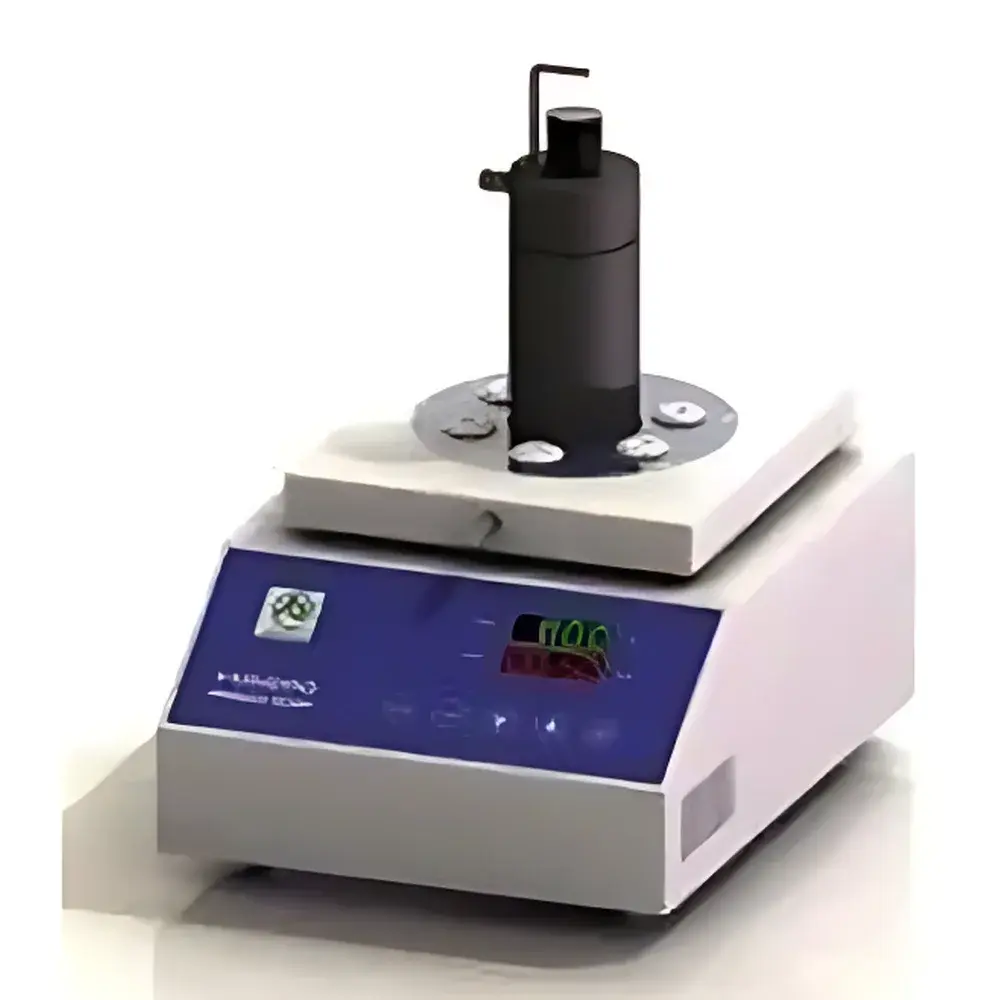
Brookfield DK-300A Static Headspace Sampler
| Brand | Beifen Sanpu |
|---|---|
| Origin | Beijing, China |
| Manufacturer Type | Direct Manufacturer |
| Instrument Type | Static Headspace Sampler |
| Automation Level | Semi-Automatic |
| Vial Heating Range | Ambient to 200 °C (1 °C increment) |
| Valve Heating Range | Ambient to 200 °C (1 °C increment) |
| Loop Volume | 1 mL |
| Temperature Control Accuracy | ±0.5 °C |
| Vial Capacity | 10 positions |
| Vial Size | 20 mL |
Overview
The Brookfield DK-300A Static Headspace Sampler is an engineered solution for routine and regulated volatile compound analysis in gas chromatography (GC) workflows. It operates on the principle of static headspace equilibrium—where a sealed sample vial is heated to promote partitioning of volatile analytes from the condensed phase (liquid or solid matrix) into the headspace gas phase. After thermal equilibration, a precise volume of this gas-phase mixture is transferred via a thermostatted sampling valve and heated transfer line directly into the GC injector. This method eliminates solvent extraction, derivatization, or filtration steps, significantly reducing matrix interference, carryover risk, and analyst exposure to hazardous solvents—making it ideal for laboratories requiring robust, trace-level quantification of volatiles under GLP, ISO/IEC 17025, or FDA-regulated environments.
Key Features
- Thermostatically controlled dual-zone heating system: independent temperature regulation for both the vial oven (ambient–200 °C) and the sampling valve/loop assembly (ambient–200 °C), ensuring complete vapor-phase integrity and preventing condensation during transfer.
- Semi-automated operation with manual vial loading and programmable equilibration timing (0–999 minutes), supporting method reproducibility across shifts and operators.
- 10-position vial carousel accommodating standard 20 mL crimp-top headspace vials—compatible with industry-standard septa and aluminum caps per ASTM D6866 and USP requirements.
- Integrated 1 mL fixed-volume sampling loop with inert, passivated stainless-steel construction; designed for high-pressure GC inlet compatibility and minimal adsorption of polar or reactive volatiles.
- Heated needle sleeve assembly maintains syringe temperature throughout injection, eliminating cold spots and preserving quantitative accuracy for low-boiling compounds (e.g., methanol, acetaldehyde, chloromethane).
- Front-panel interface with real-time temperature monitoring, audible equilibration alert, and error logging—enabling full traceability without external software dependency.
Sample Compatibility & Compliance
The DK-300A supports direct analysis of aqueous solutions, biological fluids (serum, urine), polymer matrices, pharmaceutical tablets, food homogenates, and environmental water samples. Its design conforms to key regulatory frameworks governing residual solvent testing (USP , ICH Q3C), forensic toxicology (SWGTOX guidelines), and environmental analysis (EPA Method 502.2, EPA 8260D). All wetted surfaces are chemically inert (electropolished 316 stainless steel, PTFE-sealed valves), minimizing analyte degradation and enabling compliance with GMP documentation standards—including audit trails for temperature setpoints, hold times, and operator ID when integrated with LIMS.
Software & Data Management
While the DK-300A operates independently via its embedded controller, it provides analog and digital I/O interfaces (RS-232, dry-contact trigger) for synchronization with GC systems and third-party chromatography data systems (CDS) such as Thermo Chromeleon, Agilent OpenLab CDS, or Waters Empower. When paired with compliant CDS platforms, the instrument supports 21 CFR Part 11–aligned electronic signatures, secure user access levels, and full audit trail capture—including timestamps for vial insertion, heating initiation, equilibration completion, and injection execution. Method parameters are stored locally and exportable as CSV for QA review.
Applications
- Forensic Toxicology: Quantification of ethanol, acetone, isopropanol, and aldehydes in blood and urine per AOAC 986.11 and SWGTOX Standard Operating Procedures.
- Pharmaceutical Quality Control: Residual solvent testing in active pharmaceutical ingredients (APIs) and final dosage forms per ICH Q3C Class 1–3 limits.
- Food & Beverage Safety: Measurement of ethylene oxide residues in spices, acetaldehyde in PET-packaged beverages, and low-boiling aroma compounds in beer and wine.
- Environmental Monitoring: Detection of volatile halogenated hydrocarbons (e.g., chloroform, carbon tetrachloride) in drinking water and surface water per EPA 524.2 and ISO 15681-2.
- Materials Testing: Headspace analysis of monomer emissions from polymers, packaging leachables, and catalyst outgassing in battery electrolyte formulations.
FAQ
What sample vial sizes does the DK-300A support?
The instrument is configured for 20 mL standard crimp-top headspace vials. While the hardware accommodates alternative formats (2 mL, 10 mL) with optional adapters, factory calibration and validation are performed using 20 mL vials per USP and ASTM D7217 protocols.
Is the 1 mL loop volume adjustable?
No—the DK-300A employs a fixed 1 mL stainless-steel sampling loop. For variable-volume injections, users must pair the instrument with a compatible GC inlet capable of split/splitless flow control or install an external dilution module.
Can the DK-300A be validated for GMP use?
Yes—its deterministic temperature control (±0.5 °C), mechanical repeatability, and I/O traceability support IQ/OQ/PQ protocol development. Full validation documentation templates and test scripts are available upon request from the manufacturer.
Does the system require carrier gas conditioning?
Yes—a clean, dry, hydrocarbon-free carrier gas (helium or hydrogen) is required for both headspace pressurization and GC transfer. A dedicated gas purifier and pressure regulator are recommended upstream of the instrument’s gas inlet port.
How long does thermal stabilization take from ambient to 70 °C?
Using ten 20 mL vials and a 1 mL gas-tight syringe, the oven achieves ±0.5 °C stability within ≤8 minutes—verified per ASTM E2754 calibration procedures.




