
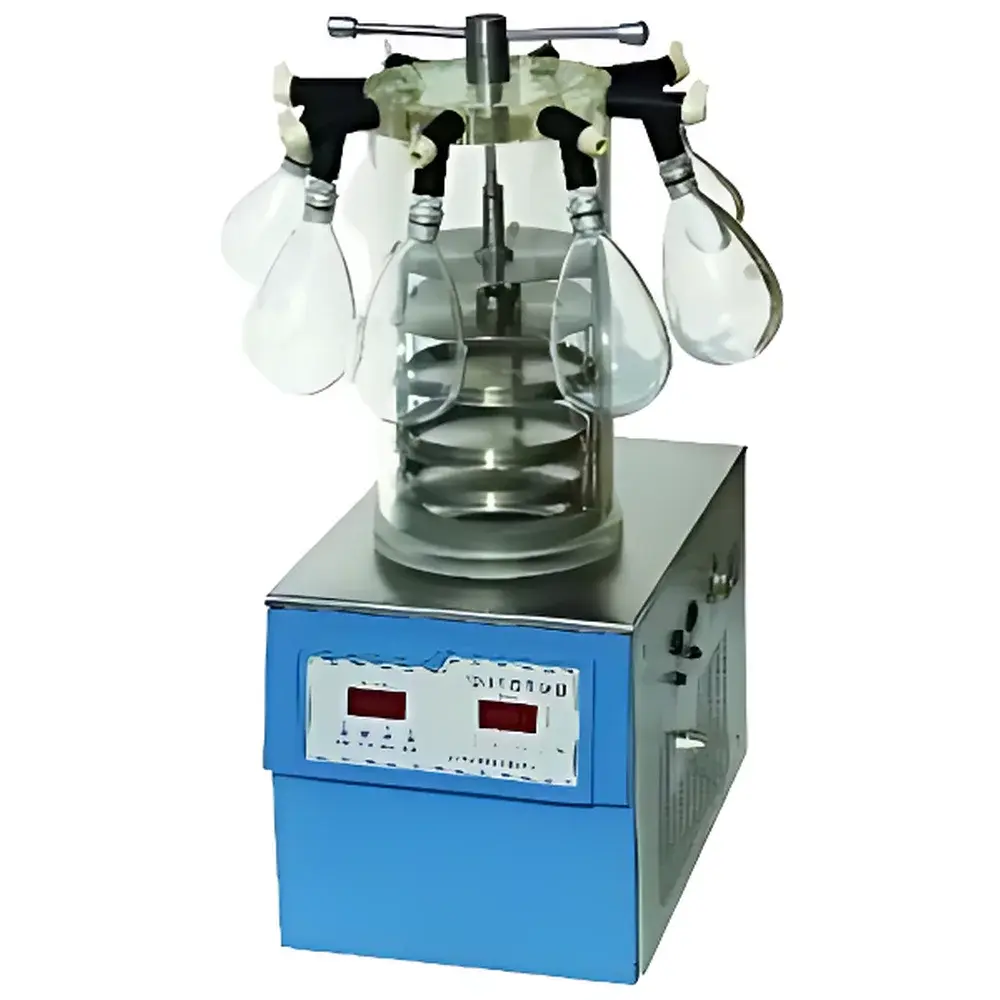
Brookfield FD-1C Stoppering Freeze Dryer
| Origin | Beijing, China |
|---|---|
| Manufacturer Type | Authorized Distributor |
| Origin Category | Domestic (China) |
| Model | FD-1C |
| Price | USD 4,500 (FOB Beijing) |
| Condenser Temperature (No Load) | ≤ −50 °C (−80 °C optional) |
| Ultimate Vacuum (No Load) | < 13 Pa |
| Shelf Area | 0.08 m² (3 stainless steel shelves, Φ200 mm each) |
| Chamber Dimensions | Φ320 × 550 mm |
| Max Sample Volume | 900 mL (at 10 mm thickness) or 192 × 22 mm vials |
| Lyophilization Cycle Time | ~24 h (for ≤10 mm layer thickness) |
| Standard Vacuum Pump | 2 L/min domestic rotary vane pump |
| Optional Vacuum Pump | Certified oil-sealed or dry scroll pump (ISO 8573-1 Class 0 compliant) |
Overview
The Brookfield FD-1C Stoppering Freeze Dryer is a benchtop lyophilization system engineered for reproducible, small-batch freeze drying of thermolabile biologicals, pharmaceutical intermediates, and research-grade samples under controlled vacuum and subzero condensation conditions. It operates on the fundamental principles of sublimation—removing water from frozen material via direct phase transition from ice to vapor under low-pressure environments—while preserving structural integrity, bioactivity, and chemical stability. Designed for laboratories requiring regulatory-compliant primary drying with manual stopper actuation capability, the FD-1C integrates a high-efficiency condenser, precision vacuum control, and an optically transparent cylindrical drying chamber. Its architecture supports both bulk tray drying and multi-vial processing, making it suitable for method development, stability testing, and pre-formulation studies in academic, QC, and early-stage biopharma settings.
Key Features
- High-capacity dual-stage condenser with selectable operating temperatures: standard −50 °C or optional −80 °C, enabling efficient water vapor capture for samples with high eutectic points or elevated total volatile content.
- Internationally standardized ISO-KF vacuum fittings ensure leak-tight connections, rapid disassembly, and compatibility with third-party gauges, valves, and vacuum accessories.
- Digital LED interface displays real-time condenser temperature and chamber pressure with ±0.5 °C and ±1 Pa resolution respectively—critical for monitoring critical process parameters (CPPs) during cycle validation.
- Ergonomic soft-touch membrane keypad enables intuitive navigation through drying stage selection, vacuum ramping, and shelf temperature hold functions without external software dependency.
- Optically clear acrylic bell jar chamber (Φ320 × 550 mm) permits full visual monitoring of sublimation front progression, cake morphology, and potential collapse events—essential for empirical optimization of primary drying endpoints.
- Modular stainless steel sample shelf assembly (Φ200 mm × 3 tiers) with adjustable inter-shelf spacing allows flexible configuration for trays, Petri dishes, or heterogeneous vial formats—including simultaneous processing of 192 × 22 mm serum vials or up to 900 mL of homogeneous solution per batch.
Sample Compatibility & Compliance
The FD-1C accommodates aqueous-based formulations including protein solutions, bacterial suspensions, enzyme preparations, diagnostic reagents, and herbal extracts. Its stainless steel cold trap and chamber surfaces meet ASTM A276 Type 304 finish requirements for corrosion resistance and cleanability. While the base configuration complies with general laboratory safety standards (IEC 61010-1), users intending GMP/GLP applications may integrate optional vacuum pumps certified to ISO 8573-1 Class 0 for oil-free operation, and employ external data loggers validated per FDA 21 CFR Part 11 for electronic record integrity. The system supports IQ/OQ documentation packages aligned with ISO 13485 and EU Annex 15 expectations for equipment qualification in regulated environments.
Software & Data Management
The FD-1C operates in standalone mode with embedded firmware; no proprietary PC software is required for basic operation. All process parameters—including time-stamped condenser temperature, chamber pressure, and elapsed cycle duration—are retained in non-volatile memory for post-run review. For advanced data governance, users may connect calibrated external pressure transducers and thermocouples to a validated SCADA system or LabArchives ELN via analog 4–20 mA outputs (available upon request). Audit trails, user access levels, and electronic signatures can be implemented externally to satisfy ALCOA+ data integrity principles during regulatory audits.
Applications
- Stabilization of monoclonal antibodies, vaccines, and plasmid DNA prior to long-term storage or transport.
- Preparation of calibration standards and reference materials for clinical chemistry and environmental testing labs.
- Routine dehydration of microbial cultures for strain preservation in microbiology and fermentation R&D.
- Processing of natural product extracts for phytochemical analysis where thermal degradation must be avoided.
- Development of lyophilized excipient matrices for nasal spray or inhalation dosage forms.
- Teaching laboratory demonstrations of phase behavior, mass transfer kinetics, and vacuum thermodynamics.
FAQ
What is the maximum allowable sample volume per batch?
Up to 900 mL of aqueous solution at 10 mm depth across three shelves—or 192 × 22 mm glass vials—assuming uniform loading and optimal heat transfer conditions.
Can the FD-1C perform automated stoppering?
No. This is a manual stoppering model: the chamber includes a built-in stopper compression mechanism operated by hand lever; full automation requires integration with external hydraulic or pneumatic stoppering stations.
Is the system compatible with organic solvents?
Only limited compatibility with low-boiling-point solvents (e.g., acetone, ethanol) is supported under strict operator supervision and enhanced ventilation; methanol, DMSO, and chlorinated solvents are prohibited due to condenser material limitations and explosion risk.
Does the standard vacuum pump meet ISO Class 0 requirements?
No—the included 2 L/min rotary vane pump uses hydrocarbon oil and is intended for general research use; ISO 8573-1 Class 0 compliance requires specification of an optional dry scroll or diaphragm pump.
What validation support is provided for GxP environments?
Brookfield supplies Equipment Specification (URS), Factory Acceptance Test (FAT), and Installation Qualification (IQ) templates; Operational Qualification (OQ) protocols must be developed in-house or by a qualified third party per site-specific SOPs.



