
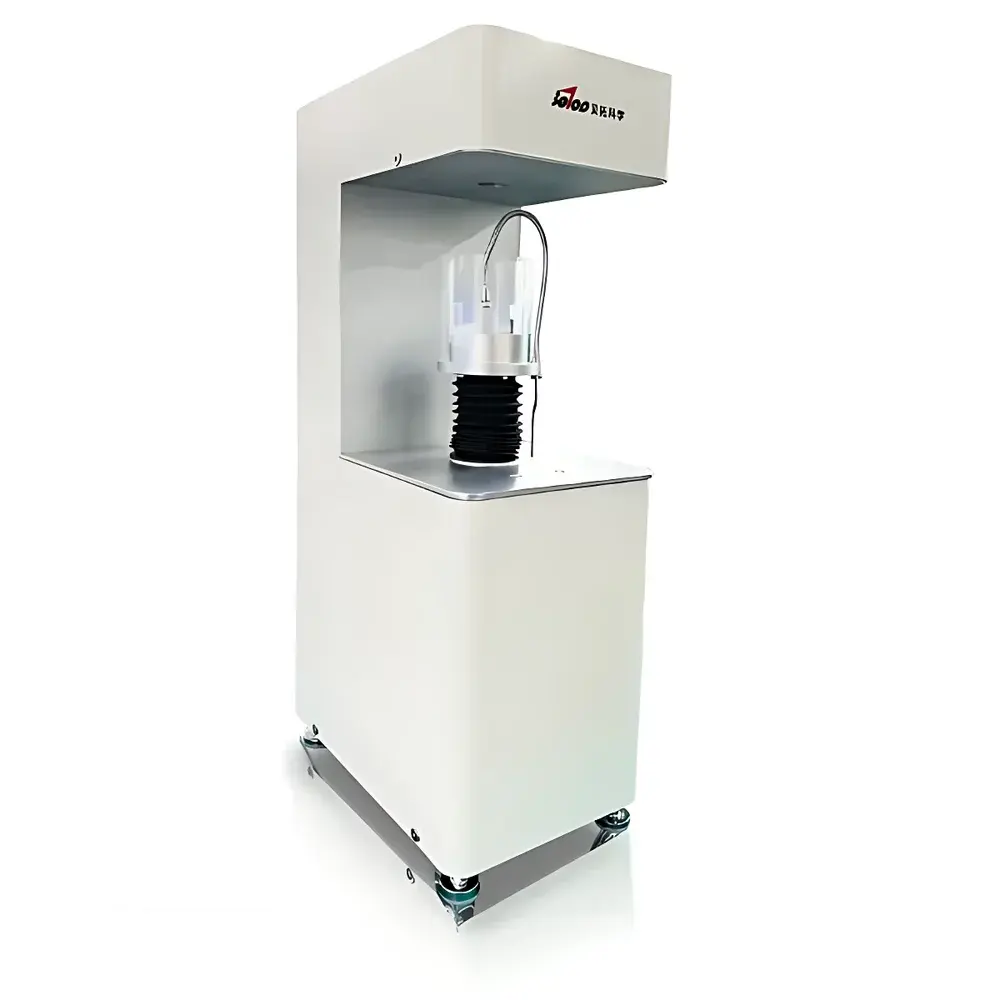
Brookfield KF10 Surface Tensiometer
| Brand | Betop Scientific |
|---|---|
| Origin | Guangdong, China |
| Manufacturer Type | Direct Manufacturer |
| Country of Origin | China |
| Model | KF10 |
| Price Range | ¥49,800–¥60,000 CNY |
| Measurement Range | 1–1000 mN/m |
| Resolution | 0.10 mN/m |
| Accuracy | ±0.5 mN/m |
| Temperature Display Range | −40 to 460 °C |
| Temperature Display Accuracy | ±0.01 °C |
| Measurement Methods | Du Noüy Ring Method, Wilhelmy Plate Method |
Overview
The Brookfield KF10 Surface Tensiometer is a precision laboratory instrument engineered for the quantitative determination of surface tension (γLV) and interfacial tension (γLV) between immiscible liquid phases. It operates on two standardized physical principles defined in ASTM D971, ISO 6295, and ISO 1409: the Du Noüy ring method and the Wilhelmy plate method. Both techniques rely on force-balance measurement using high-stability electromagnetic compensation transducers coupled with a calibrated platinum-iridium ring or platinum plate. The KF10 integrates a motorized vertical sample stage with programmable lift speed and position repeatability, enabling consistent immersion and withdrawal kinetics critical for dynamic surface tension profiling and equilibrium measurement. Designed for routine QC labs and R&D environments, the system delivers traceable, reproducible results under ambient or controlled thermal conditions—supporting both static and quasi-dynamic characterization protocols.
Key Features
- High-resolution force detection with 0.10 mN/m resolution and ±0.5 mN/m accuracy across the full 1–1000 mN/m range
- Dual-method capability: interchangeable platinum ring and Wilhelmy plate modules compliant with ASTM D1331 and ISO 4789
- Integrated temperature monitoring system with ±0.01 °C display resolution over −40 to 460 °C range (external temperature control units required for active regulation)
- Motor-driven sample stage offering 100 mm vertical travel and ≥1.2 mm/min programmable speed for precise meniscus positioning
- Integrated white LED illumination system for enhanced meniscus visualization during manual alignment or method validation
- Robust mechanical architecture featuring overload protection circuitry and electromagnetic damping to extend transducer service life
- Modular design supporting future upgrades including temperature-controlled jackets, CMC analysis packages, and contact angle accessories
Sample Compatibility & Compliance
The KF10 accommodates a broad spectrum of liquid and liquid–liquid systems—including aqueous surfactant solutions, hydrocarbon–water interfaces, polymer melts, ionic liquids, and pharmaceutical formulations. Its open-sample chamber configuration permits use with viscous, volatile, or thermally sensitive samples. All measurement protocols align with internationally recognized standards: ASTM D971 (interfacial tension of oil–water systems), ASTM D1331 (surface tension of surfactant solutions), ISO 6295 (determination of interfacial tension), and ISO 1409 (plastics—determination of surface tension). Data acquisition and reporting support GLP-compliant documentation when used with validated software configurations; optional audit trail and electronic signature modules are available for FDA 21 CFR Part 11–regulated environments.
Software & Data Management
The KF10 is operated via TENTION software—a Windows-based platform providing real-time force curve visualization, automated peak detection for ring detachment, baseline correction algorithms, and multi-point calibration workflows. Software features include batch processing, statistical summary generation (mean, SD, CV%), export to CSV/PDF/Excel formats, and customizable report templates aligned with internal SOPs or regulatory submission requirements. Raw force vs. time/position data are stored with metadata tags (operator ID, timestamp, method ID, environmental conditions), ensuring full traceability. Version-controlled software updates maintain compatibility with current OS security patches and support long-term archival integrity per ISO/IEC 17025 clause 7.5.2.
Applications
- Quantification of critical micelle concentration (CMC) for surfactant screening and formulation optimization
- Wettability assessment of APIs, excipients, and tablet coatings in pharmaceutical development
- Evaluation of paint, ink, and coating adhesion behavior on substrates via surface energy component analysis
- Monitoring oxidative degradation of lubricants and transformer oils through interfacial aging trends
- Assessment of cleaning efficacy in food processing equipment via tank rinse water surface tension shifts
- Characterization of fiber wettability and textile finish performance in nonwoven manufacturing
- Stability evaluation of emulsions, microemulsions, and Pickering dispersions in cosmetic and agrochemical R&D
- Surface modification verification following plasma, corona, or chemical grafting treatments
FAQ
What measurement methods does the KF10 support?
The KF10 supports both the Du Noüy ring method and the Wilhelmy plate method, each implemented according to ASTM and ISO reference procedures.
Is temperature control built into the instrument?
The KF10 includes high-precision temperature sensing (−40 to 460 °C, ±0.01 °C), but active temperature regulation requires an external Peltier or oil-circulating bath system.
Can the KF10 measure dynamic surface tension?
Yes—by programming controlled immersion and withdrawal speeds, users can acquire force–time profiles suitable for dynamic surface tension estimation using standard models such as the Lucassen–van den Tempel equation.
Does the system comply with FDA 21 CFR Part 11 requirements?
Out-of-the-box compliance is not enabled; however, optional software modules with electronic signatures, audit trails, and role-based access control are available for validation in regulated environments.
What is the maximum sample volume supported?
The open-beaker configuration allows flexible vessel selection; typical measurements use 30–50 mL samples, though larger volumes may be accommodated depending on vessel geometry and meniscus stability.
Related Products



