
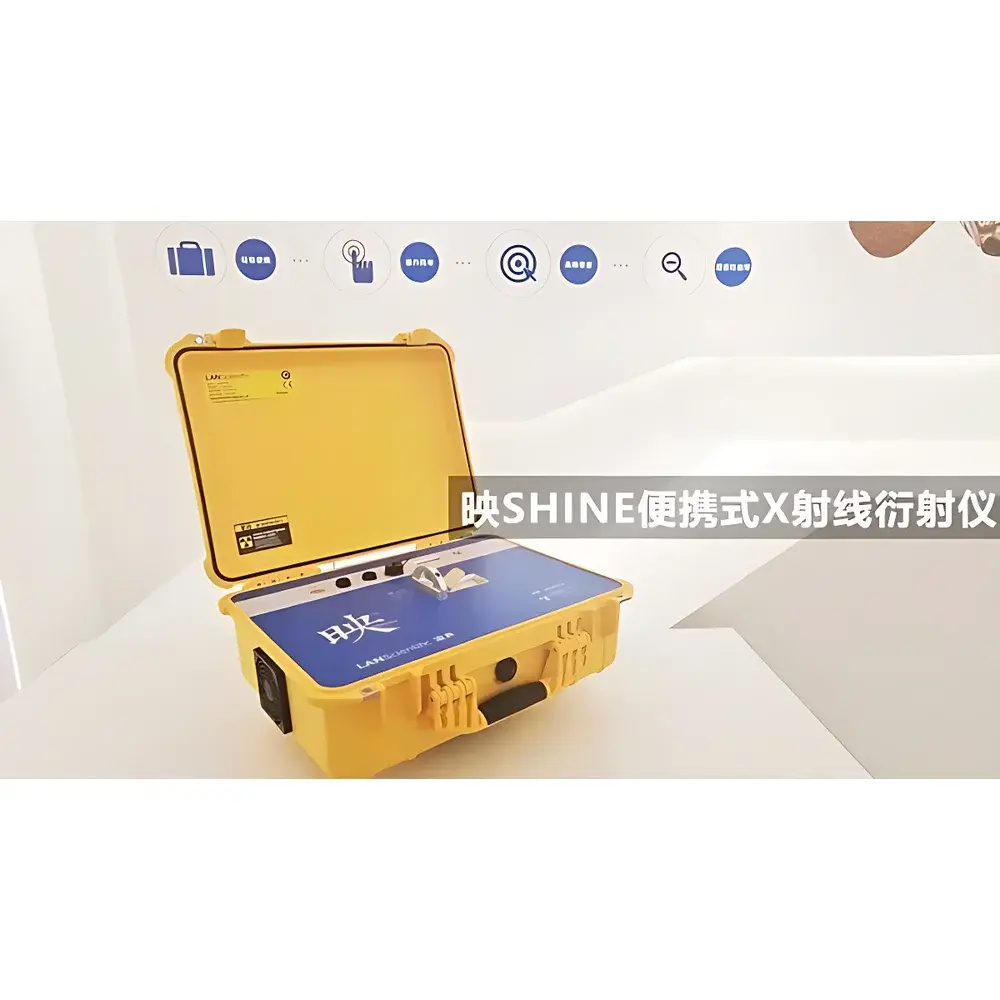
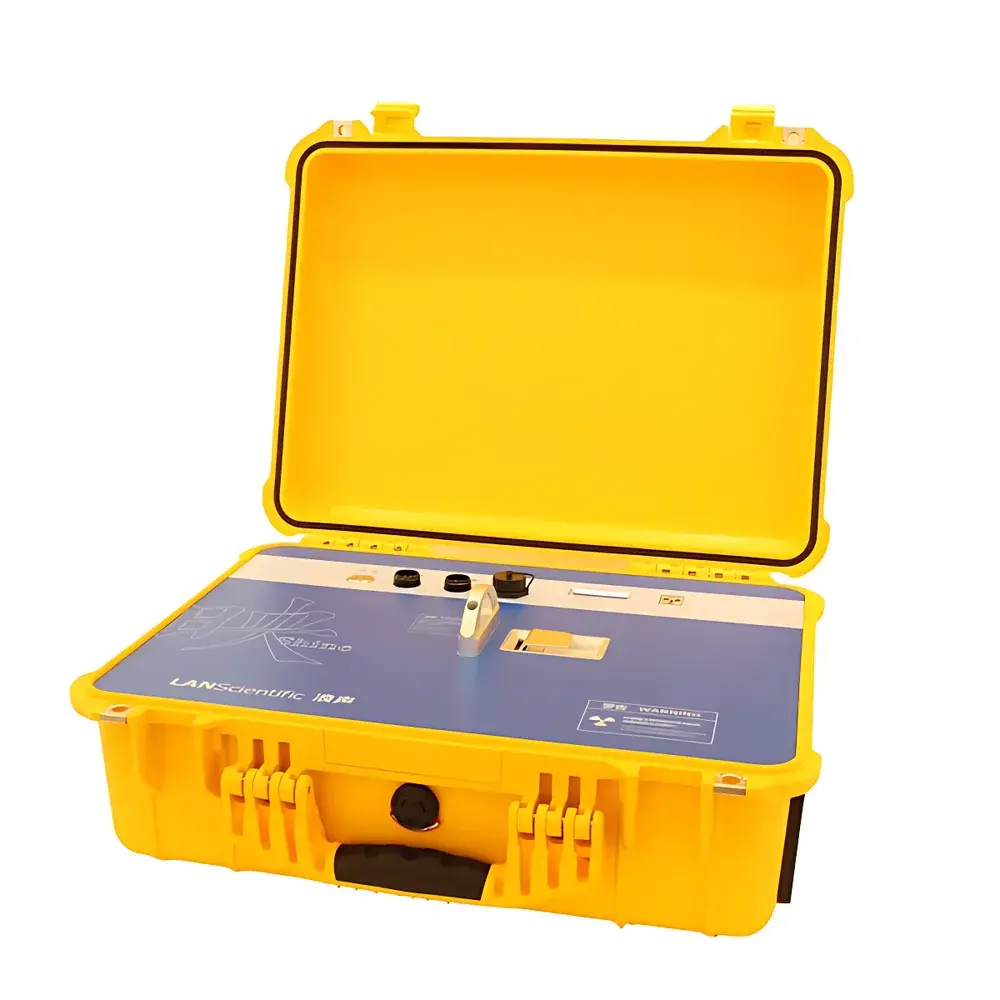
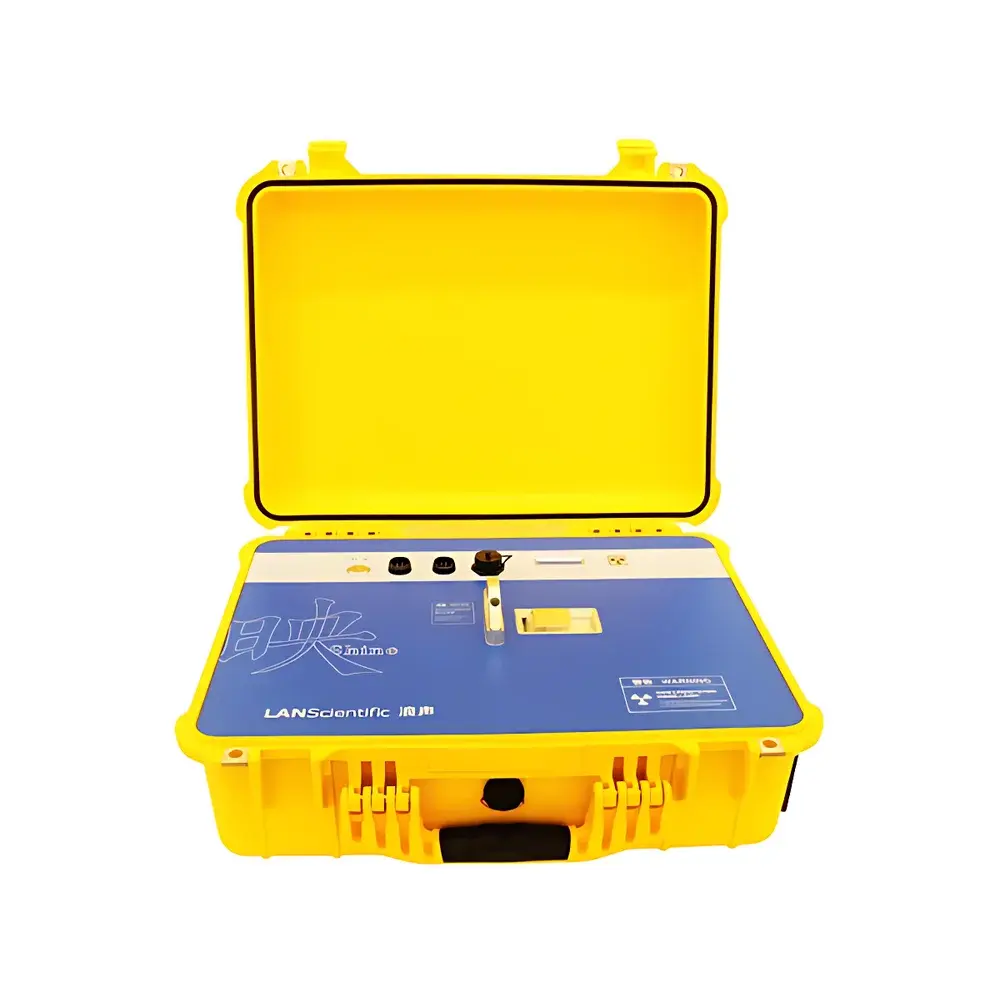
Brookfield LANScientific SHINE Research Edition Portable X-ray Diffractometer (XRD)
| Brand | LANScientific |
|---|---|
| Origin | Jiangsu, China |
| Manufacturer Type | Direct Manufacturer |
| Product Category | Domestic |
| Model | SHINE Research Edition |
| Instrument Type | Powder X-ray Diffractometer |
| Geometry | Transmission-mode |
| Detection | CCD-based 2D detector |
| Sample Form | Loose powder (no pressing required) |
| Sample Mass | ~20 mg per analysis |
| Data Output | Full-pattern XRD + simultaneous XRF elemental data |
| Connectivity | USB / Bluetooth / Wi-Fi |
| Enclosure | IP65-rated ruggedized portable case |
| Radiation Safety | Fully shielded |
| Software | Integrated phase identification & quantitative Rietveld refinement engine |
Overview
The LANScientific SHINE Research Edition is a purpose-engineered portable X-ray diffractometer designed for in situ and laboratory-based crystalline phase analysis of powdered materials. Operating on the fundamental principle of Bragg diffraction, the instrument utilizes a microfocus X-ray tube coupled with a transmission geometry configuration—where the incident X-ray beam passes directly through a thin, vibration-agitated powder bed—enabling high-fidelity collection of complete Debye–Scherrer diffraction rings on a CCD-based 2D detector. Unlike conventional reflection-mode benchtop XRD systems, this transmission architecture eliminates angular dependence on sample density and surface flatness, delivering consistent resolution across low-Z, low-density matrices such as pharmaceutical actives, hydrated clays, or porous catalysts. The system integrates monochromatic Cu-Kα radiation (λ = 0.15418 nm) with real-time beam collimation and active vibration dispersion to maximize crystallographic sampling uniformity. Its fully self-contained, mechanically static design—featuring zero goniometer movement or motorized stages—ensures long-term calibration stability and field-deployable robustness.
Key Features
- Transmission-mode XRD geometry optimized for loose powder analysis without pelletization, eliminating preferred orientation artifacts and density-related peak broadening.
- Simultaneous dual-modal acquisition: Co-registered XRD pattern and XRF spectral data collected in a single measurement cycle, enabling direct correlation between crystalline phase composition and elemental stoichiometry.
- Ruggedized IP65-rated enclosure with integrated shock-absorbing chassis, rated for operation in ambient temperatures from −10 °C to +50 °C and relative humidity up to 90% non-condensing.
- Automated workflow: One-button initiation triggers beam exposure, real-time pattern acquisition, automatic background subtraction, peak indexing, ICDD PDF-4+ database matching, and semi-quantitative phase abundance estimation via reference intensity ratio (RIR) methods.
- No routine recalibration required: Fixed-source–detector geometry and factory-traceable alignment ensure measurement reproducibility over time and across units (inter-unit RSD < 1.2% for quartz standard).
- Comprehensive radiation safety architecture: Lead-composite shielding, interlocked beam gate, and real-time dosimetry monitoring conforming to national and international regulatory thresholds (≤0.5 µSv/h at 5 cm from housing surface).
Sample Compatibility & Compliance
The SHINE Research Edition accepts untreated, unpressed powders ranging from 10 nm to 200 µm particle size, including hygroscopic, thermally labile, or air-sensitive materials housed in sealed Kapton capillaries. It supports compliance-critical workflows under GLP and ISO/IEC 17025 frameworks: audit-trail logging of all acquisition parameters, user authentication, electronic signatures, and encrypted raw-data archiving meet FDA 21 CFR Part 11 readiness requirements. Instrument performance verification adheres to ASTM E975 (Standard Practice for X-ray Diffraction Measurements), ISO 17873 (Quantitative Phase Analysis by Rietveld Method), and USP (Powder X-ray Diffraction for Pharmaceutical Identification).
Software & Data Management
The bundled SHINE Analyze Suite runs natively on Windows 10/11 and provides full-spectrum visualization, interactive Le Bail and Rietveld refinements, amorphous halo deconvolution, and crystallite size/strain analysis via Williamson–Hall plots. All raw 2D images and processed 1D patterns are stored in vendor-neutral .cif, .xye, and .csv formats. Remote control and live spectrum streaming are enabled via secure Wi-Fi or Bluetooth 5.0, allowing integration into centralized LIMS environments. Data export modules support ASTM E1346-compliant reporting templates and direct import into third-party platforms including TOPAS, GSAS-II, and HighScore Plus.
Applications
- Pharmaceutical R&D: Polymorph screening, hydrate/anhydrate differentiation, excipient compatibility studies, and counterfeit drug detection.
- Environmental geochemistry: In-field mineralogical mapping of soil, sediment, and airborne particulates (e.g., asbestos, heavy metal-bearing phases).
- Catalysis & materials science: In situ phase evolution tracking during thermal treatment, redox cycling, or gas adsorption experiments.
- Academic teaching labs: Hands-on instruction in crystallography, solid-state chemistry, and structure–property relationships using authentic research-grade instrumentation.
- Metallurgy & corrosion science: Identification of oxide scales, intermetallics, and degradation products on alloy surfaces without destructive sectioning.
FAQ
Does the SHINE require external cooling or compressed air?
No. The microfocus X-ray tube employs thermoelectric (Peltier) cooling and operates passively within its sealed enclosure.
Can it analyze samples in sealed containers?
Yes—Kapton, Mylar, or beryllium windows up to 25 µm thickness are fully compatible with transmission geometry.
Is Rietveld refinement supported out-of-the-box?
Yes. The SHINE Analyze Suite includes a licensed Rietveld engine with built-in constraints for common space groups and lattice parameter optimization.
What databases are included for phase identification?
The system ships with ICDD PDF-4+ 2023 (over 1.1 million entries), plus customizable user-defined libraries and optional subscription updates.
How is measurement traceability maintained across field deployments?
Each unit undergoes factory certification using NIST-traceable Si and Al2O3 standards; calibration certificates and uncertainty budgets are provided with delivery.



