
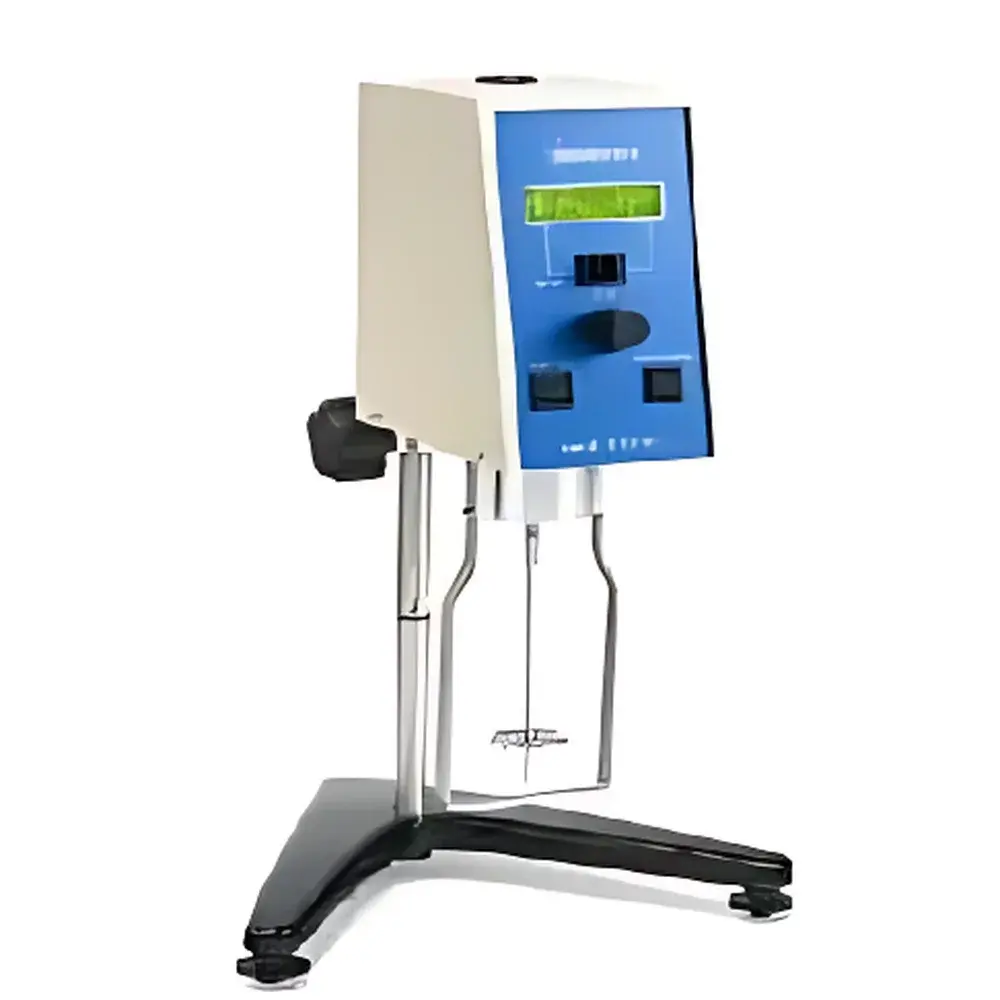
Brookfield LVDV-C Digital Rotational Viscometer
| Origin | USA |
|---|---|
| Manufacturer Type | Authorized Distributor |
| Origin Category | Imported |
| Model | LVDV-C |
| Instrument Type | Portable Rotational Viscometer |
| Operating Environment | Ambient Temperature |
| Viscosity Range | 1–2,000,000 mPa·s (cP) |
| Speed Settings | 18 programmable RPM |
| Accuracy | ±0.1% of full scale |
| Repeatability | ±0.2% |
| Torque Display | % torque, cP, and mPa·s directly readable |
| Sensor Architecture | High-density torsion transducer with 4 sensing points per revolution |
| Calibration | Individual rotor calibration |
| Compliance | Designed to support ASTM D2196, ISO 2555, ISO 3219, and USP <911> viscosity testing protocols |
Overview
The Brookfield LVDV-C Digital Rotational Viscometer is a precision-engineered, portable instrument designed for routine viscosity measurement in quality control laboratories and R&D environments across polymer science, coatings, pharmaceuticals, food processing, and personal care industries. Based on the well-established Couette flow principle, the LVDV-C applies controlled rotational shear to a sample contained between a stationary cup (or guard) and a rotating spindle—generating torque proportional to the fluid’s resistance to flow. This torque is measured via a high-resolution torsion transducer with four discrete sensing points per revolution, enabling rapid data acquisition even at low rotational speeds (e.g., 0.3 rpm), where single-point sensors would yield unacceptably long update intervals (>200 s). The instrument delivers direct digital readouts in standard SI and CGS units—mPa·s (equivalent to cP)—alongside percent torque, eliminating manual conversion and reducing operator error. Its compact, benchtop-friendly architecture integrates seamlessly into regulated workflows while maintaining metrological traceability to NIST-traceable standards.
Key Features
- 18 pre-programmed rotational speeds (0.3–100 rpm) optimized for broad dynamic range coverage—from low-viscosity solvents to highly structured gels and pastes.
- High-fidelity torsion transducer with quadruple sensing points per revolution ensures sub-second response time and stable signal acquisition below 1 rpm.
- Field-replaceable spindles (LV series) with individual NIST-traceable calibration certificates; no system-level recalibration required after spindle replacement.
- Direct digital display of viscosity (mPa·s/cP), % torque, and speed—no calculation or lookup tables needed.
- Robust mechanical design with aluminum alloy housing and sealed electronics, rated for continuous operation at ambient temperatures (15–30 °C).
- Compliance-ready architecture supports audit trails when paired with optional PC interface software (e.g., Rheo3000™), facilitating adherence to GLP and GMP documentation requirements.
Sample Compatibility & Compliance
The LVDV-C accommodates a wide range of Newtonian and non-Newtonian samples using standard LV spindles (SC4-13, SC4-18, etc.) and optional accessories such as small-sample adapters, temperature-controlled jackets, and ultra-low-volume holders. It meets the physical test criteria defined in ASTM D2196 (non-Newtonian fluids), ISO 2555 (resin solutions), ISO 3219 (polymer melts and solutions), and USP (pharmaceutical dosage forms). While the base unit does not include integrated temperature control, its design permits integration with external Peltier or water-circulated baths (sold separately) to support temperature-dependent rheological profiling under ISO 7391 or ASTM D445 conditions.
Software & Data Management
When connected via RS-232 or USB-to-serial adapter, the LVDV-C interfaces with Brookfield’s Rheo3000™ software suite—enabling real-time graphing, multi-speed ramp protocols, statistical reporting, and automated pass/fail evaluation against user-defined limits. All measurements are timestamped and stored with spindle ID, speed, temperature (if external probe is connected), and operator ID—supporting 21 CFR Part 11-compliant electronic records when deployed with appropriate validation packages and role-based access controls. Raw data exports to CSV or Excel formats facilitate integration with LIMS platforms and internal QA databases.
Applications
- QC release testing of adhesives, latex dispersions, and architectural paints per ASTM D1200 and ISO 2555.
- Formulation development of topical gels, suspensions, and oral liquid dosage forms compliant with USP and Ph. Eur. 2.9.35.
- Stability assessment of emulsions and colloidal systems via time-sweep measurements at fixed shear rates.
- Evaluation of thixotropic recovery behavior using controlled shear start-stop sequences.
- Batch-to-batch consistency verification in food manufacturing (e.g., ketchup, sauces, dairy products) aligned with ISO 11357-6.
FAQ
Does the LVDV-C include built-in temperature control?
No—the LVDV-C operates at ambient temperature only. For temperature-dependent measurements, an external temperature-controlled bath or Peltier accessory must be used.
Can I use RV or HA/HB spindles with the LVDV-C?
No—only LV-series spindles are mechanically and electronically compatible with the LVDV-C torque range and calibration matrix.
Is calibration traceable to national standards?
Yes—each spindle ships with a NIST-traceable calibration certificate documenting viscosity accuracy across its specified range.
What is the minimum sample volume required for standard LV spindles?
Using the standard SC4-13 spindle, the minimum recommended volume is 400 mL in a 600-mL Griffin beaker; reduced volumes (as low as 16 mL) are achievable with the optional UL Adapter.
How does the LVDV-C ensure measurement reproducibility across global laboratories?
Through standardized spindle geometry, factory-applied torque calibration, and adherence to ISO/IEC 17025-aligned verification procedures—ensuring inter-laboratory agreement within ±0.2% repeatability.



