
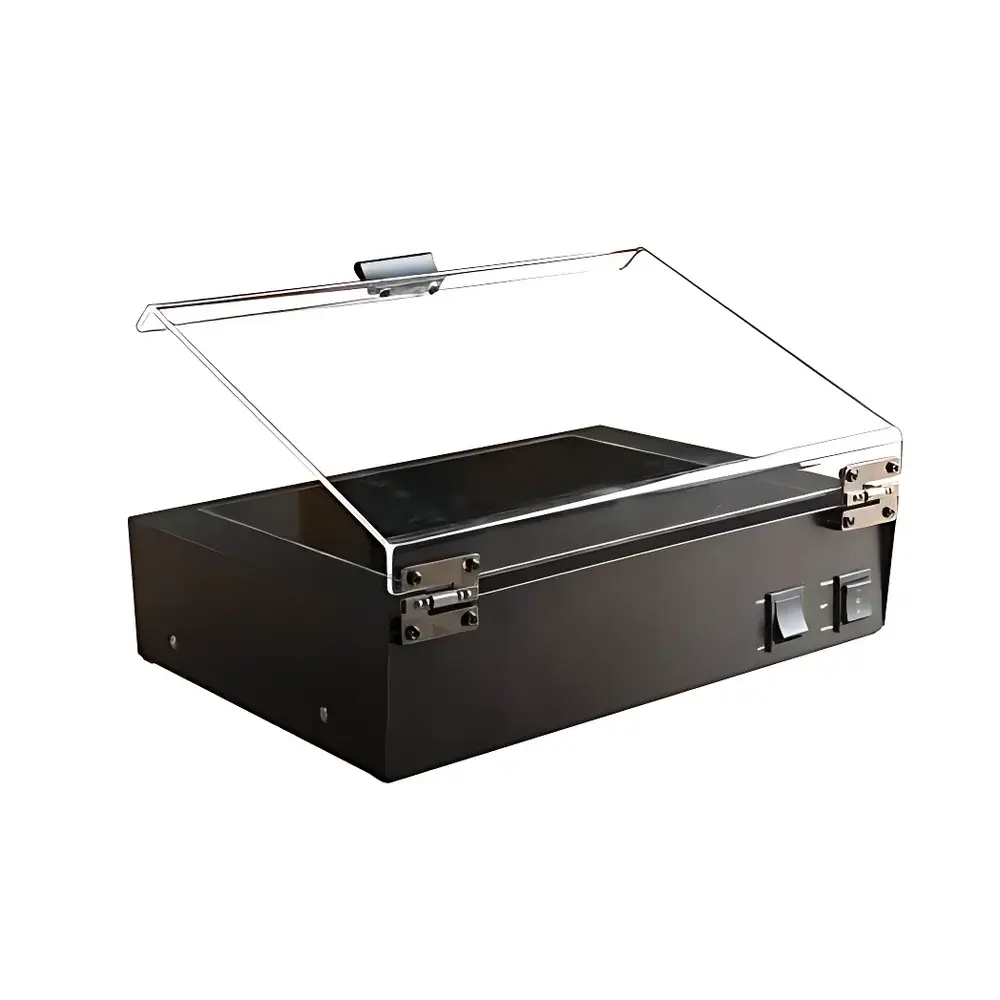
PacificImage UV TI2621D Dual-Wavelength UV Transilluminator with Integrated Gel Cutting Shield
| Brand | PacificImage |
|---|---|
| Model | UV TI2621D |
| Type | Darkroom-style transilluminator |
| Wavelength Options | 302 nm and 365 nm |
| UV Filter Area | 21 × 26 cm |
| UV Lamps | 8 W × 5 (302 nm) + 8 W × 6 (365 nm) |
| Power Supply | 100–240 VAC, 50–60 Hz |
| Operating Frequency | 40 kHz |
| Illumination Method | Transillumination |
| Intensity Control | High/Low dual-level adjustment |
| UV Protective Shield | Integrated acrylic shield with interlock safety design |
| Dimensions (W×H×D) | 340 × 255 × 94 mm |
| Weight | 4.0 kg |
| Certifications | CE, FCC |
Overview
The PacificImage UV TI2621D is a laboratory-grade dual-wavelength UV transilluminator engineered for high-fidelity visualization, documentation, and precise excision of nucleic acid and protein bands in agarose and polyacrylamide gels. It operates on the principle of ultraviolet transillumination—where short-wave UV light (302 nm) induces ethidium bromide (EtBr), SYBR® Safe, or other DNA-intercalating fluorophores to emit visible fluorescence, while long-wave UV (365 nm) enables safer, low-photobleaching imaging of alternative dyes such as SYPRO® Ruby or Deep Purple™. Designed for consistent illumination across the entire 21 × 26 cm viewing area, the TI2621D employs high-frequency (40 kHz) electronic ballasts to eliminate flicker and ensure photometric stability—critical for quantitative densitometry and reproducible gel documentation workflows in molecular biology, genomics, and quality-controlled electrophoresis laboratories.
Key Features
- Dual-wavelength capability: Independent 302 nm (5 lamps) and 365 nm (6 lamps) UV sources, each rated at 8 W, enabling flexible fluorophore selection and reduced DNA damage during prolonged exposure.
- Flicker-free illumination: 40 kHz high-frequency electronic ballast system eliminates perceptible flicker and minimizes thermal drift—enhancing image consistency for time-lapse documentation and CCD-based capture systems.
- Uniform irradiance profile: Optimized lamp array geometry and diffuser-integrated quartz plate deliver ±5% intensity variation across the full 21 × 26 cm transillumination surface—meeting ASTM E275-22 requirements for uniformity in analytical UV visualization.
- Integrated safety architecture: Patented UV-blocking acrylic shield with mechanical interlock ensures automatic lamp deactivation upon shield removal; additional protections include over-current, short-circuit, and thermal overload cutoffs.
- Dual-intensity operation: Selectable High/Low output modes allow optimization for sensitive detection (e.g., low-concentration PCR products) or rapid band scanning (e.g., routine QC gels), extending lamp service life and reducing cumulative UV exposure.
- Compliance-ready design: CE-marked and FCC-certified; meets IEC 61010-1 safety standards for laboratory electrical equipment and supports GLP-aligned operational traceability when paired with validated imaging software.
Sample Compatibility & Compliance
The TI2621D supports standard horizontal electrophoresis formats including mini-gels (up to 15 × 15 cm), midi-gels (up to 20 × 20 cm), and full-size submarine gels (21 × 26 cm max). It is compatible with EtBr, GelRed®, GelGreen®, SYBR® Gold/Safe, and UV-excitable protein stains—including those compliant with ISO 15190:2020 (clinical laboratory safety) and USP (fluorescent dye validation). The unit’s 302 nm output aligns with common nucleic acid staining protocols referenced in CLSI EP17-A2 (limit of detection assessment), while 365 nm mode satisfies low-UV-risk requirements outlined in OSHA Technical Manual Section VI: Laboratory Safety. No external ventilation or ozone scrubbing is required—lamps are low-ozone-emission type per IEC 62471 photobiological safety classification.
Software & Data Management
While the TI2621D operates as a standalone hardware platform, it is fully interoperable with third-party gel documentation systems (e.g., Bio-Rad ChemiDoc™, Azure Sapphire™, or open-source ImageJ/Fiji pipelines) via standard USB/RS-232 control interfaces (optional adapter). When integrated into regulated environments, its manual intensity switching and shield interlock status can be logged externally to support FDA 21 CFR Part 11-compliant audit trails. Firmware does not store operational data; all usage parameters—including lamp-on duration and mode selection—are recorded only by connected imaging software or LIMS systems, preserving data integrity and facilitating retrospective review under ISO/IEC 17025 Clause 7.7 (result reporting).
Applications
- Visualization and semi-quantitative analysis of DNA fragments in agarose and PAGE gels.
- Preparative gel excision under controlled UV exposure for downstream cloning, sequencing, or mass spectrometry sample preparation.
- Validation of restriction digests, PCR amplification, RNA integrity (RIN assessment), and Southern/Northern blot transfer efficiency.
- Training and teaching labs requiring robust, low-maintenance UV platforms compliant with institutional biosafety office (BSO) policies.
- QC release testing in biomanufacturing facilities where visual confirmation of product purity must adhere to ICH Q5B and Q5C guidelines.
FAQ
Is the UV TI2621D suitable for use with SYBR® Safe stain?
Yes—the 302 nm wavelength delivers optimal excitation efficiency for SYBR® Safe, while the 365 nm mode provides lower-energy visualization to minimize dye degradation during extended imaging sessions.
Does the unit require external cooling or forced air ventilation?
No—the lamp assembly and electronic ballast are thermally managed via passive convection and aluminum heat-sink integration; ambient lab temperatures between 15–30°C are sufficient for continuous operation.
Can the protective shield be removed for direct gel manipulation?
The shield is mechanically interlocked: removal automatically cuts power to all UV lamps. Re-engagement restores functionality without manual reset—ensuring fail-safe operator protection per ANSI Z87.1-2020 impact and UV filtration standards.
What is the expected service life of the UV lamps?
Rated for ≥5,000 hours at nominal output; performance remains stable within ±10% irradiance over 80% of rated lifetime when operated in High/Low mode per manufacturer cycling guidelines.
Is calibration or annual certification required for regulatory compliance?
While no built-in radiometric calibration is provided, users may validate irradiance uniformity annually using NIST-traceable UV radiometers (e.g., ILT950UV) per ISO/IEC 17025 Clause 6.4.1—documentation supports audit readiness in GxP environments.




